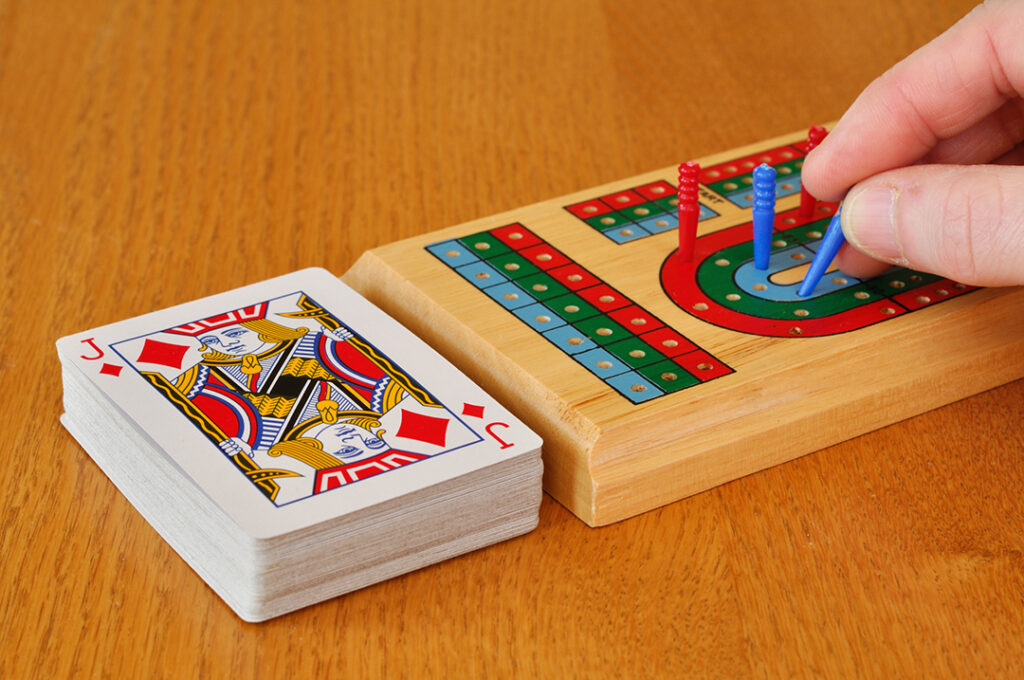
Cribbage results from Feb. 6 and Feb. 9

Special to the Times Vedette

On Feb. 6, a total of 11 players participated. The players were apparently stuck on 16. Sandy Rumelhart got two 16s. Dennis Betts, Kathy Fielmier and Allen Pierce ended up with one 16 each.

On Feb. 9, a total of six players participated. High hands are hard to come by, but Wayne Nickel knew how to do it with a 16.

The Guthrie Center cribbage players generally meet at Guthrie Center Library, 400 Grand St., on Mondays at 8 a.m. and at the New Homestead independent living dining hall, 2306 State St., at 8 a.m. on Wednesdays and at 1 p.m. on Fridays. Organizers say there is always room for more, and they will be glad to teach you how to play. They play for quarters on Wednesday and Friday.

No short cuts

Who came up with the 40-hour work week? And why?

According to a 2014 story from NBC News, eight-hour days “became rallying cries in the latter half of the 19th century, as workers in the building trades and similar industries marched together for better conditions.” The article also states that The Ford Motor Company “advanced the idea in 1914, when it scaled back from a 48-hour to a 40-hour workweek after founder Henry Ford believed that too many hours were bad for workers’ productivity.”

Work conditions are much improved thanks to the efforts of many in prior generations. Even so, a growing number of workers today think 40 hours on the clock per week is too much. A generation of workers are often criticized for not being willing to “put in the hours.”

The pandemic certainly didn’t help many employers with this dilemma. The idea of expecting employees to come to the office or work site on time and put in a full eight hours before heading home has seemingly become an idea of the past, at least for some.

With labor shortages aplenty, many some have given in to demands for reduced hours, more vacation and increased benefits because they don’t have a choice. Meanwhile, the companies that do this then often have greater expenses and less output, resulting in a decrease of profits and, ultimately, an increase in the consumers’ cost of the company’s products or services. In other words, inflation. This working-less approach is a vicious circle and one that we all seemingly end up paying for, one way or another.  

Meanwhile, the old adage that the road to success doesn’t have any short cuts will continue to prove to be true. It takes hard work. And 40 hours per week. 

Have a telling Tuesday, and, as always, thanks for reading. 

Shane Goodman
Editor and Publisher
Times Vedette digital newsletter
shane@gctimesnews.com
641-332-2707

Hunting, fishing license sales in 2025

From the Iowa Department of Natural Resources

In 2025, Iowa residents purchased…

Fishing

  • 198,202 annual licenses
  • 8,794 lifetime fishing licenses
  • 17,405 three-year licenses
  • 1,098 seven-day license
  • 3,586 one-day license
  • 41,850 trout fees
  • 166 paddlefish licenses
  • 19,513 third line licenses (resident and nonresident combined)
  • 30,344 fishing, hunting and habitat combination licenses

Hunting

  • 42,868 annual licenses
  • 47,185 hunting and habitat annual combination licenses
  • 3,466 lifetime hunting licenses
  • 6,477 hunting and habitat three-year licenses
  • 803 apprentice (hunting and habitat) licenses
  • 25,004 migratory game bird licenses
  • 42,789 habitat fees
  • 13,929 furharvester annual licenses age 16 and older
  • 315 furharvester annual licenses age 15 and younger
  • 410 furharvester and habitat annual combination licenses
  • 423 lifetime furharvester licenses

Large Game

Deer

  • 14,507 youth general deer, 1,510 antlerless deer licenses
  • 245 disabled hunter general deer, 31 antlerless deer licenses
  • 52,232 archery general deer, 20,369 antlerless deer licenses
  • 5,088 early muzzleloader general deer, 1,096 antlerless deer licenses
  • 40,253 first shotgun general deer, 16,369 antlerless deer licenses
  • 42,010 second shotgun general deer, 17,084 antlerless deer licenses
  • 16,723 late muzzleloader general deer, 8,023 antlerless deer licenses

Turkey

  • 5,161 spring bow licenses
  • 18,917 spring gun/bow licenses seasons 1-3
  • 17,890 spring gun/bow licenses season 4
  • 6,837 spring youth gun/bow licenses
  • 2,022 fall gun/bow
  • 1,527 fall bow

Landowner-Tenant

Deer

  • 48 antlerless deer licenses
  • 30,406 free general deer, 20,261 free antlerless
  • 1,895 antlerless deer licenses
  • 421 antlerless deer licenses
  • 5,603 antlerless deer licenses
  • 1,439 antlerless deer licenses

Turkey

  • 2,458 spring gun/bow season 1-3
  • 2,233 spring gun/bow season 4
  • 900 bow licenses
  • 30 youth licenses
  • 3,317 free general fall turkey

In 2025, nonresidents purchased…

Fishing

  • 28,076 annual licenses
  • 2,816 seven-day licenses
  • 13,411 three-day licenses
  • 17,261 one-day licenses
  • 7,595 trout fees
  • 37 paddlefish licenses

Hunting

  • 6,348 annual licenses age 18 and older
  • 15,203 hunting and habitat annual combination licenses age 18 and older
  • 4,984 five-day licenses
  • 2,163 five-day hunting and habitat combination
  • 13,290 habitat fees
  • 3,840 migratory game bird fees
  • 380 apprentice (hunting and habitat) licenses
  • 142 furharvester annual licenses
  • 47 furharvester and habitat annual combination licenses

Drought watches lifted, but precipitation deficits remain

From the Iowa Department of Natural Resources

Despite below-average precipitation in January, all regions of Iowa previously under drought watch have had those designations lifted, according to the latest monthly Water Summary Update.

Although months of dryness triggered a drought resurgence in October, improving conditions in January led to the removal of drought watches and moderate drought designations in eastern Iowa, though declining soil moisture persists even as seasonal streamflows stay within normal ranges.

Iowa’s preliminary statewide January precipitation totaled 0.93 inches, or 0.04 inches below normal. The driest conditions were concentrated in the northwest corner, which reported approximately 30% of normal precipitation for the month. The preliminary statewide average temperature for January was 19.3 degrees, which is 0.2 degrees below normal.

The U.S. Drought Monitor (USDM) currently shows that half of Iowa is abnormally dry, with a persistent area of moderate drought in northwestern Iowa. According to Iowa’s Drought Plan, most of the state’s drought regions experienced improving conditions in January except in areas of southern Iowa, where soil moisture conditions remained dry. Despite these widespread precipitation deficits, other factors improved or are consistent with average conditions, leading to the removal of previous drought watch designations through the Iowa Drought Plan.

The National Weather Service’s Climate Prediction Center’s February outlook indicates an equal chance for above, below, or near-average precipitation across the entire state and an increased likelihood of below-average temperatures. The seasonal outlook suggests continued drought in far northwestern Iowa, and no drought development across the remainder of the state.

“January is climatologically the driest month of the year, and soil moisture deficits remain from months of drier-than-normal conditions. However, improved conditions, such as streamflow, aided in lifting all drought watches from the state. Seasonal drought outlooks indicate the continuation of a small area of drought in far northwest Iowa through April, and no indication of the development of drought for the rest of the state,” said Jessica Reese McIntyre, DNR Environmental Specialist.

For a thorough review of Iowa’s water resource trends, visit www.iowadnr.gov/watersummaryupdate.

The report is prepared by technical staff from Iowa DNR, the Iowa Department of Agriculture and Land Stewardship, IIHR — Hydroscience and Engineering, and the U.S. Geological Survey, in collaboration with Iowa Homeland Security and Emergency Management Department.

Panorama Esports swept by ELC and OABCIG

By Cyote Williams | Times Vedette

The Panorama Esports team (2-3) lost its final two Overwatch 2 games of the season to Estherville Lincoln Central (7-0), and OABCIG (2-3), both 3-0. The Panthers play again on Monday, Feb. 9, against Westwood (5-1). The Panthers currently are tied for seventh in the Class 1 West standings.