
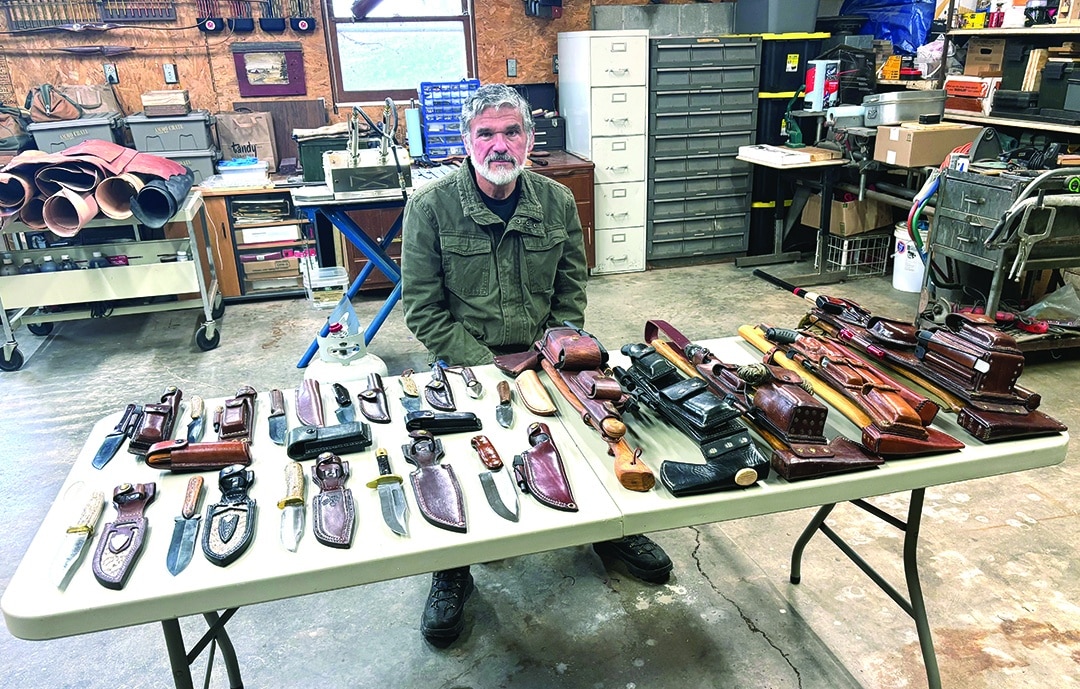
Darwin Wetzel’s hobby turns out quality items.
Darwin Wetzel says his years of working with metal have served him well, giving him knowledge of the technical aspects of the steel he works with.
By Rich Wicks | Guthrie Center Times, November 2025
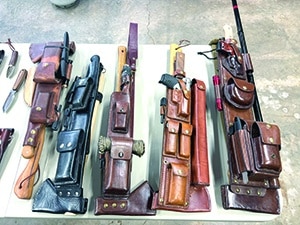
Outdoorsman multipacks are a favorite item.
“I actually started about two years ago,” he said. “Basically, I went through about a year and three months of operation after operation after operation. I lost my leg, so I was sitting in a wheelchair going stir-crazy, trying to figure out what I was going to do instead of watching TV all the time.”
Wetzel said he decided to start doing leather work and making sheaths for knives and axes.
“I’ve been in the welding business and was a welding instructor for 21 years, so I’ve always been in the metal industry, and I always wanted to make custom knives,” he said. “So, as soon as I could stand in front of the belt grinder, I started making knives.”
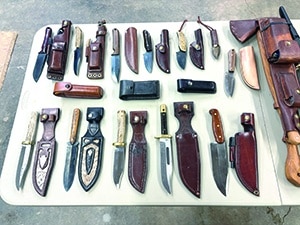
Darwin Wetzel makes a wide variety of knives.
“I’ve been selling a little. Frontier Outfitting, just north of Adair, he’s been kind enough to let me put my products in his store,” Wetzel said. “And then we’ve gone to some gun shows, and I’ve sold quite a few multipacks.”
The multipacks Wetzel creates are essentially oversized Swiss Army knives that include an axe, knives, a folding saw, possibly a handgun and other items, all held together safely in leather sheaths. The idea is that the user can wear the pack when going out into the woods or the mountains and have all the essential survival tools handy. These packs have proven to be quite popular.
“In the past two months, I’ve probably sold six of those multipacks,” Wetzel said.
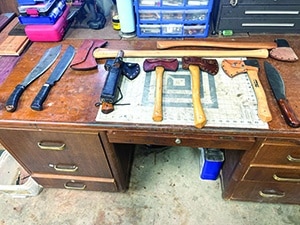
Machetes, hatchets and axes made by Darwin Wetzel.
“I actually make some of them out of those big old buzzsaw blades from sawmills. It’s very good steel, high-carbon steel,” he said. “Some of the knives have some pitting that was in the saw blade, and sometimes I leave that in for character.”
Wetzel also occasionally uses unique materials in the knife handles or sheaths, such as elk antlers or arrowheads.
He said his years of working with metal have served him well, giving him knowledge of the technical aspects of the steel he works with. Wetzel remains committed to focusing on quality rather than quantity.
“I’m getting better,” he said. “The biggest thing is improving the quality of my knives, the appearance and the professionalism. I’m kind of limited to what I can heat-treat with just a standard forge. I’ve got a little two-burner forge sitting on the table.”
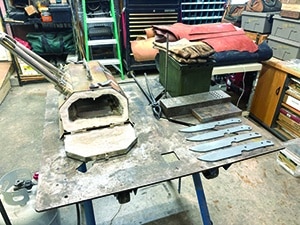
Darwin Wetzel’s forge and knives in the works.
“I want to make something that an individual will take out and use,” Wetzel said. “I do like nice-looking knives, but, basically, the knives I produce are something that I intend to be utilitarian.”
Wetzel’s knives are generally in the $100 to $300 range, depending on the amount of work required. He doesn’t use a website for marketing, instead relying on local vendor shows and word of mouth.
“I’ve gone to some gun shows and craft shows,” he said. “I’ve given a lot away to Pheasants Forever and some other organizations that want something for an auction. It gets me out there and gets some exposure.”
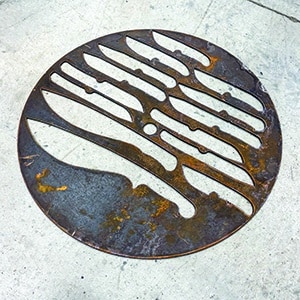
One old saw blade provides steel for many knives.
“I just do it for the fun. I love to do it,” Wetzel said. “This is a hobby, and I’m retired, so I didn’t want to turn this into a job. n