
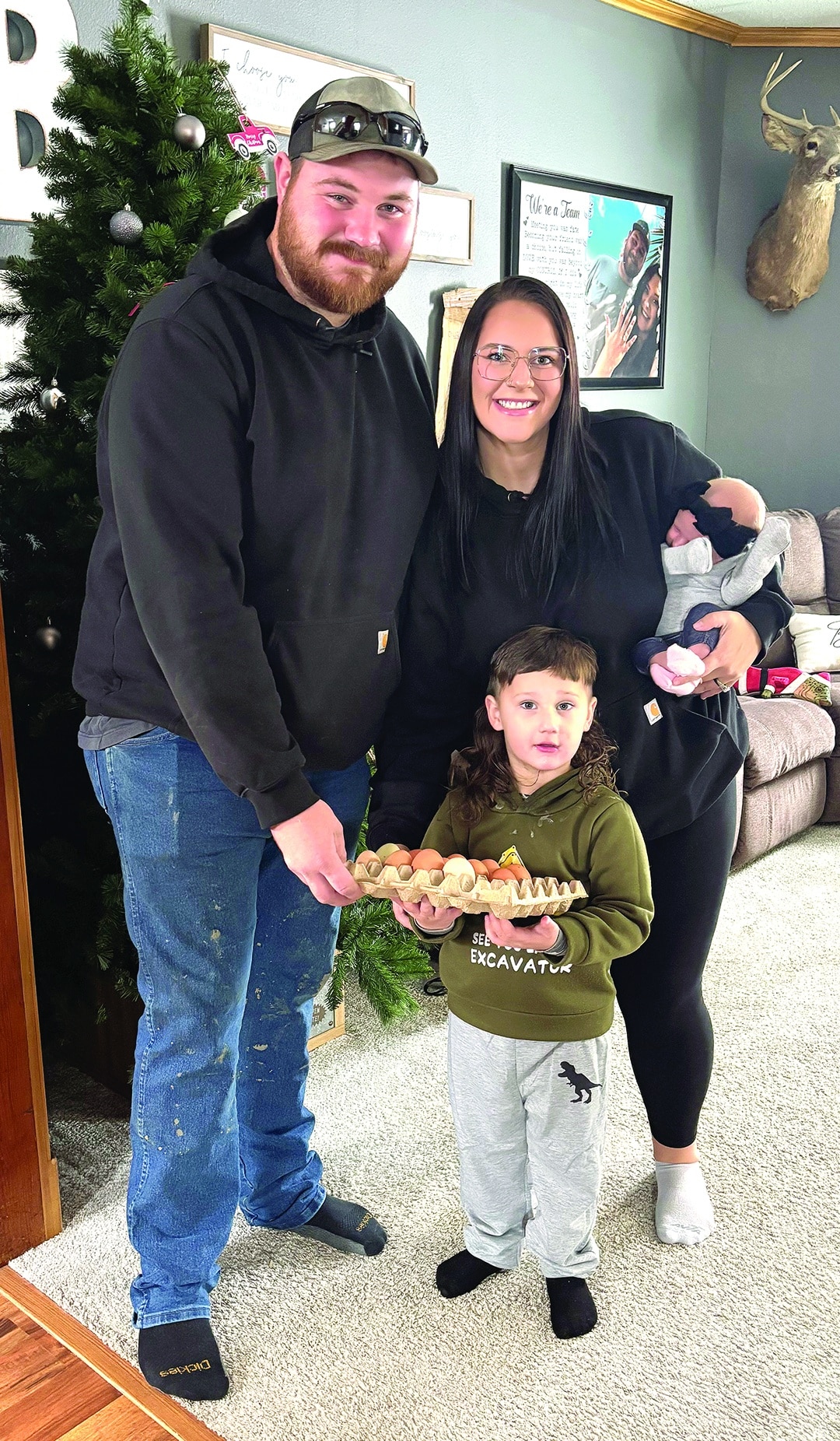
Dylan, Aspen, River and Charlie show the eggs they raise.
Barnes family of Casey has found a hobby they enjoy that also teaches valuable lessons for their children.
By Rich Wicks | Guthrie Center Times, January 2026
The Dylan and Aspen Barnes family of Casey has found a hobby they enjoy that also helps teach valuable lessons for the children. For the past four years, the family has been keeping chickens for egg-laying. The family now includes 3-year-old son, River, and 2-month-old daughter, Charlie.
“When we first moved to Casey in 2021, we started out with goats and sheep, then we got into chickens, pretty much for a fun hobby,” Aspen said. “Once we had River, we knew that we wanted to keep up with the animals, because it does teach kids good responsibility. I grew up with that, and when I met Dylan, he had chickens under his deck at his mom’s house. So, we were used to that, and we wanted to introduce that to River.”
In addition to the life lessons, the family appreciates the edible results of their hobby.
“My dad actually went in half on this with us, just because he likes the farm-fresh eggs as well,” Aspen said. “This is our fourth year of having eggs, but our first year selling them.”
Unfortunately, Dylan and Aspen discovered others viewed the chickens as a free meal, too.
“There’s a little barn out there, and Dylan built a little run off it just so the chickens could be outside,” Aspen said. “We had some free-range chickens for the first three years, but there are a lot of foxes around here, so the chickens disappeared very quickly.”
Aspen and Dylan explained that besides foxes, the chickens face threats from other predators, including raccoons, hawks, opossums, minks, owls and others. Dylan made changes to the chicken enclosure, and the predators have no longer been a major issue.
The chickens produce more than enough eggs for the family, so some eggs are now donated or sold.
“We have only hens. We got them in April,” Aspen said. “They are just now all starting to lay eggs. Now we’re getting 20 to 30 eggs a day. We eat eggs like crazy, but we can’t keep up.”
Aspen explained that free local delivery of eggs is available, and she even delivers to the Des Moines area for free when she is headed there. Currently, the eggs sell for $3 a dozen, but Aspen explained the price may fluctuate from time to time. Discounts are offered for anyone who trades in empty cartons. When the family has plenty of eggs to sell, Aspen posts their availability on the Casey Community page on Facebook with current pricing.
The family’s eggs are various shades of brown and vary in size, but the insides look nearly identical to store-bought eggs with bright yellow yolks. Although free-range eggs tend to have orange yolks, the Barnes family’s eggs do not get that coloration in their run.
“The chicken run eggs look like store-bought eggs when you crack them open. But ours are not processed in any way,” Aspen said.
The Barnes eggs are available either washed or unwashed. Although some customers prefer washed, the unwashed eggs stay fresh longer.
“You can keep unwashed eggs for three to four months on the counter, and if they’re in the fridge, probably seven to eight months,” Dylan said.
Looking to the future, Aspen said the family plans to continue having animals as long as that provides a learning experience for the kids and as long as the workload remains reasonable. Asked about the most challenging part of having laying hens, Aspen said the weather can make everything more work.
“Chickens are fairly simple. The chores can be challenging, especially when it’s really cold out. Their water freezes,” Aspen said. “At one point, I was ready to just throw in the towel and be done with animals, but, at the end of the day, I do want to be able to teach our kids that these are living creatures and they provide for us, so we need to provide for them.”