
Stories of notable local barns and the families that cherish them
By Rich Wicks | Panora Times, June 2025
Barns have been called “cathedrals of the prairie.” That seems a fitting phrase, since, like cathedrals, barns are often the most easily spotted and recognizable features on the horizon for travelers through rural Iowa. And for the families that live and work on Iowa farms, the family barn means much more than just a structure to which the cows come home.
Barns have long been an iconic image of Iowa. In recent decades, the number of family farms statewide has decreased, and barns have also become less prevalent. But in Guthrie County, many barns have stood the test of time. Some have been repurposed, while others have been refurbished to continue housing livestock, hay bales, and other farm necessities.
Here are the stories of some notable local barns and the families that cherish them.
Marvin and Judi Smith
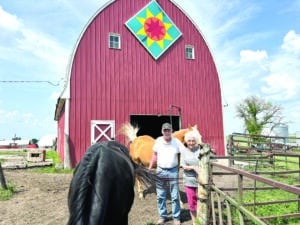
Marvin and Judi Smith are proud of their barn.
Marvin and Judi Smith’s property and barn in rural Panora have some interesting history. Judi explained.
“Actually, this property was Milo Yale’s. He gave all the land that became the town of Yale. There used to be a big, square, three-story house here,” Judi said. “When Marvin bought this place in 1972, he could see that it was going to be a money pit, so he tore it down and built this house.”
The story of the barn is a story of changes. Marvin said he recalls when the barn was built.
“I believe the barn was built in 1950, because I remember when they built it; I graduated in 1954, and they were building it a few years before that,” Marvin said. “We’ve lived here since 1972. We’ve always had horses and ridden horses. We used it as a corn crib for a while. It used to sit a little further north, but I converted it to shelled corn for several years. I filled both sides with shelled corn. We had about 14,000 bushels of corn in there.”
When the government program changed, using the building in that way no longer made financial sense, so Marvin came up with a new idea.
“We didn’t want to have to tear it down, and we weren’t going to use it for a corn crib anymore. It’s worked out really nice for a barn,” Marvin said. “Now we have a head gate in there, and we can run cattle in there and work them.”
Marvin recalled the process of moving the one-time corn crib and turning it into a barn.
“We moved it up here for a barn. I’d say that was in the late 1980s,” Marvin said.
“Well, first I ran the foundation. Then I had the guy from Perry come, and he just loaded it up and pulled it up there and set it on the foundation, and it’s been there ever since. Hopefully, it doesn’t blow away.”
Eventually, the couple decided they wanted their small barn to look more like a traditional barn. Judi took on the challenge of creating a barn quilt on the building. She started looking for a pattern she liked.
“I saw ours on a calendar. It was called the “Star of the East,” and since it was going to be on the east side of our house, and I liked the colors, that’s how I came up with that,” Judi said.
About 15 years ago, Judi painted the original barn quilt pattern herself.
“We had a guy come out with a cherry picker and put it up there, along with a cupola, and I had bought a horse weathervane, so we put that up there,” she said. “That made it look like a barn instead of a corn crib.”
The barn quilt is 8 feet by 8 feet, and it was repainted by a crew last summer.
The Smiths are happy with how their small barn functions and with its appearance, too.
“Now we just use it for horse stables, mostly, and I’ve got a tack room in there. So, when we saddle up the horses, we bring them in through there into the tack room and throw the saddle on,” Marvin said.
He added how others seem to agree that the barn is pleasing to the eye.
“When people stop out on the road to take pictures, I don’t know if it’s because of the quilt block or because of the barn,” Marvin said.
Dave and Sheila Deardorff
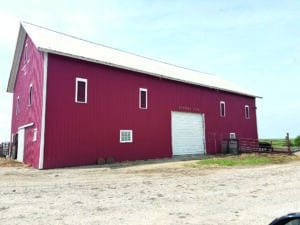
Dave and Sheila Deardorff’s home is a century farm with an historic barn.
The barn of Dave and Sheila Deardorff, rural Yale, is one of the most historic in the county. Not only did the barn have a notable beginning, but it is still in use today to house the many cattle on the farm.
In 1889, Mahlon and Sarah Deardorff moved from Illinois to a farm in rural Yale in Cass Township. The farm previously had been the Reuben Reaver farm and consisted of 267 acres. In 1892, the Deardorffs had a new barn built. As was common at the time, a large crew of men helped build the new barn. The workers must have been skilled carpenters, since the barn is still in use today. Reportedly, after the barn was completed, the 70 men were treated to a well-deserved dinner, followed by cigars and lemonade.
The farm has been in the Deardorff family ever since. Mahlon and Sarah’s son, Russell, and his wife, Mary, owned the farm, followed by their son, Orville, and his wife, Marjorie. Dave and Sheila Deardorff now own the farm.
Megan Smith
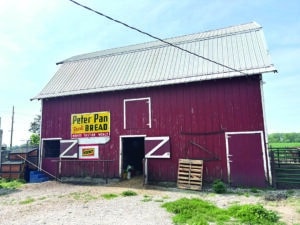
An old sign adorns the barn at Megan Smith’s home.
At 1075 Highway 4 in rural Bagley, Megan Smith and her family live on a farm with a traditional Iowa barn.
“It was built in 1904, but I don’t know much else about its history,” Smith said.
The barn is still used for housing livestock.
“I’ve lived here all my life,” Smith said. “We had used it for draft horses, but then we converted it, and now we use it for horses and my daughter’s show calves.”
Norman and Gladys Willey
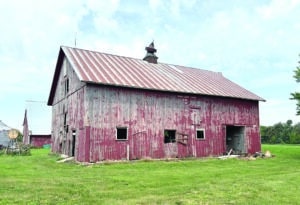
Signage on the Willey’s barn says “Woodland Farm 1934”
For Gladys Willey of rural Yale, the family farm, and especially the barn, is a tangible reminder of her family’s history. Although the two large barns on her property no longer house any farm animals, the buildings are home to a lifetime of family memories.
“My grandparents, Arthur and Femmie Wood, came to live here in 1934. They had lost their farm in Orient, Iowa. They went 28 miles the first day and stayed at Stuart. Then they came the last 20 miles the next day, with horses tied onto their wagons,” Gladys said. “They raised horses and angus cattle. The barn was already here when they came. They kept their draft horses and cattle in there.”
Since then, the farmstead has stayed in the family.
“My parents, Lloyd and Delores Chaloupka, bought it in 1965. I was in fourth grade, maybe,” Gladys said. “They lived here until 1981, and at that time, my husband, Norman, and I moved here. After my mother passed away, we sold the farmland but kept the acreage.”
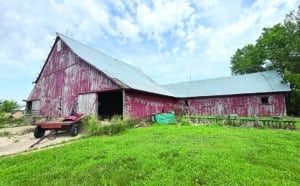
The western barn on the Willey’s property is weathered but structurally sound.
Norman and Gladys are now retired, and the barns on the property are no longer used regularly.
“About three years ago, we had a family reunion here, and everybody came out and looked at the barns,” Gladys said. “They’ve been unused for about 20 years.”
Looking back, she recalled a childhood memory at the farm.
“I remember one story after we had moved here. One of my sisters had graduated. One was a senior, and my brother was a junior. Dad sold the milk cows because he didn’t have enough kids around to do the milking anymore,” Gladys said. “The other kids told me I was spoiled because I was the baby and I didn’t have to milk cows.”
She also recalled how the barn offered kids plenty of chances for fun.
“We used to play in the haymow. That east barn had a pretty nice haymow,” Gladys said. “There were always kittens to find up there, too, because the cats would have them up there to hide them.”
Looking to the future, Gladys knows the barns are continuing to age, but she has no plans to fix them in the foreseeable future.
“I’d like to have the money to restore them, but I don’t think that’s in the cards,” she said.