
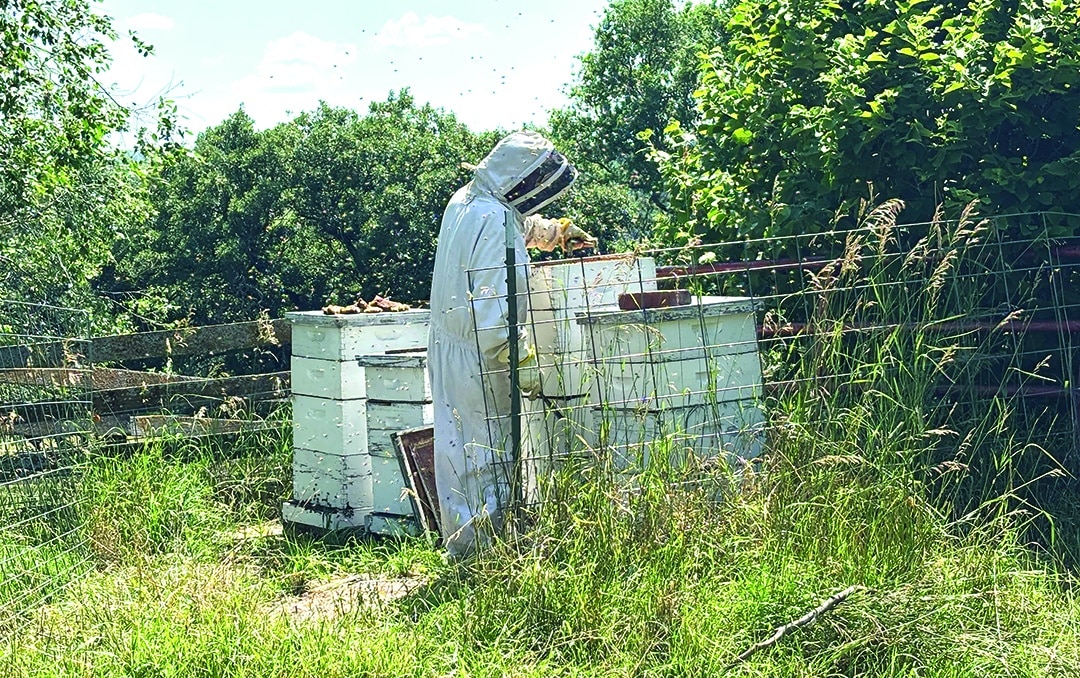
Craig Hinderaker checks the status of the hives.
Craig and Cathy Hinderaker keep busy with beekeeping and bottling honey.
By Rich Wicks | Guthrie Center Times, July 2025
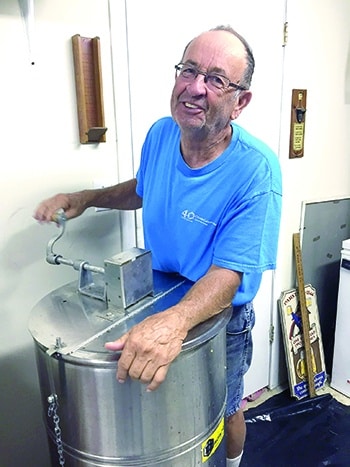
Craig Hinderaker uses the extractor to spin honey out of the frames.
After many years of beekeeping and bottling honey, the Hinderakers were considering giving up the hobby, but Cathy explained they were unable to resist the urge to continue.
“One year the bees died over the winter, and we took that as a sign that we were done,” Cathy said. “But it was just lonesome; there just weren’t bees around.”
So, the couple has continued beekeeping as a hobby. Cathy shared how she first became interested in bees. She recalls during her childhood, seeing unfamiliar boxes on a farmyard near Guthrie Center. She asked her father about the boxes, and he explained beekeeping.
“Ever since then, I thought it was interesting,” Cathy said.
Years later, an educational opportunity caught Cathy’s eye.
“I saw that Story County was having a class on bees, and I said to Craig that we should go. It was one night a week for two months, for three hours a night,” Cathy said. “We went through that training, then we got one hive and started it, and it just grew since then.”
Craig recalled that the couple’s original hive didn’t produce an abundance of honey at first.
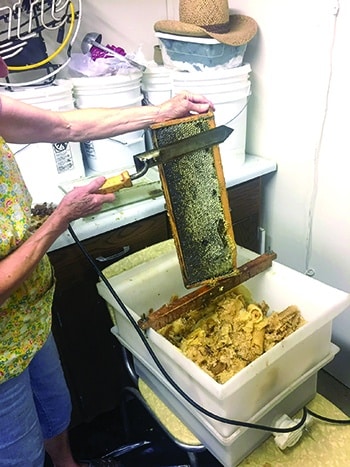
Cathy Hinderaker cuts wax from a frame of capped honey.
But the couple persisted, and, as they learned, the harvest grew.
Currently, they maintain a total of six to eight hives with most on their property south of Guthrie Center and two or three at Lake Panorama. Each hive is home to up to 60,000 bees, and each hive can produce about 90 pounds of honey per year.
For the past 30 years, the Hinderakers have continued raising bees and harvesting the honey each summer. Craig is a retired rural mail carrier. Cathy is a retired ACGC High School teacher, and she still fills in as a substitute teacher. To help cover the costs of their hobby, the couple sells their honey at Art on State.
Craig and Cathy explained the labor-intensive process of collecting the honey. At the end of summer, the Hinderakers harvest the honey by using a heated knife to separate the honeycombs and wax. The honeycombs are then spun in a large extractor. The honey is strained into 5-gallon buckets and then poured into individuals bottles as needed. Cathy explained how most commercially produced honey is heated so that it will resist crystalizing, but that process eliminates some of the benefits in raw honey. The Hinderakers’ honey is pure, raw honey, which means it has the full antibiotic and health properties.
As with any hobby, beekeeping is more complicated than most people realize. One example is a species of mite that is a frequent parasite on honeybees. Each spring and fall, the Hinderaker bees are treated for that.

Cathy and Craig Hinderaker show a bottle of their bees’ work.
Asked what advice they would give anyone considering becoming a beekeeper, Craig and Cathy stressed the importance of learning from someone with beekeeping experience.
“It takes some courage at first. And it’s a lot of work. I think it’s more work and more expensive than people realize,” Cathy said. “It is a hobby, but it’s also work.”
According to Cathy, no one in the family’s younger generations has yet caught the bug for beekeeping.
“We have three grown children and grandchildren, but none of them seem to be interested in raising bees,” she said.
Although beekeeping requires specialized clothing and equipment, an understanding of bees and respect for bees are the most important requirements.
“Unless you’re trying to get in their house, they’re just docile,” Cathy said.
When asked for a most memorable story about their bees, Cathy had an immediate answer.
“Once we were harvesting, and we both had bee suits on. Of course, the bees get upset when you’re taking their honey away. We had it stacked in the back of the Gator,” Cathy said. “We were so covered with these angry bees, we didn’t know what to do, so we drove down the road, going like mad, and there was this big swarm of bees chasing us. That’s the maddest we’ve ever seen them. It was like a cartoon. That had to be a funny sight if anybody saw us.”
Know someone in the area with an interesting hobby or collection that we should write about? Email rich@gctimesnews.com.