
Celebrate Iowa’s big trees this Arbor Day

From the Iowa Department of Natural Resources

Iowa’s trees tell a story of resilience, history and ecological importance. These towering giants serve as living landmarks, connecting communities to Iowa’s rich forestry heritage while highlighting the vital role trees play in our environment.

The Big Trees of Iowa program, coordinated by the Iowa Department of Natural Resources (DNR) Forestry section, celebrates the largest known specimens of each tree species in the state. Knowing of these impressive trees helps document growth potential, draws public attention to trees and encourages friendly competition.

Explore Iowa’s Big Tree Registry online at https://experience.arcgis.com/experience/db8a533a6ca34fc89a3df0603b6b2cb4/.

Volunteers are needed to learn the art and science of big tree hunting to help verify dimensions of nominated trees, monitor growth and explore and record unknown record-sized trees. Larger trees are likely out there, possibly in your neighborhood or backyard.

One dedicated volunteer has steadfastly crisscrossed Iowa in search of ever bigger specimens for decades and kept tabs on big trees he first measured in boyhood. Learn more about his obsession with big trees in the Spring 2025 Iowa Outdoors magazine.


Thank trees for all they do 

Get out and enjoy the beauty of April tree blossoms across Iowa neighborhoods.

Trees quietly enhance our daily lives in many ways. They’re like superheroes for our health.

Neighborhood trees are like natural air filters, cleaning up the air we breathe and making it fresher. They also help us feel less stressed and more focused. Being around trees has been shown to make us feel better both mentally and physically.

Here’s some fun options to celebrate trees near you this Arbor Day and throughout the year.

  • Plant a Tree. Follow DNR foresters’ tree planting tips to help it survive and thrive.
  • Visit a Park and Adopt a Tree. Choose a particular tree to observe. Get better acquainted with your chosen tree by using your senses of sight, touch, hearing, and smell to describe the tree. Find more fun family activities to do when visiting on the Project Learning Tree Exploring a Local Park webpage.
  • Read a Book About Trees. Visit your local library and ask for books about trees.
  • Discover what trees are growing around you. Iowa’s 10 Most Common Urban Trees can help you identify trees in your yard or neighborhood and learn more about each kind of tree.
  • Learn how to prevent wildfires. Smokey Bear lives within us all! While at home or on a camping trip, follow these important safety tips.

Cribbage results from April 23

Special to the Times Vedette

A total of 13 players participated on April 23. Wayne Nickel got a 16 and an 18, Sandy Rumelhart got a 16 and a 20, Lela Schwartz got a 16, and Chet Vaughan had a 24.

The Guthrie Center cribbage players generally meet at Guthrie Center Library on Mondays at 8 a.m., at the New Homestead independent living rec room at 8 a.m. on Wednesdays, and at the Guthrie Center Activity Center at 1 p.m. on Fridays. Organizers say there is always room for more, and they will be glad to teach you how to play. They play for quarters on Wednesday and Friday.

Law enforcement appreciation event May 14

Special to the Times Vedette

The Guthrie County Chaplains Association is hosting an appreciation event for local law enforcement on May 14  at 3 p.m. at the Freedom Rock, 405 State St. (West Highway 44) in Guthrie Center. Organizers encourage the public to show up to support law enforcement officers and their families. Messages will be shared by elected officials in Washington, D.C., elected officials, who have expressed appreciation for the jobs our law enforcement officers are doing back home. Attendees are also welcomed to offer brief words of encouragement to the officers. Lawn chairs are recommended.
The event will be held at the First Christian Church Fellowship Hall at 105 North Fourth St. in case of rain.

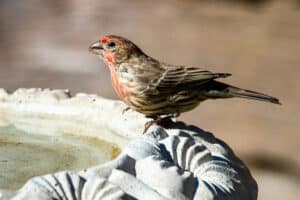
Plan regular cleanings for bird feeders, waterers and baths

From the Iowa Department of Natural Resources

Spring weather arrived, and with it, the annual spring cleaning and garden prep rituals going on in backyards and acreages across Iowa.

Iowans who set out bird feeders and waterers are encouraged to include regular feeder cleaning as part of their annual to do list, to avoid unintentionally spreading disease among birds that frequent these feeders.

Clean bird feeders and waterers with a 10% bleach solution about once each month and make sure the feeder is dry before refilling it with seed. Hummingbird feeders should be cleaned every 3-5 days with hot water and dish soap or with the 10% bleach solution, and rinsed thoroughly, and bird baths should get fresh water and a good scrub at least once per week.

Of equal importance to disinfecting the feeder is cleaning up spilled seed and bird droppings below feeders.

Be sure to wear rubber gloves while cleaning the feeders, since humans can contract some diseases, such as those caused by some Salmonella bacteria, from affected feeders or sick birds. If people do find sick birds at their feeders they should take the feeders down for at least two weeks to help stop the spread of disease and contact the DNR.

Feeder birds are not typically impacted by avian influenza, which circulates mostly in waterfowl, shorebirds, and waterbirds, and unless there are waterfowl using the feeders, there is no concern with continuing to feed.

It comes down to propellers

Symmetry is wonderful. It is part of the whole balance thing. The ying for the yang. The right for each left. And a necessity for those of us who believe there is a place for everything and everything has its place.   

I was reminded of the need for symmetry and balance the other day when I had a hangnail and trimmed it off with some clippers. Then I decided to trim all the nails on my left hand. My daughter told me we were late to go somewhere, so I put the clippers down and decided I would do the right hand later. I was off kilter all night, as I couldn’t get the unfinished nail thing off my mind. 

My barber told me of a similar story when he was trimming those crazy eyebrow hairs on a customer. He said he trimmed one side and then got caught up in a conversation and forgot to do the other. The customer came back — with his head tilted. 

Have you ever noticed how many things are truly symmetrical? Cut them in half, and you get the same thing on both sides. Our faces are symmetrical. So are our bodies. When cut the long way, a bicycle is even symmetrical. But a car isn’t. Huh?

Can someone explain why steering wheels are not in the middle of otherwise-symmetrical vehicles? I sort of understand why we in the U.S. do the opposite of those in the U.K., but why isn’t the steering wheel in the middle on all cars, everywhere? 

Some say it is safest when the driver is placed closest to the middle of the road, which is on the left side in America. OK, I will buy that. But then why are the steering wheels for boats traditionally placed on the right side? Well, according to boatingbasicsonline.com, there are several “technical and conventional reasons, lookout theories, and even international disciplines that come together and keep the steering wheels of boats on starboard.”

In plain English, it comes down to propellers. According to the same website, “as propellors spin clockwise, the motion tends to put the left side down. The port side is then pushed by around 2 to 3 degrees physically. In turn, the right side of the boat will significantly rise out. The weight of the one behind the steering wheel may prevent this rise and keep the ship afloat.” Sure.

Meanwhile, some modern pleasure crafts and wooden speed boats do have steering wheels on the left. Sometimes, they can also be found in the center. That makes more sense to me, at least from a symmetrical point of view.

Now, would somebody please pass me the nail clippers? 

Have a fantastic Friday, and thanks for reading.

Shane Goodman
Editor and Publisher
Times Vedette digital editions
shane@gctimesnews.com
641-332-2707