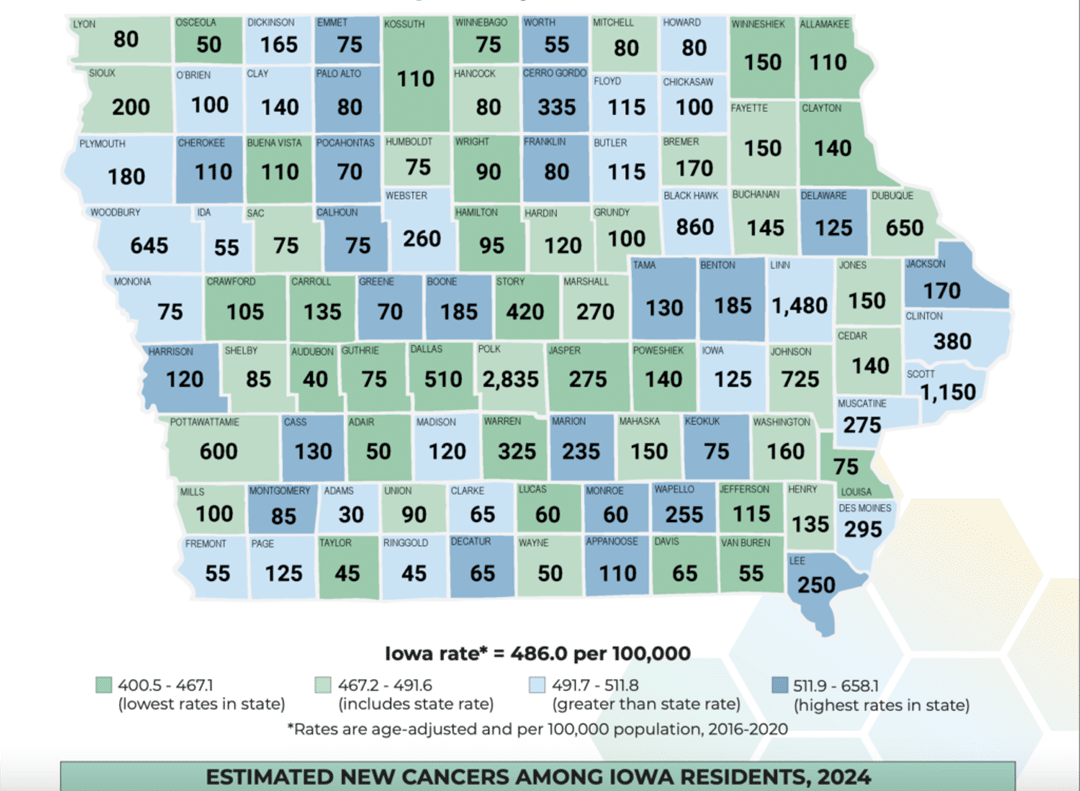
Map of 2024 estimates of new cancers per Iowa county as part of the Iowa Cancer Registry’s “Cancer in Iowa” report from February. (Map courtesy of Iowa Cancer Registry)
Iowa Cancer Registry to visit all Iowa counties to share cancer data.
By Cami Koons | Iowa Capital Dispatch
The Iowa Cancer Registry plans to deliver county-specific reports to all 99 counties in Iowa and meet with communities to point out particular policies or trends that might be driving higher rates of one particular type of cancer.
Mary Charlton, director of the Iowa Cancer Registry, said Iowa continues to have increasing cancer figures where other states are seeing steady or declining rates. She said it’s important for Iowans to know this research and to get involved in pushing for changes that could lower these rates.
“What we’re really wanting to make people aware of is: We have a high cancer burden here in Iowa,” Charlton said. “We have to start getting loud with our elected officials about doing something about it.”
Cancer in Iowa and county trends
Charlton said Iowa stacks up poorly compared to other states.
According to Charlton, who is also president of the Iowa Cancer Consortium, breast cancer is a “big driver” for Iowa’s increasing cancer rates overall. These rates are higher in urban areas than rural areas in Iowa. Charlton said the registry hypothesizes this because urban areas typically have higher levels of education, which often means women will wait longer to have children and that increases the risk of breast cancer.
Iowa’s rates of melanoma are also on the rise. Charlton said Iowa’s skin cancer rates are similar to those in Arizona. Researchers are unsure why that is, though the rates are highest in northern counties.
Charlton said it’s difficult to point to any one factor that could be causing trends, such as higher rates of prostate cancer in western Iowa, or more colon cancer in rural counties, because the patterns are varied.
New cancer report coming
Charlton said the newest Cancer Registry report will be released Feb. 25 and the schedule of county presentations will be posted on the website.
“It’s just kind of a complex grouping of factors that we’re exposed to here in Iowa,” Charlton said. “I don’t see how it could just be one thing, because it’s so different for each cancer.”
The 2024 Cancer in Iowa report, released in February, pointed to alcohol consumption in Iowa as a key component to Iowa cancer rates, as alcohol has been linked to breast, liver, colon and other cancers.
Charlton said “thankfully” lung cancer rates are declining overall, but said Iowa has made the least progress of any state when it comes to lung cancer, which is still the number one type of cancer in cancer-related deaths in the state.
An August 2024 report from Iowa Cancer Registry showed rates of lung cancer for Iowa females was increasing overall, as were rates in several counties. The American Lung Association, in November 2024, labeled Iowa as “among the worst in the nation” for new lung cancer cases.
Grassroot effort for change
Charlton said policies like a higher tobacco tax could improve lung cancer rates in Iowa, since smoking is the biggest driver of lung cancer. She said the last time Iowa increased its tax, in 2007, the percentage of Iowans who smoke declined, but she said without another increase to the tax over the past 18 years, the rate of smokers is close to what it was before the tax increase.
“We could make a lot of significant gains by doing that again,” Charlton said.
Charlton said while efforts are made at the Statehouse around tobacco laws most years, there isn’t enough support to get the bills passed. She hopes that engaging folks at a county level will get Iowans to “make some noise” on the issue to reach their elected representatives.
“I can talk all I want, but I need the policymakers to hear it in their own contacts, in their own community, how concerned people are about this and how much this is impacting people’s lives, and that it’s time to start doing something,” Charlton said.
Rep. Hans Wilz, R-Ottumwa, said he pushed for quite a few cancer-related bills last year, including issues tied to tanning beds and obesity.
Wilz said as he enters his sophomore year in the Legislature, he plans to put his energy into a smaller number of bills that will have a greater chance of passing.
“We need to find the bills that we can get through, that will get to the finish line and help us continue working and telling the story,” Wilz said.
Wilz said the first focus will likely be on a radon regulation bill, which passed the House last session and he said has been part of what he has talked with senators about out of session, with a goal of getting it passed in 2025.
Other bills, he said, will need to come from a “concerted conversation” among groups like the Iowa Cancer Registry, the Iowa Cancer Consortium, legislators on both sides of the aisle and everyday Iowans.
He said tobacco tax bills, as they have in the past, will likely face the biggest barriers to getting through the legislative process.
“I won’t put a ranking of importance on this at all, but it does come down to, what can we all afford to do,” Wilz said regarding opposition in the Legislature. “In my opinion, one of your best returns on investment is solving the cancer crisis.”
Wilz said the 99 counties initiative from the Cancer Registry is a “great idea” to start more conversations and awareness happening around cancer and across the state.
Charlton said the Cancer Registry has already had a meeting with Palo Alto County, which garnered close to 150 participants on the virtual call. The next call will be Jan. 23 for Dickinson County. Charlton said the rest of the schedule will be announced soon.
“We have very few policies that make it easier to do the healthy thing and harder to do the unhealthy thing,” Charlton said. “Everybody has an individual responsibility, but that’s not working …What would be working, I think better is if we had policies and programs in place to help people do the healthier things … instead of just letting (our cancer rates) continue to go up without changing any sort of policies in the state.”