Iowa Crop Progress and Condition Report — Week of Aug. 18, 2025 

Released by the USDA National Agricultural Statistics Service

Iowa Secretary of Agriculture Mike Naig commented on the Iowa Crop Progress and Condition Report released by the USDA National Agricultural Statistics Service. The report is released weekly April through November. Additionally, the Iowa Department of Agriculture and Land Stewardship provides a weather summary each week during this time.

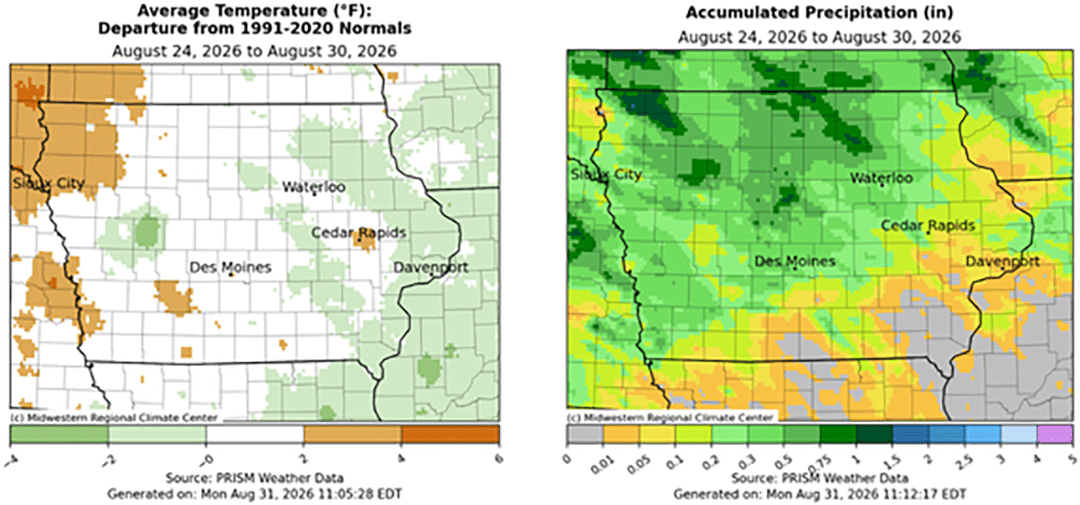
“Warm and muggy conditions didn’t deter visitors from enjoying another successful Iowa State Fair,” Secretary Naig said. “Drier weather in western Iowa broke an eight-week streak of unseasonably wet conditions, and for the first time in over a year, Iowa’s drought map is free of drought and abnormal dryness. The outlook through the end of August suggests cooler temperatures and more seasonal rainfall potential.”

The weekly report is also available on the USDA’s website at nass.usda.gov.

Crop report

Scattered precipitation across the State allowed Iowa’s farmers 5.1 days suitable for fieldwork during the week ending Aug. 17, 2025, according to the USDA, National Agricultural Statistics Service. Field activities included harvesting oats and hay and a few reports of fungicide and insecticide applications.

Topsoil moisture condition rated 0 percent very short, 2 percent short, 72 percent adequate and 26 percent surplus. Subsoil moisture condition rated 0 percent very short, 4 percent short, 73 percent adequate and 23 percent surplus.

Nearly all of Iowa’s corn has reached the silking stage. Corn in the dough stage reached 78 percent, 1 day behind last year’s pace and 3 days behind normal. Corn in the dent stage reached 27 percent, 1 day ahead of last year, but 1 day behind the five-year average. Corn condition rated 1 percent very poor, 2 percent poor, 11 percent fair, 56 percent good and 30 percent excellent. Soybeans blooming reached 96 percent. Eighty-three percent of soybeans were setting pods, 1 day ahead of last year’s pace, but 4 days behind normal. Soybean condition rated 1 percent very poor, 2 percent poor, 15 percent fair, 60 percent good and 22 percent excellent. Ninety-one percent of the oat for grain crop has been harvested.

The third cutting of alfalfa hay reached 65 percent complete. Pasture condition rated 83 percent good to excellent. Frequent rains have kept pastures growing and extended grazing periods. Livestock were generally in good condition, with a few reports of stress caused by heat and humidity.

Weather summary

Provided by Justin Glisan, Ph.D., State Climatologist, Iowa Department of Agriculture and Land Stewardship

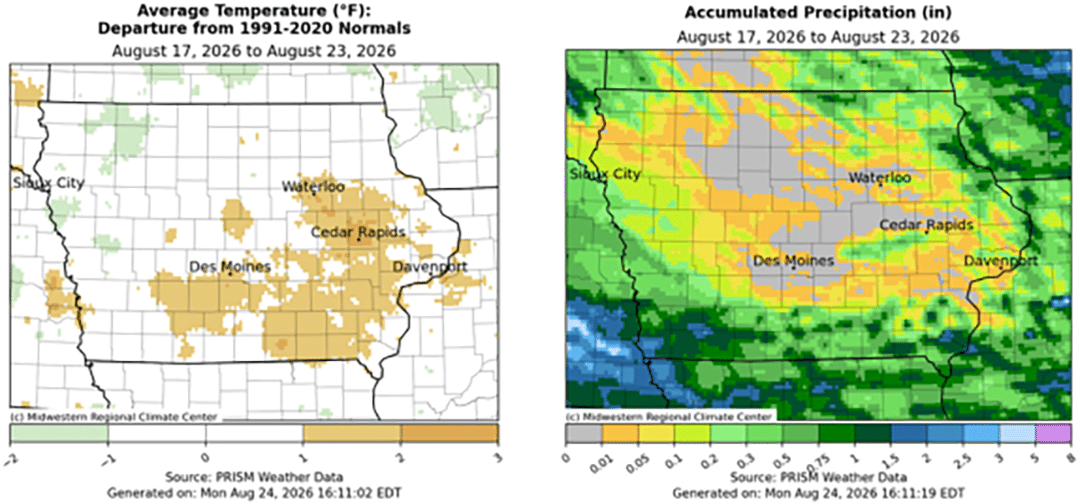
While parts of eastern Iowa saw above normal rainfall during the reporting period, this was the first week since mid-June in which statewide precipitation was below normal. Unseasonably warm and muggy conditions also persisted with positive departures in the two-to-four degree range; the statewide average temperature was 74.8 degrees, 2.9 degrees above normal.

Thunderstorms producing moderate to heavy rainfall across eastern Iowa finally exited the state early on Sunday (10th) afternoon. Nearly 20 stations observed at least 2.00 inches from east-central to northeast Iowa; Waterloo (Black Hawk County) collected 2.10 inches while 3.10 inches was reported at Dubuque Lock and Dam (Dubuque County). Daytime temperatures ranged from the low 70s north to low 80s south with lingering showers in western Iowa. Isolated strong storms reformed in eastern Iowa towards evening but fell apart after sunset. Scattered showers and thunderstorms developed in southeastern Iowa through the day on Monday (11th) as afternoon temperatures held in the upper 70s and low 80s. Some storms became severe in extreme southeast Iowa with two weak and short-lived tornadoes observed in Lee County. Rainfall was observed over Iowa’s southeastern one-third with widespread 0.50-1.00 inch totals; the highest amounts were found in a swath from south-central to eastern Iowa with 1.18 inches in Ottumwa (Wapello County) to 2.20 inches in Parnell (Iowa County). Stations farther north and west reported a few tenths of an inch. Patchy fog was reported at daybreak on Tuesday (12th) with lows in the upper 50s northwest to low 70s southeast. Skies remained mostly sunny with afternoon temperatures held in the low 80s as a cold front dropped southeast through the state. Winds shifted northeasterly behind the front with overnight lows dropping into the mid 50s to low 60s west to east. Daytime conditions were pleasant with light winds, lower relative humidity and temperatures in the upper 70s and low 80s.

Winds shifted to a southeasterly direction into Thursday (14th) as scattered showers pushed across parts of Iowa with numerous stations registering a tenth of an inch or less. Winds became blustery through the day as a low pressure center approached the Upper Midwest. Clouds increased into Friday (15th) morning as a small complex of thunderstorms propagated into northwestern Iowa from South Dakota. In the presence of ample moisture and instability, the complex expanded into a severe-warned bow echo and sped across northern Iowa before banking southeast into eastern Iowa by the evening hours. There were several reports along the path of the storms of large hail and wind gusts above 60 mph; 72 mph gusts were observed at La Porte City (Black Hawk County) and East Amana (Iowa County). The strongest part of the line moved out of eastern Iowa by sundown with scattered thunderstorms popping in northeast Iowa. Multiple stations along the swath observed totals above 0.75 inch with two stations in Vinton (Benton County) registering 1.72 to 2.07 inches. Amounts on the periphery were from a few to several tenths of an inch, particularly in northwest, central and eastern Iowa. Saturday (16th) was generally a quiet day, though unseasonably hot with daytime temperatures in the upper 80s and low 90s under bright sunshine. Nearly stationary thunderstorms formed on an existing boundary along the Iowa-Wisconsin border into Sunday (17th) morning. Decorah Municipal Airport (Winneshiek County) observed 1.02 inches while Decorah’s National Weather Service co-op station reported 2.90 inches.

Weekly precipitation totals ranged from no accumulation at a few western Iowa stations to 5.01 inches in Monticello (Jones County). The statewide weekly average precipitation was 0.80 inch, while the normal is 0.93 inch. Guttenberg Lock and Dam (Clayton County) reported the week’s high temperature of 98 degrees on the 17th, 16 degrees above normal. Spencer Municipal Airport (Clay County) reported the week’s low temperature of 53 degrees on the 13th, seven degrees below normal.

Iowa Crop Progress and Condition Report — Week of Aug. 11, 2025

Released by the USDA National Agricultural Statistics Service

Iowa Secretary of Agriculture Mike Naig commented on the Iowa Crop Progress and Condition Report released by the USDA National Agricultural Statistics Service. The report is released weekly April through November. Additionally, the Iowa Department of Agriculture and Land Stewardship provides a weather summary each week during this time.

“After a soggy and muggy start to the Iowa State Fair, temperatures and humidity eased, making for a more pleasant first Sunday of the event. Unfortunately, there are parts of the state, especially in eastern Iowa, that are also dealing with localized flooding from several waves of heavy rainfall,” Secretary Naig said. “Looking ahead, forecasts are indicating seasonal temperatures and drier conditions for the final week of the fair.”

The weekly report is also available on the USDA’s website at nass.usda.gov.

Crop report

Precipitation, heaviest in the western third of the State, limited producers to 4.7 days suitable for fieldwork during the week ending Aug. 10, 2025, according to the USDA, National Agricultural Statistics Service. Some fields started to dry out while low spots still had ponding. Field activities included harvesting oats and hay as conditions allowed.

Topsoil moisture condition rated 0 percent very short, 2 percent short, 68 percent adequate and 30 percent surplus. Subsoil moisture condition rated 0 percent very short, 3 percent short, 71 percent adequate and 26 percent surplus.

Ninety-six percent of Iowa’s corn has reached the silking stage. Corn in the dough stage was 68 percent, 1 day ahead of both last year’s pace and the 5-year average. Fifteen percent of the corn crop was dented. Corn condition rated 1 percent very poor, 2 percent poor, 11 percent fair, 57 percent good and 29 percent excellent. Soybeans blooming reached 93 percent. Seventy-five percent of soybeans were setting pods, 2 days ahead of last year, but 3 days behind normal. Soybean condition rated 1 percent very poor, 2 percent poor, 16 percent fair, 60 percent good and 21 percent excellent. Eighty-three percent of the oat crop has been harvested for grain, 1 week behind last year and 5 days behind average.

The second cutting of alfalfa hay neared completion while 50 percent of the third cutting has been completed. Hay condition rated 85 percent good to excellent.

Weather summary

Provided by Justin Glisan, Ph.D., State Climatologist, Iowa Department of Agriculture and Land Stewardship

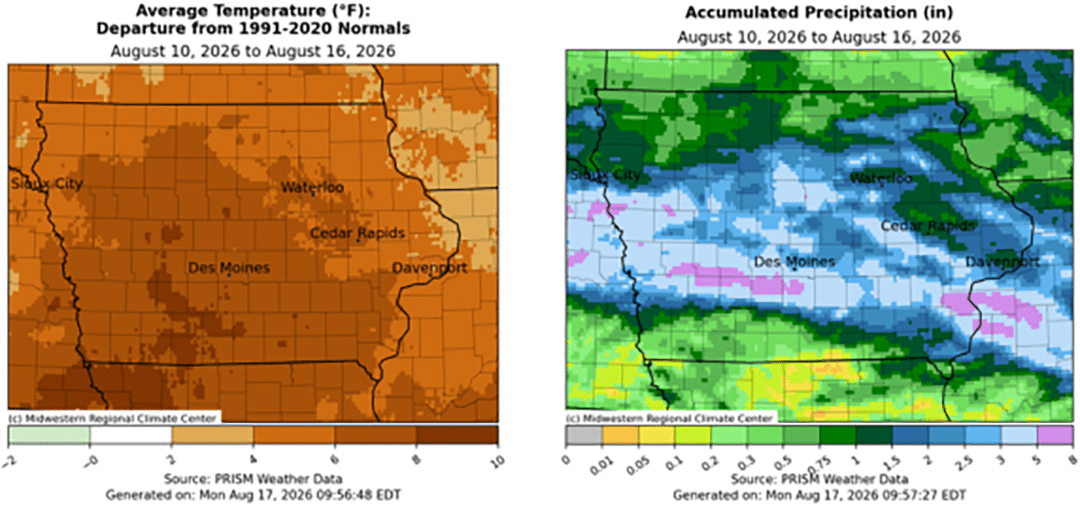
August’s first full week was unseasonably wet across western Iowa with drier conditions southeast; a wet reporting period along with the 2nd wettest July on record aided in the removal of all remaining drought from Iowa. Weekly temperatures varied from above to near average northeast to southwest, respectively, with a statewide average of 73.9 degrees, 1.8 degrees above normal.

Sunday (3rd) afternoon temperatures were pleasant, holding in the low to mid 70s with mostly sunny skies and southeasterly winds. The flow shifted easterly into early Monday (4th) with some patchy fog reported at east-central stations and morning temperatures in the low to mid 60s. Scattered showers in western Iowa brought some stations a few tenths of an inch with Mondamin (Harrison County) collecting 0.44 inch. Daytime conditions remained partly cloudy with temperatures warming into the upper 70s with some lingering Canadian wildfire smoke. Overnight lows dipped into the upper 50s and low 60s with easterly winds persisting at sunrise on Tuesday (5th). High temperatures into the afternoon hours rose into the upper 70s and low 80s as southerly winds shifted in advance of a complex of thunderstorms moving through South Dakota and Minnesota. The line entered northern Iowa after midnight on Wednesday (6th) and continued south before dissipating in south-central Iowa during the late morning. Northwestern Iowa stations reported widespread one-inch totals with 2.00 inches in Lake Park (Dickinson County) and 2.20 inches at Odebolt (Sac County). Skies remained mostly sunny through the daylight hours with temperatures returning to the upper 70s to mid 80s. Overnight lows into Thursday (7th) held in the upper 60s to low 70s as sluggish thunderstorms formed over south-central Iowa, bringing rainfall to the opening ceremony of the 166th Iowa State Fair in Des Moines (Polk County). Nearly 15 stations observed totals over two inches with 2.04 inches in Earlham (Madison County), 3.22 inches at Williamson (Lucas County) and 4.01 inches in Osceola (Clarke County); totals farther north and west were in the 0.50- to 1.00-inch range.

Afternoon conditions stabilized with a persisting southerly wind and cloud cover in western and northern Iowa. Friday (8th) dawned warm and muggy with temperatures in the low 70s and clear skies. Daytime conditions quickly warmed into the upper 80s and low 90s with dewpoints in the mid to upper 70s. Ample atmospheric moisture and instability helped fire stronger thunderstorms across northwestern Iowa towards the nighttime hours in advance of a strong cold front. Several cells became severe warned with strong gusts in the 60-70 mph range in west-central Iowa. Flash flooding also occurred due to slow-moving thunderstorms producing heavy rain. The line lost strength as it advanced into central and eastern Iowa through Saturday (9th) morning and early afternoon. After a quiet late afternoon and evening, strong thunderstorms redeveloped into Sunday (10th) morning ahead of a low pressure system over southwest Iowa, spreading across the state. Thirty-six-hour rain totals showed nearly 50 stations in pockets of western, central and eastern Iowa registering at least 2.00 inches with the heaviest totals from 3.23 inches in Muscatine (Muscatine County) to 4.77 inches in Pacific Junction (Mills County). More than 130 stations observed at least one inch with a statewide average of 0.86 inch. Morning temperatures in southeast Iowa were in the mid to upper 70s at some stations.

Weekly precipitation totals ranged from 0.01 inch at Ainsworth (Washington County) to 6.64 inches in Pacific Junction. The statewide weekly average precipitation was 1.60 inches; the normal is 1.01 inches. Several stations reported the week’s high temperature of 93 degrees on the 8th, on average nine degrees above normal. 

Iowa Crop Progress and Condition Report — Week of Aug. 4, 2025

Released by the USDA National Agricultural Statistics Service

Iowa Secretary of Agriculture Mike Naig commented on the Iowa Crop Progress and Condition Report released by the USDA National Agricultural Statistics Service. The report is released weekly April through November. Additionally, the Iowa Department of Agriculture and Land Stewardship provides a weather summary each week during this time.

“After experiencing above-average rainfalls throughout the month, preliminary data shows this will go down as the second wettest July on record with statewide rainfalls averaging over nine inches. Unfortunately, the active weather pattern included a derecho that brought damaging winds to northern and eastern Iowa. Our hearts go out to impacted Iowans as they work to clean up damage to trees, buildings and vehicles, and assess impacts on crops and livestock,” Secretary Naig said. “With the Canadian wildfire smoke clearing out, Iowans will be greeted with seasonal temperatures for the first several days of the world-famous Iowa State Fair.”

The weekly report is also available on the USDA’s website at nass.usda.gov.

Crop report

Fieldwork activities were limited as rain and wind held Iowa farmers to 3.8 days suitable for fieldwork during the week ending August 3, 2025, according to the USDA, National Agricultural Statistics Service. There were scattered reports of crops damaged or down due to storms, with some crops in low lying areas reportedly impacted by overly wet conditions.

Topsoil moisture condition rated 1 percent very short, 4 percent short, 64 percent adequate and 31 percent surplus. Subsoil moisture condition rated 1 percent very short, 6 percent short, 66 percent adequate and 27 percent surplus.

Corn silking reached 92 percent. Fifty-three percent of Iowa’s corn has reached the dough stage, 2 days ahead of both last year’s pace and the 5-year average. Nine percent of corn reached the dent stage. Corn condition rated 1 percent very poor, 2 percent poor, 12 percent fair, 57 percent good and 28 percent excellent. Soybeans blooming reached 89 percent. Sixty-five percent of soybeans were setting pods, 4 days ahead of last year but 1 day behind average. Soybean condition rated 1 percent very poor, 2 percent poor, 17 percent fair, 59 percent good and 21 percent excellent. Almost all of Iowa’s oats were turning color and 64 percent of oats for grain have been harvested.

The second cutting of alfalfa hay reached 93 percent complete, while 39 percent of the third cutting has been completed. Hay condition rated 84 percent good to excellent. Pasture condition rated 81 percent good to excellent. Some grazing acres were affected by standing water in North Central Iowa.

Weather summary

Provided by Justin Glisan, Ph.D., State Climatologist, Iowa Department of Agriculture and Land Stewardship

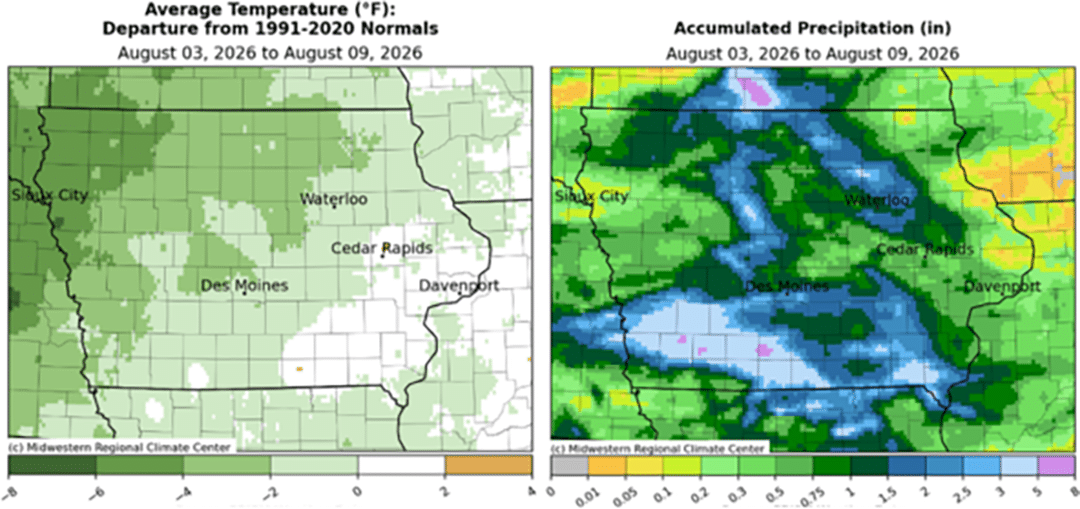
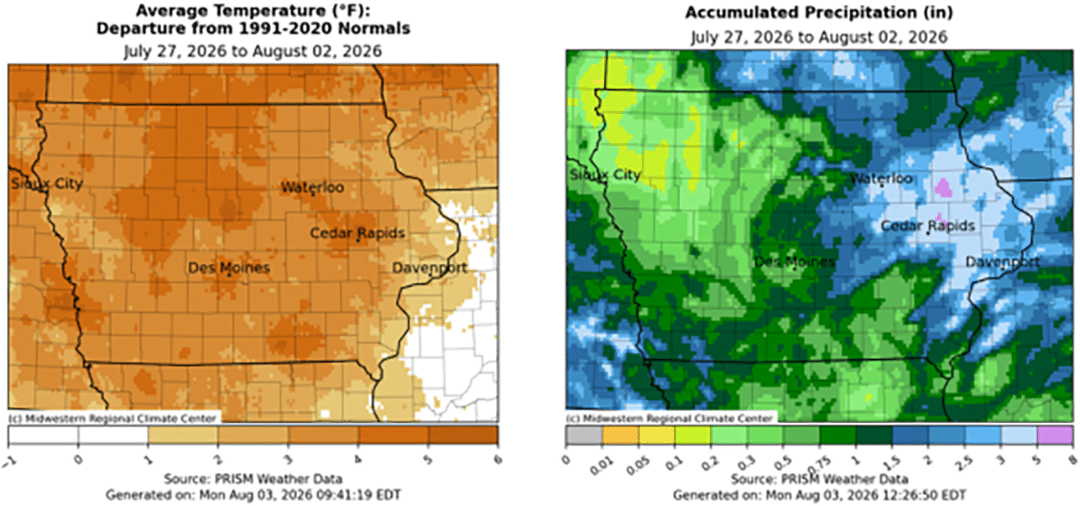
July’s final reporting period began with a derecho speeding through northern and eastern Iowa to a transition back to northwesterly flow, which brought in Canadian wildfire smoke and poor air quality. Weekly precipitation was above average statewide with widespread positive departures in the 1.00 – 3.00-inch range. Temperatures across the state were also below average for the first time in several weeks; the statewide average temperature was 71.0 degrees, 1.5 degrees below normal.

Sunday (27th) afternoon was mostly sunny across Iowa with temperatures in the upper 80s to low 90s and southerly winds. Clouds increased in northern Iowa after midnight as a line of strong thunderstorms pushed south through the state. There were numerous reports of strong straight-line winds over northern Iowa as the line advanced before dissipating after sunrise on Monday (28th) morning in southern Iowa. Many northern stations registered totals in the 0.50- to 1.50-inch range with amounts tailing off farther south. Eastern Iowa locations reported the highest amounts, from 2.10 inches in Waucoma (Fayette County) to 2.48 inches in Asbury (Dubuque County). Clouds cleared through the late morning as sunny skies warmed daytime temperatures into the mid to upper 80s north to south. Later in the evening, severe thunderstorms in South Dakota coalesced into a bow echo that rapidly propagated through northern Iowa. Two spin-up tornadoes were observed near Alvord (Lyon County), producing a swath of damage to acres of corn and soybeans. As the complex, which was later classified as a “derecho” by the Storm Prediction Center, moved into north-central Iowa, it dove southeast and sped across eastern Iowa. There were numerous reports of significant wind gusts along the path length, with 99 mph observed at Sioux Center (Sioux County), 92 mph at both Orange City (Sioux County) and Spencer (Clay County) and 83 mph in Cedar Rapids (Linn County). Rain totals reported at 7:00 am on Tuesday (29th) were also above 0.75 to 1.00 inch along the axis of movement with 1.56 inches in Osage (Mitchell County) to 1.99 inches in Sigourney (Keokuk County). Clearing skies and southerly winds helped boost afternoon temperatures into the 90s over Iowa’s southwestern half with low 80s observed in northeastern Iowa; a stationary boundary was the dividing line, effectively splitting the state.

The surface boundary was a forcing mechanism for an initial line of storms in west-central Iowa through the evening hours. A broader line of thunderstorms developed along a cold front crashing into the warm and humid airmass over Iowa. A widening shield of moderate to heavy rain continued into Wednesday (30th) morning with more than 220 stations reporting at least 1.00 inch and over 50 registering totals over 2.00 inches. A swath of stations from Polk City (Polk County) to Jefferson (Greene County) collected totals from 3.08 inches to 3.62 inches, respectively, with a statewide average of 1.18 inches. Winds shifted to a northerly direction behind the front with pleasant temperatures in the upper 70s and low 80s. Morning lows on Thursday (31st) dropped into the low 60s with patchy fog and haze reported at many stations; wildfire smoke moved into the state as high pressure over the Upper Midwest dominated the flow. Afternoon highs held in the low to mid 70s with light northeasterly winds. Air quality degraded overnight as upper level smoke mixed down to the lower atmosphere through Friday (1st). Daytime temperatures were again five to 10 degrees below average, ranging from the low 70s west to upper 70s east. Morning lows on Saturday (2nd) varied from the low 50s northwest to low 60s southeast with light and variable winds under hazy skies. Daytime temperatures remained unseasonably cool and similar to the previous day. Sunday (3rd) dawned chilly with lows in the 50s and smoky skies.

Weekly precipitation totals ranged from 0.44 inch at Lansing (Allamakee County) to 5.00 inches in Orange City. The statewide weekly average precipitation was 2.18 inches, more than double the normal of 0.95 inch. Carroll (Carroll County) reported the week’s high temperature of 99 degrees on the 29th, 15 degrees above normal. Iowa Falls (Hardin County) reported the week’s low temperature of 48 degrees on the 1st, 14 degrees below normal.

Iowa Crop Progress and Condition Report — Week of July 28, 2025

Released by the USDA National Agricultural Statistics Service

Iowa Secretary of Agriculture Mike Naig commented on the Iowa Crop Progress and Condition Report released by the USDA National Agricultural Statistics Service. The report is released weekly April through November. Additionally, the Iowa Department of Agriculture and Land Stewardship provides a weather summary each week during this time.

“Last week was hot and muggy as a heat dome settled over the Midwest, producing some sweltering heat and humidity,” Secretary Naig said. “Forecasts show chances for a few more thunderstorms this week, followed by a welcome break from the hot weather. With a few days to go in the month, preliminary estimates indicate it could rank among the top ten wettest Julys on record.”

The weekly report is also available on the USDA’s website at nass.usda.gov.


Crop report

Another wet and humid week limited Iowa farmers to 3.6 days suitable for fieldwork during the week ending July 27, 2025, according to the USDA, National Agricultural Statistics Service. Field activities included harvesting oats, cutting hay and applying fungicide.

Topsoil moisture condition rated 1 percent very short, 4 percent short, 65 percent adequate and 30 percent surplus. Subsoil moisture condition rated 2 percent very short, 7 percent short, 67 percent adequate and 24 percent surplus.

Corn silking reached 84 percent, 1 day ahead of both last year and the five-year average. Thirty-four percent of Iowa’s corn has reached the dough stage, 1 day ahead of last year’s pace and 3 days ahead of normal. Corn condition rated 1 percent very poor, 2 percent poor, 10 percent fair, 59 percent good and 28 percent excellent. Soybeans blooming reached 81 percent, unchanged from last year, but 2 days behind normal. Fifty-two percent of soybeans were setting pods, 5 days ahead of last year and 2 days ahead of the five-year average. Soybean condition rated 1 percent very poor, 2 percent poor, 15 percent fair, 61 percent good and 21 percent excellent. Ninety-five percent of oats were turning color and 49 percent of the oat crop has been harvested. Oat condition rated 0 percent very poor, 3 percent poor, 14 percent fair, 67 percent good and 16 percent excellent.

The second cutting of alfalfa hay reached 87 percent complete while 28 percent of the third cutting has been completed. Hay condition rated 86 percent good to excellent. Pasture condition rated 82 percent good to excellent. Livestock stress from heat and humidity was reported.

Weather summary

Provided by Justin Glisan, Ph.D., State Climatologist, Iowa Department of Agriculture and Land Stewardship

A heat dome developed over the Midwest through the reporting period, boosting air and dew point temperatures to anomalous levels. With ample moisture availability, several days of showers and thunderstorms brought widespread rainfall, adding a sixth consecutive week of unseasonably wet conditions across Iowa. Temperatures ranged from two to six degrees above the 30-year climatology with the statewide average temperature at 77.5 degrees, 4.1 degrees above normal.

Showers dissipated across eastern Iowa by noon on Sunday (20th) with isolated thunderstorms firing in central Iowa during the evening hours. Afternoon temperatures varied from the upper 70s north to mid 80s south with an easterly wind and cloudy skies. Winds shifted southeasterly into Monday (21st) morning with low temperatures in the low to mid 70s with patchy fog. Daytime temperatures were pleasant, in the upper 70s, with clouds over eastern Iowa; farther northwest, sunny skies boosted temperatures into the mid to upper 80s. Overcast conditions persisted through the nighttime hours with morning lows on Tuesday (22nd) in the low to mid 70s and patchy fog. Temperatures quickly warmed into the mid to upper 80s across western and central Iowa as the remnants of a mesoscale convective vortex moved northeast from Kansas through the day; the disturbance was a forcing mechanism for isolated severe thunderstorms to fire towards the evening hours. The complex of storms moved from central Iowa and re-intensified a few hours later in northeast Iowa, where heavy rain and stronger winds were observed. Thirty northeastern stations registered at least an inch; a narrow swath of significant rainfall was found from Oelwein (Fayette County) to Strawberry Point (Clayton County) where totals of 2.03 and 4.90 inches were reported, respectively. Wednesday (23rd) dawned unseasonably warm with morning lows in the low to mid 70s under mostly clear skies and muggy, stagnant air; the statewide average low was 72 degrees, nine degrees above normal. Southerly flow enhanced moisture advection into the state with dew points pushing into the upper 70s and low 80s and air temperatures in the upper 80s. These were ideal conditions to support a squall line and a widespread shield of rainfall to cross Iowa from northwest to southeast though the afternoon hours into Thursday (24th) morning.

The line was strongest over west-central Iowa where an 82-mph wind gust was observed in Coon Rapids (Carroll County). The heaviest rainfall was found in north-central and extreme southwest Iowa. Totals from 2.50 inches to 5.00 inches were found in Fort Dodge (Webster County) to Grafton (Worth County). Shenandoah (Page County) collected 1.81 inches while across the state, Fort Madison (Lee County) observed 2.40 inches as the system persisted for several hours. Overall, nearly 120 stations reported at least an inch with a statewide average of 0.78 inch. Partly cloudy skies remained behind the system with lower humidity and comfortable highs in the upper 70s and low 80s. Friday (25th) morning conditions were foggy in southwest and east-central Iowa with temperatures varying from the low 60s north to low 70s south. Spotty showers moved into southern Iowa into the afternoon hours and continued through the overnight hours, becoming sluggish with moderate to heavy rainfall in southeastern Iowa. The complex of showers pushed out of the state by noon on Saturday (26th), leaving behind significant totals on the order of nearly a month’s worth of rainfall at several stations. Six stations in Muscatine and Van Buren counties observed 4.95 to 5.38 inches with nearly 50 stations at or above two inches. Winds were light and variable into the afternoon with highs in the 80s. Overnight conditions into Sunday (27th) were slightly warmer than average with lows in the 70s and cloud cover over the state’s eastern half.

Weekly precipitation totals ranged from 0.12 inch at Dubuque Lock and Dam (Dubuque County) to 7.26 inches in Montrose (Lee County). The statewide weekly average precipitation was 1.58 inches while the normal is 0.97 inches. Dubuque Lock and Dam reported the week’s high temperature of 95 degrees on the 23rd, 11 degrees above normal. Hampton (Franklin County) reported the week’s low temperature of 52 degrees on the 26th, ten degrees below normal.

Iowa Crop Progress and Condition Report — Week of July 21, 2025

From the Iowa Department of Agriculture and Land Stewardship

Iowa Secretary of Agriculture Mike Naig commented on the Iowa Crop Progress and Condition Report released by the USDA National Agricultural Statistics Service. The report is released weekly April through November. Additionally, the Iowa Department of Agriculture and Land Stewardship provides a weather summary each week during this time.

“July has been particularly wet for portions of Iowa. The monthly statewide average rainfall is above normal and we’ve still got 10 days to go. Unfortunately, saturated soils and increased streamflow have led to localized issues with standing water and flash flooding in some areas,” Secretary Naig said. “While overall crop progress has benefited from the wetter conditions and somewhat milder temperatures, attention is now turning to the heat dome building in over the state, which will bring hot temperatures and humidity this week.”

The weekly report is also available on the USDA’s website at nass.usda.gov.

Crop report

Iowa had 4.3 days suitable for fieldwork during the week ending July 20, 2025, according to the USDA, National Agricultural Statistics Service. Heavy rain was received in portions of the state. Field activities during the week included fungicide spraying, cutting hay and harvesting oats.

Topsoil moisture condition rated 2 percent very short, 5 percent short, 72 percent adequate and 21 percent surplus. Subsoil moisture condition rated 2 percent very short, 9 percent short, 72 percent adequate and 17 percent surplus.

Corn silking reached 62 percent, 1 day behind last year’s pace. Eighteen percent of Iowa’s corn has reached the dough stage. Corn condition rated 1 percent very poor, 2 percent poor, 11 percent fair, 59 percent good and 27 percent excellent. Sixty-nine percent of soybeans had bloomed, 1 day ahead of last year, but 1 day behind normal. Thirty-three percent of soybeans were setting pods, 4 days ahead of last year and 2 days ahead of the five-year average. Soybean condition rated 1 percent very poor, 2 percent poor, 17 percent fair, 59 percent good and 21 percent excellent. Eighty-three percent of oats were turning color and 35 percent of oats have been harvested for grain. Oat condition rated 0 percent very poor, 1 percent poor, 15 percent fair, 68 percent good and 16 percent excellent.

The second cutting of alfalfa hay was 79 percent complete while 17 percent of the third cutting has been completed. Hay condition rated 86 percent good to excellent. Pasture condition rated 79 percent good to excellent.

Weather Summary

Provided by Justin Glisan, Ph.D., State Climatologist, Iowa Department of Agriculture and Land Stewardship

Widespread rainfall through the reporting period, heavy at various times and locations, added to a particularly wet July; a pocket of central Iowa observed two to three inches of above-normal totals. Temperatures moderated back to near normal over southeastern Iowa and slightly cooler northwest; the statewide average temperature was 72.3 degrees, 3.0 degrees below normal.

Sunday (13th) afternoon was pleasant with temperatures in the upper 70s and low 80s with a light southerly wind and ample sunshine. Morning lows on Monday (14th) held in the mid 60s with patchy fog across much of Iowa. Southerly flow pushed dew points into the upper 60s and low 70s with daytime temperatures in the low to mid 80s. Tuesday (15th) dawned with similar conditions as the previous morning with partly cloudy skies over eastern Iowa. Temperatures rose into the mid to upper 80s under persisting southerly winds and mostly sunny skies. Clouds increased over northwestern Iowa towards midnight as thunderstorms fired along a cold front in eastern South Dakota. The line pushed across Iowa overnight into Wednesday (16th), losing strength from central to eastern Iowa by daybreak. Much of western Iowa observed rainfall totals of at least 0.50 inch with most stations on the eastern periphery receiving a few tenths of an inch. Locations in northwest Iowa registered the highest totals with 1.11 inches in Westfield (Plymouth County) to 2.15 inches in Spencer (Clay County). Winds shifted to the northwest behind the front with daytime highs in the low 80s ahead of the front while the upper 60s and low 70s were observed west. Northerly winds continued into Thursday (17th) with overcast skies and lows in the mid 50s northwest to upper 60s southeast. With high pressure stabilizing the weather pattern, afternoon conditions started to improve as clouds broke with temperatures in the upper 60s and low 70s. Overnight lows into Friday (18th) varied from the mid 50s northeast to mid 60s southwest where clouds were present. Clouds expanded over the state through the daytime hours with afternoon highs in the 70s and southerly winds.

Clouds redeveloped across northern Iowa after midnight on Saturday (19th) as an east-west-oriented squall line sped southeast through Iowa. The line’s core thunderstorms became severe warned towards sunrise with a weak tornado reported near Gilbert (Story County). The cell then produced several reports of strong straight-line winds with a 71-mph gust a few miles southeast of the tornadic circulation. Several stations from north-central to eastern Iowa observed at least two inches of rain with 2.07 inches in Eagle Grove (Wright County) to 3.25 inches at Mount Auburn (Benton County). Nearly 100 stations collected an inch or more farther south and east of the highest totals with a statewide average of 0.61 inch. Skies gradually cleared through the day with a stationary front setting up over the middle of the state. Afternoon temperatures north of the boundary held in the upper 70s and low 80s with northerly winds. South of the front, winds were out of the south with mid-80 readings. Showers and thunderstorms formed along the front through the overnight hours into Sunday (20th). A concentrated line of heavier thunderstorms stretched from west-central Iowa southeast, with an expanded shield of moderate rain north and south. Numerous flash flood warnings were issued due to higher intensity rainfall on top of saturated soil profiles. Central to south-central Iowa saw the most significant totals with several stations accumulating nearly a month’s worth of rainfall; nearly 70 stations reported at least two inches with 4.1 inches in Allerton (Wayne County) and 4.49 inches in Osceola (Clarke County). The statewide average came in at 1.08 inches.

Weekly precipitation totals ranged from 0.09 inch in Corning (Adams County) to 5.14 inches in Sully (Jasper County). The statewide weekly average precipitation was 1.88 inches while the normal is 1.02 inches. Lamoni (Decatur County) reported the week’s high temperature of 91 degrees on the 16th, four degrees above normal. Fayette (Fayette County) reported the week’s low temperature of 50 degrees on the 18th, ten degrees below normal.

Iowa Crop Progress and Condition Report — Week of July 14, 2025

From the Iowa Department of Agriculture and Land Stewardship

Iowa Secretary of Agriculture Mike Naig commented on the Iowa Crop Progress and Condition Report released by the USDA National Agricultural Statistics Service. The report is released weekly April through November. Additionally, the Iowa Department of Agriculture and Land Stewardship provides a weather summary each week during this time.

“Iowans experienced another wild weather week with reports of weak tornadoes, hail and wind, along with pockets of significant rainfall producing flash flooding,” Secretary Naig said. “Though the rainfall is improving drought conditions and helping the corn during tasseling and pollination, there are now parts of the state that could use a break from the rain.”

The weekly report is also available on the USDA’s website at nass.usda.gov.

Crop report

Rain on and off throughout the week limited farmers to 3.8 days suitable for fieldwork during the week ending July 13, 2025, according to the USDA, National Agricultural Statistics Service. Wet conditions made field activities difficult.

Topsoil moisture condition rated 0 percent very short, 6 percent short, 71 percent adequate and 23 percent surplus. Subsoil moisture condition rated 1 percent very short, 9 percent short, 74 percent adequate and 16 percent surplus.

Corn silking reached 36 percent, 1 day behind last year, but 1 day ahead of normal. Five percent of Iowa’s corn reached the dough stage. Corn condition rated 1 percent very poor, 2 percent poor, 12 percent fair, 58 percent good and 27 percent excellent. Soybeans blooming reached 54 percent, 3 days ahead of last year but equal to the five-year average. Eighteen percent of soybeans were setting pods, 4 days ahead of last year and 3 days ahead of the five-year average. Soybean condition rated 1 percent very poor, 2 percent poor, 18 percent fair, 59 percent good and 20 percent excellent. Ninety-six percent of Iowa’s oat crop was headed and 71 percent of oats were turning color. Oats harvested for grain reached 19 percent complete. Oat condition rated 0 percent very poor, 1 percent poor, 13 percent fair, 71 percent good and 15 percent excellent.

The State’s second cutting of alfalfa hay reached 66 percent complete while 7 percent of the third cutting was completed. Hay condition rated 83 percent good to excellent. Pasture condition rated 75 percent good to excellent.

Weather summary

Provided by Justin Glisan, Ph.D., State Climatologist, Iowa Department of Agriculture and Land Stewardship

With ample moisture transport into the Upper Midwest persisting, Iowa experienced another anomalously wet and active week. A band of two to four inches above-normal rainfall ran west to east across Iowa. Warmth continued over the state’s southeastern half with near normal conditions northwest; the statewide average temperature was 74.1 degrees, 0.6 degree below normal.

Northerly winds held through Sunday (6th) afternoon with partly cloudy skies and highs in the low to mid 80s statewide. Monday (7th) morning lows varied from the low 60s northwest to low 70s southeast with patchy fog and calm to light winds. Daytime temperatures were in the low to mid 80s with winds shifting to the south in advance of a squall line racing through South Dakota towards Iowa’s northwest counties. Showers and thunderstorms commenced mid evening and sped across western Iowa with multiple severe-warned cells producing scattered reports of strong straight-line winds. Much of western Iowa reported at least 0.50 inch with a pocket of 2.00- to 3.00-inch totals in central Iowa; Adel (Dallas County) observed 2.09 inches with 3.12 inches in the Des Moines (Polk County) metro area. The complex mostly dissipated by sunrise on Tuesday (8th) with a few additional thunderstorms developing in east-central Iowa. Conditions through the day were partly to mostly sunny with many stations registering temperatures in the 80s. Several isolated thunderstorms popped in eastern Iowa with a stray storm in northwestern Iowa producing a 0.45-inch reading in Milford (Dickinson County). The storms over eastern Iowa had heavier totals along with localized flash flood warnings; two stations in Scott County, Park View and Long Grove, reported 1.69 inches and 2.31 inches, respectively. Lows on Wednesday (9th) dipped into the mid 60s to low 70s under calm conditions and sunny skies. Wind directions varied across Iowa as a stationary front situated itself from northwest to southeast over Iowa. This boundary created a path for a second disturbance to interact with, following an afternoon of temperatures in the mid to upper 80s and high dew points.

The line of thunderstorms crossed into Iowa after midnight on Thursday (10th) and sped in a north-south orientation across the state. Moderate to locally heavy rain was reported before the line fizzled farther east. Daytime instability increased as discrete thunderstorms quickly developed with a few cells becoming tornado-warned late afternoon into the evening; a brief tornado was observed near Canton (Jackson County). A separate grouping storms propagated into western Iowa as the eastern batch was moving out of the state. Embedded severe thunderstorms sped into central Iowa with a 74-mph wind gust reported at Des Moines International Airport. Behind the complex, a broad swath of 0.50- to 1.50-inch accumulations were reported as the line dissipated and moved east; eastern stations registered the highest totals with 3.50 inches in Charlotte (Clinton County). Friday (11th) was another active day as a warm front across southern Iowa became a focusing mechanism for sluggish supercells. Morning convection started over northern Iowa before storms fired south and east. Several waves of storms were severe and tornado-warned with extremely heavy rain from central into eastern Iowa. There were two confirmed tornadoes, one near Clarinda (Page County) and the other in Scott County, which also had a rare Flash Flood Emergency issued by the National Weather Service. Numerous high wind reports were noted with an 85-mph gust in Cascade (Jones County). Nealy 130 stations collected an inch or more with two gauges in Davenport (Scott County) recording 2.95 and 3.21-inch amounts, respectively. Canadian wildfire smoke was apparent in the Saturday (12th) morning sky after a northwesterly shifting wind behind the passing cold front. Temperatures were in the low 60s in northwest Iowa, where skies cleared; mid to upper 60s were reported farther east as clouds held on behind the exiting system. Iowans experienced pleasant afternoon conditions with a light breeze, fair weather cumulus and highs in the mid 70s to low 80s west to east. Overnight calmness blanketed Iowa with Sunday (13th) lows in the upper 50s and low 60s.

Weekly precipitation totals ranged from 0.40 inch at Fort Atkinson (Winneshiek County) to 6.77 inches in Asbury (Dubuque County). The statewide weekly average precipitation was 2.37 inches; the normal is 1.05 inches. Multiple southern stations reported the week’s high temperature of 92 degrees on the 11th, on average six degrees above normal. Audubon (Audubon County) reported the week’s low temperature of 53 degrees on the 13th, nine degrees below normal.