Iowa Crop Progress and Condition Report — Week of July 21, 2025

From the Iowa Department of Agriculture and Land Stewardship

Iowa Secretary of Agriculture Mike Naig commented on the Iowa Crop Progress and Condition Report released by the USDA National Agricultural Statistics Service. The report is released weekly April through November. Additionally, the Iowa Department of Agriculture and Land Stewardship provides a weather summary each week during this time.

“July has been particularly wet for portions of Iowa. The monthly statewide average rainfall is above normal and we’ve still got 10 days to go. Unfortunately, saturated soils and increased streamflow have led to localized issues with standing water and flash flooding in some areas,” Secretary Naig said. “While overall crop progress has benefited from the wetter conditions and somewhat milder temperatures, attention is now turning to the heat dome building in over the state, which will bring hot temperatures and humidity this week.”

The weekly report is also available on the USDA’s website at nass.usda.gov.

Crop report

Iowa had 4.3 days suitable for fieldwork during the week ending July 20, 2025, according to the USDA, National Agricultural Statistics Service. Heavy rain was received in portions of the state. Field activities during the week included fungicide spraying, cutting hay and harvesting oats.

Topsoil moisture condition rated 2 percent very short, 5 percent short, 72 percent adequate and 21 percent surplus. Subsoil moisture condition rated 2 percent very short, 9 percent short, 72 percent adequate and 17 percent surplus.

Corn silking reached 62 percent, 1 day behind last year’s pace. Eighteen percent of Iowa’s corn has reached the dough stage. Corn condition rated 1 percent very poor, 2 percent poor, 11 percent fair, 59 percent good and 27 percent excellent. Sixty-nine percent of soybeans had bloomed, 1 day ahead of last year, but 1 day behind normal. Thirty-three percent of soybeans were setting pods, 4 days ahead of last year and 2 days ahead of the five-year average. Soybean condition rated 1 percent very poor, 2 percent poor, 17 percent fair, 59 percent good and 21 percent excellent. Eighty-three percent of oats were turning color and 35 percent of oats have been harvested for grain. Oat condition rated 0 percent very poor, 1 percent poor, 15 percent fair, 68 percent good and 16 percent excellent.

The second cutting of alfalfa hay was 79 percent complete while 17 percent of the third cutting has been completed. Hay condition rated 86 percent good to excellent. Pasture condition rated 79 percent good to excellent.

Weather Summary

Provided by Justin Glisan, Ph.D., State Climatologist, Iowa Department of Agriculture and Land Stewardship

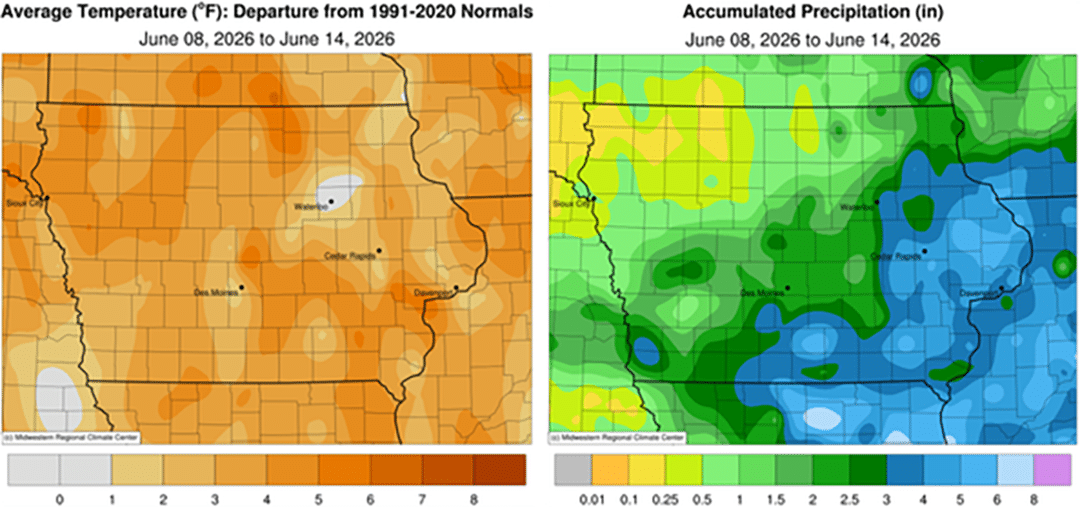
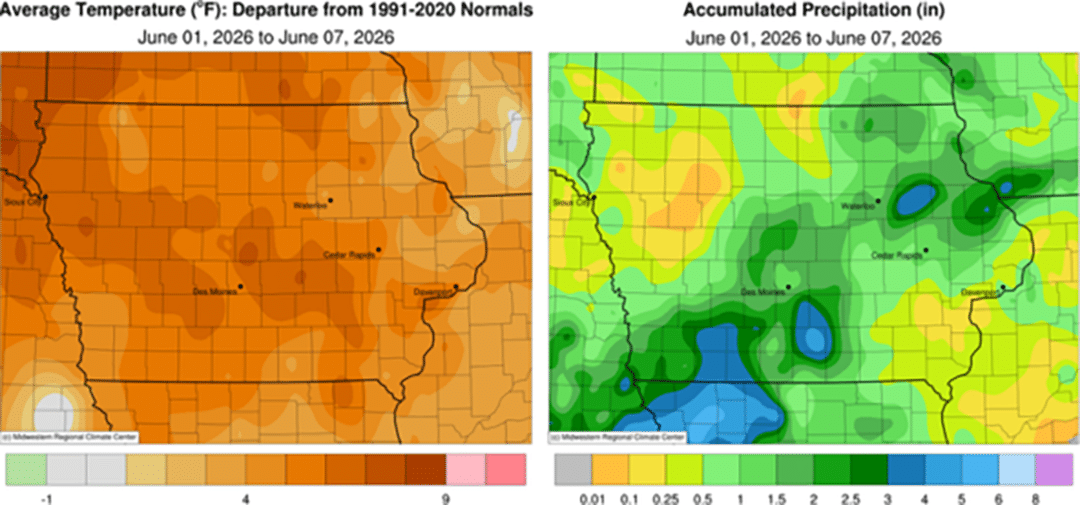
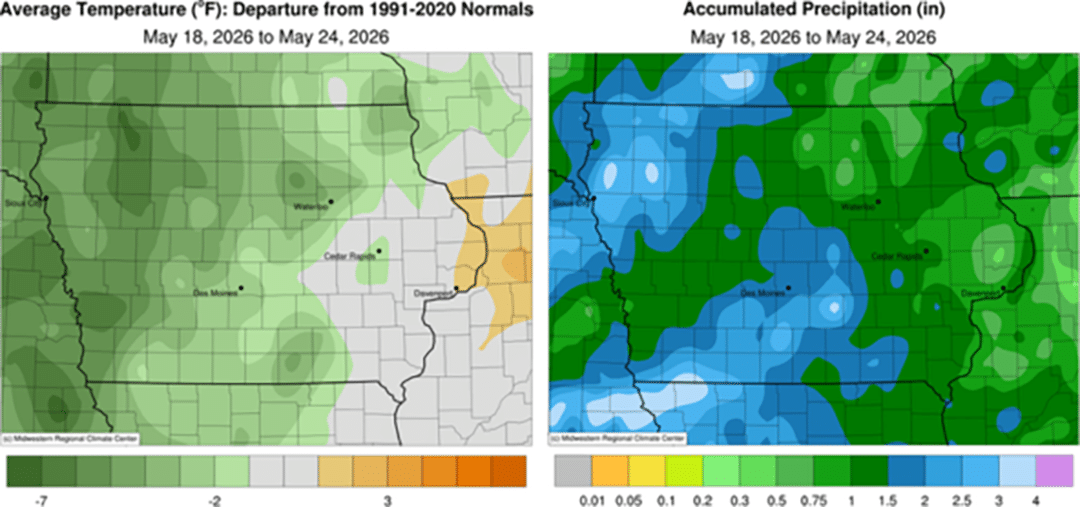
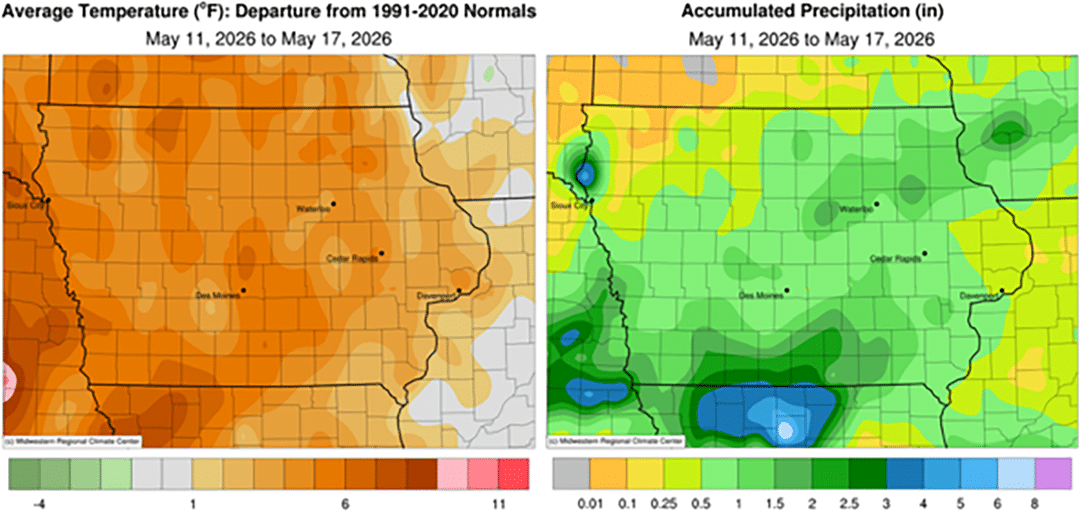
Widespread rainfall through the reporting period, heavy at various times and locations, added to a particularly wet July; a pocket of central Iowa observed two to three inches of above-normal totals. Temperatures moderated back to near normal over southeastern Iowa and slightly cooler northwest; the statewide average temperature was 72.3 degrees, 3.0 degrees below normal.

Sunday (13th) afternoon was pleasant with temperatures in the upper 70s and low 80s with a light southerly wind and ample sunshine. Morning lows on Monday (14th) held in the mid 60s with patchy fog across much of Iowa. Southerly flow pushed dew points into the upper 60s and low 70s with daytime temperatures in the low to mid 80s. Tuesday (15th) dawned with similar conditions as the previous morning with partly cloudy skies over eastern Iowa. Temperatures rose into the mid to upper 80s under persisting southerly winds and mostly sunny skies. Clouds increased over northwestern Iowa towards midnight as thunderstorms fired along a cold front in eastern South Dakota. The line pushed across Iowa overnight into Wednesday (16th), losing strength from central to eastern Iowa by daybreak. Much of western Iowa observed rainfall totals of at least 0.50 inch with most stations on the eastern periphery receiving a few tenths of an inch. Locations in northwest Iowa registered the highest totals with 1.11 inches in Westfield (Plymouth County) to 2.15 inches in Spencer (Clay County). Winds shifted to the northwest behind the front with daytime highs in the low 80s ahead of the front while the upper 60s and low 70s were observed west. Northerly winds continued into Thursday (17th) with overcast skies and lows in the mid 50s northwest to upper 60s southeast. With high pressure stabilizing the weather pattern, afternoon conditions started to improve as clouds broke with temperatures in the upper 60s and low 70s. Overnight lows into Friday (18th) varied from the mid 50s northeast to mid 60s southwest where clouds were present. Clouds expanded over the state through the daytime hours with afternoon highs in the 70s and southerly winds.

Clouds redeveloped across northern Iowa after midnight on Saturday (19th) as an east-west-oriented squall line sped southeast through Iowa. The line’s core thunderstorms became severe warned towards sunrise with a weak tornado reported near Gilbert (Story County). The cell then produced several reports of strong straight-line winds with a 71-mph gust a few miles southeast of the tornadic circulation. Several stations from north-central to eastern Iowa observed at least two inches of rain with 2.07 inches in Eagle Grove (Wright County) to 3.25 inches at Mount Auburn (Benton County). Nearly 100 stations collected an inch or more farther south and east of the highest totals with a statewide average of 0.61 inch. Skies gradually cleared through the day with a stationary front setting up over the middle of the state. Afternoon temperatures north of the boundary held in the upper 70s and low 80s with northerly winds. South of the front, winds were out of the south with mid-80 readings. Showers and thunderstorms formed along the front through the overnight hours into Sunday (20th). A concentrated line of heavier thunderstorms stretched from west-central Iowa southeast, with an expanded shield of moderate rain north and south. Numerous flash flood warnings were issued due to higher intensity rainfall on top of saturated soil profiles. Central to south-central Iowa saw the most significant totals with several stations accumulating nearly a month’s worth of rainfall; nearly 70 stations reported at least two inches with 4.1 inches in Allerton (Wayne County) and 4.49 inches in Osceola (Clarke County). The statewide average came in at 1.08 inches.

Weekly precipitation totals ranged from 0.09 inch in Corning (Adams County) to 5.14 inches in Sully (Jasper County). The statewide weekly average precipitation was 1.88 inches while the normal is 1.02 inches. Lamoni (Decatur County) reported the week’s high temperature of 91 degrees on the 16th, four degrees above normal. Fayette (Fayette County) reported the week’s low temperature of 50 degrees on the 18th, ten degrees below normal.

Iowa Crop Progress and Condition Report — Week of July 14, 2025

From the Iowa Department of Agriculture and Land Stewardship

Iowa Secretary of Agriculture Mike Naig commented on the Iowa Crop Progress and Condition Report released by the USDA National Agricultural Statistics Service. The report is released weekly April through November. Additionally, the Iowa Department of Agriculture and Land Stewardship provides a weather summary each week during this time.

“Iowans experienced another wild weather week with reports of weak tornadoes, hail and wind, along with pockets of significant rainfall producing flash flooding,” Secretary Naig said. “Though the rainfall is improving drought conditions and helping the corn during tasseling and pollination, there are now parts of the state that could use a break from the rain.”

The weekly report is also available on the USDA’s website at nass.usda.gov.

Crop report

Rain on and off throughout the week limited farmers to 3.8 days suitable for fieldwork during the week ending July 13, 2025, according to the USDA, National Agricultural Statistics Service. Wet conditions made field activities difficult.

Topsoil moisture condition rated 0 percent very short, 6 percent short, 71 percent adequate and 23 percent surplus. Subsoil moisture condition rated 1 percent very short, 9 percent short, 74 percent adequate and 16 percent surplus.

Corn silking reached 36 percent, 1 day behind last year, but 1 day ahead of normal. Five percent of Iowa’s corn reached the dough stage. Corn condition rated 1 percent very poor, 2 percent poor, 12 percent fair, 58 percent good and 27 percent excellent. Soybeans blooming reached 54 percent, 3 days ahead of last year but equal to the five-year average. Eighteen percent of soybeans were setting pods, 4 days ahead of last year and 3 days ahead of the five-year average. Soybean condition rated 1 percent very poor, 2 percent poor, 18 percent fair, 59 percent good and 20 percent excellent. Ninety-six percent of Iowa’s oat crop was headed and 71 percent of oats were turning color. Oats harvested for grain reached 19 percent complete. Oat condition rated 0 percent very poor, 1 percent poor, 13 percent fair, 71 percent good and 15 percent excellent.

The State’s second cutting of alfalfa hay reached 66 percent complete while 7 percent of the third cutting was completed. Hay condition rated 83 percent good to excellent. Pasture condition rated 75 percent good to excellent.

Weather summary

Provided by Justin Glisan, Ph.D., State Climatologist, Iowa Department of Agriculture and Land Stewardship

With ample moisture transport into the Upper Midwest persisting, Iowa experienced another anomalously wet and active week. A band of two to four inches above-normal rainfall ran west to east across Iowa. Warmth continued over the state’s southeastern half with near normal conditions northwest; the statewide average temperature was 74.1 degrees, 0.6 degree below normal.

Northerly winds held through Sunday (6th) afternoon with partly cloudy skies and highs in the low to mid 80s statewide. Monday (7th) morning lows varied from the low 60s northwest to low 70s southeast with patchy fog and calm to light winds. Daytime temperatures were in the low to mid 80s with winds shifting to the south in advance of a squall line racing through South Dakota towards Iowa’s northwest counties. Showers and thunderstorms commenced mid evening and sped across western Iowa with multiple severe-warned cells producing scattered reports of strong straight-line winds. Much of western Iowa reported at least 0.50 inch with a pocket of 2.00- to 3.00-inch totals in central Iowa; Adel (Dallas County) observed 2.09 inches with 3.12 inches in the Des Moines (Polk County) metro area. The complex mostly dissipated by sunrise on Tuesday (8th) with a few additional thunderstorms developing in east-central Iowa. Conditions through the day were partly to mostly sunny with many stations registering temperatures in the 80s. Several isolated thunderstorms popped in eastern Iowa with a stray storm in northwestern Iowa producing a 0.45-inch reading in Milford (Dickinson County). The storms over eastern Iowa had heavier totals along with localized flash flood warnings; two stations in Scott County, Park View and Long Grove, reported 1.69 inches and 2.31 inches, respectively. Lows on Wednesday (9th) dipped into the mid 60s to low 70s under calm conditions and sunny skies. Wind directions varied across Iowa as a stationary front situated itself from northwest to southeast over Iowa. This boundary created a path for a second disturbance to interact with, following an afternoon of temperatures in the mid to upper 80s and high dew points.

The line of thunderstorms crossed into Iowa after midnight on Thursday (10th) and sped in a north-south orientation across the state. Moderate to locally heavy rain was reported before the line fizzled farther east. Daytime instability increased as discrete thunderstorms quickly developed with a few cells becoming tornado-warned late afternoon into the evening; a brief tornado was observed near Canton (Jackson County). A separate grouping storms propagated into western Iowa as the eastern batch was moving out of the state. Embedded severe thunderstorms sped into central Iowa with a 74-mph wind gust reported at Des Moines International Airport. Behind the complex, a broad swath of 0.50- to 1.50-inch accumulations were reported as the line dissipated and moved east; eastern stations registered the highest totals with 3.50 inches in Charlotte (Clinton County). Friday (11th) was another active day as a warm front across southern Iowa became a focusing mechanism for sluggish supercells. Morning convection started over northern Iowa before storms fired south and east. Several waves of storms were severe and tornado-warned with extremely heavy rain from central into eastern Iowa. There were two confirmed tornadoes, one near Clarinda (Page County) and the other in Scott County, which also had a rare Flash Flood Emergency issued by the National Weather Service. Numerous high wind reports were noted with an 85-mph gust in Cascade (Jones County). Nealy 130 stations collected an inch or more with two gauges in Davenport (Scott County) recording 2.95 and 3.21-inch amounts, respectively. Canadian wildfire smoke was apparent in the Saturday (12th) morning sky after a northwesterly shifting wind behind the passing cold front. Temperatures were in the low 60s in northwest Iowa, where skies cleared; mid to upper 60s were reported farther east as clouds held on behind the exiting system. Iowans experienced pleasant afternoon conditions with a light breeze, fair weather cumulus and highs in the mid 70s to low 80s west to east. Overnight calmness blanketed Iowa with Sunday (13th) lows in the upper 50s and low 60s.

Weekly precipitation totals ranged from 0.40 inch at Fort Atkinson (Winneshiek County) to 6.77 inches in Asbury (Dubuque County). The statewide weekly average precipitation was 2.37 inches; the normal is 1.05 inches. Multiple southern stations reported the week’s high temperature of 92 degrees on the 11th, on average six degrees above normal. Audubon (Audubon County) reported the week’s low temperature of 53 degrees on the 13th, nine degrees below normal.

Iowa Crop Progress and Condition Report — Week of July 7, 2025

From the Iowa Department of Agriculture and Land Stewardship

Iowa Secretary of Agriculture Mike Naig commented on the Iowa Crop Progress and Condition Report released by the USDA National Agricultural Statistics Service. The report is released weekly April through November. Additionally, the Iowa Department of Agriculture and Land Stewardship provides a weather summary each week during this time.

“Widespread showers and thunderstorms across Iowa helped close out a wetter than average June. July got off to a similar start, with hit-or-miss storms over the long holiday weekend. Chances of rain remain in the forecast for portions of the state this week,” Secretary Naig said. “Outlooks for the next few weeks indicate that warm weather is likely to stick around as we enter the peak of county fair season and an important period for corn and soybean development.”

The weekly report is also available on the USDA’s website at nass.usda.gov.

Crop report

Farmers had 4.8 days suitable for fieldwork to during the week ending July 6, 2025, according to the USDA, National Agricultural Statistics Service.

Topsoil moisture condition rated 1 percent very short, 10 percent short, 73 percent adequate and 16 percent surplus. Subsoil moisture condition rated 3 percent very short, 14 percent short, 73 percent adequate and 10 percent surplus.

Corn silking reached 15 percent, matching last year, but 2 days ahead of the five-year average. A few reports of corn reaching the dough stage were received. Corn condition rated 0 percent very poor, 2 percent poor, 12 percent fair, 62 percent good and 24 percent excellent.  Soybeans blooming reached 36 percent, 3 days ahead of last year and 1 day ahead of average. Nine percent of soybeans were setting pods. Soybean condition rated 1 percent very poor, 2 percent poor, 18 percent fair, 60 percent good and 19 percent excellent. Iowa’s oat crop reached 94 percent headed and 55 percent turning color. Oats harvested for grain reached 9 percent complete. Oat condition rated 0 percent very poor, 1 percent poor, 11 percent fair, 71 percent good and 17 percent excellent.

The State’s second cutting of alfalfa hay reached 53 percent complete and a few producers have started on the third cutting. Hay condition rated 84 percent good to excellent. Pasture condition rated 71 percent good to excellent. Livestock conditions were generally good despite the heat and high humidity.

Weather summary

Provided by Justin Glisan, Ph.D., State Climatologist, Iowa Department of Agriculture and Land Stewardship

Unseasonably warm and wet conditions continued into the first week of July with many stations observing positive departures in the 0.50- to 1.00-inch range portions of southeast and southwest Iowa were slightly below normal. The warmest conditions were found in eastern Iowa with the statewide average temperature at 76.4 degrees, 3.2 degrees above normal.

Morning thunderstorms across western and southern Iowa dissipated by Sunday (29th) afternoon, which was mostly sunny with light winds and temperatures in the low to mid 80s. Thunderstorms refired along a cold front in northeastern Iowa and held together into the early hours of Monday (30th) before falling apart. Skies continued to clear with morning lows in the upper 60s and low 70s and patchy fog in western Iowa. Rain amounts were highest in southern and northeast Iowa where many stations collected more than an inch; Elkader (Clayton County) reported 1.14 inches while Promise City (Wayne County) observed 2.61 inches. With a dome of high pressure centered over the Upper Midwest, daytime temperatures on Tuesday (1st) held in the low to mid 80s with lower humidity and light northwesterly winds. Nighttime skies remained clear with a small pocket of showers pushing into southwestern Iowa by daybreak. As of 7:00 am on Wednesday (2nd) only a handful of stations reported a trace or more with 0.28 inch in Leon (Decatur County). Morning lows varied from the mid 60s to low 70s though conditions warmed into the mid 80s, helped along by sunshine and southerly flow. Isolated thunderstorms popped in northeastern Iowa as the sun set, with two cells becoming severe warned for hail and gusty winds. A few more cells moved into northwestern Iowa several hours later but dissipated in the early morning. Rain totals covering the previous 24 hours were more prevalent northeast and southwest with 0.38 inch in Lime Springs (Howard County) and between 0.45 to 0.60 inches in Council Bluffs (Pottawattamie County).

Thursday (3rd) was unseasonably warm with partly cloudy skies and southerly winds boosting temperatures in the upper 80s and low 90s. Instability in eastern Iowa helped thunderstorms bubble into the late evening hours, some of which produced localized tree and outbuilding damage in Grundy and Jones counties. Stations from east-central to northeast Iowa reported a few tenths of an inch though several stations measured totals nearing an inch; Garwin (Tama County) had 0.65 inch with a 0.86-inch total in Independence (Buchanan County). Friday (4th) dawned pleasantly with temperatures in the low 70s under cloudless skies. Conditions were ideal for Independence Day fireworks after a muggy afternoon of highs in the upper 80s. Cloud cover gradually increased over western Iowa into Saturday (5th) as a cold front pushed east through Iowa. Several waves pushed across central to eastern Iowa as the day progressed, leading to several pockets of higher-end rain totals, particularly south-central to north-central Iowa. Event totals were at or above one inch for more than 200 stations and more than double for 40 stations. The highest totals were found in east-central to north-central Iowa; Fort Dodge (Webster County) registered 4.76 inches with 5.19 inches in Pella (Marion County) and statewide average at 1.15 inches. Winds swung to the north behind the front as clouds cleared west to east. Morning temperatures on Sunday (6th) varied from mid 60s northwest to low 70s southeast.

Weekly precipitation totals ranged from 0.22 inch in Salem (Henry County) to 5.19 inches in Pella. The statewide weekly average precipitation was 1.36 inches; the normal is 1.08 inches. Ames (Story County) reported the week’s high temperature of 95 degrees on the 3rd, 11 degrees above normal. Several stations reported the week’s low temperature of 57 degrees on the 1st, on average six degrees below normal.

Iowa Crop Progress and Condition Report — Week of June 30, 2025

From the Iowa Department of Agriculture and Land Stewardship

Iowa Secretary of Agriculture Mike Naig commented on the Iowa Crop Progress and Condition Report released by the USDA National Agricultural Statistics Service. The report is released weekly April through November. Additionally, the Iowa Department of Agriculture and Land Stewardship provides a weather summary each week during this time.

“Last week brought multiple rounds of rain to much of the state, marking the wettest seven days of the growing season thus far. In addition to benefitting the corn and soybeans, the moisture helps to replenish our streams, pastures and hay fields. Corn tassels are also just beginning to show after the recent warm weather, signaling crop development remains on track,” Secretary Naig said. “As July begins, Iowans can expect seasonal temperatures and fewer storm chances – pleasant conditions for a festive and fun Independence Day weekend filled with fireworks, cookouts and outdoor celebrations.”

The weekly report is also available on the USDA’s website at nass.usda.gov.

Crop report

Precipitation, heavy in some parts of Iowa, reduced days suitable for fieldwork to just 2.7 during the week ending June 29, 2025, according to the USDA, National Agricultural Statistics Service. While beneficial, the wet conditions limited field activities throughout much of the State.

Topsoil moisture condition rated 1 percent very short, 9 percent short, 69 percent adequate and 21 percent surplus. Subsoil moisture condition rated 2 percent very short, 15 percent short, 70 percent adequate and 13 percent surplus.

Reports of corn starting to silk were received, reaching 3 percent. Corn condition rated 0 percent very poor, 2 percent poor, 13 percent fair, 63 percent good and 22 percent excellent. Soybeans blooming reached 22 percent, 3 days ahead of last year and 2 days ahead of normal. There were a few reports of soybeans setting pods. Soybean condition rated 1 percent very poor, 3 percent poor, 19 percent fair, 61 percent good and 16 percent excellent. Iowa’s oat crop reached 90 percent headed with 39 percent turning color. There were scattered reports of oats starting to be harvested. Oat condition rated 0 percent very poor, 2 percent poor, 15 percent fair, 68 percent good and 15 percent excellent.

First cutting of alfalfa hay is mostly complete, while the second cutting reached 30 percent complete. Hay condition rated 81 percent good to excellent. Pasture condition rated 73 percent good to excellent. No unusual livestock conditions were reported.

Weather summary

Provided by Justin Glisan, Ph.D., State Climatologist, Iowa Department of Agriculture and Land Stewardship

Iowa experienced the wettest reporting period of the season with widespread two to four inches of above normal rainfall from east-central through southern and western Iowa; only southeastern Iowa was near to slightly below normal. Temperatures also remained unseasonably warm with the statewide average temperature at 76.8 degrees, 3.9 degrees above normal.

Sunny skies and strong southerly winds continued through Sunday (22nd) afternoon as both dewpoint and air temperatures pushed into the 70s and 90s, respectively; the statewide average high was 92 degrees, 10 degrees above normal. Clouds increased over western Iowa into Monday (23rd) morning as a cold front moved through northwestern Iowa with morning lows hovering in the 70s. With ample moisture and temperatures in the 80s and low 90s, thunderstorms blossomed along the cold front from northeast to southwest into the evening hours, producing locally heavy rain and scattered severe wind gusts. Steady rain persisted across southern Iowa where Flash Flood Warnings were issued during the late morning. Daytime temperatures were generally in the upper 70s and low 80s with peeks of sunshine and a brief lull from widespread thunderstorms. Redevelopment of sluggish thunderstorms occurred over Iowa’s southern third around sunset and pushed into west-central Iowa by daybreak on Tuesday (24th) with additional flood warnings issued. Numerous stations from central to southwestern Iowa reported totals over 3.00 inches, with Decatur County stations of Davis City and Grand River collecting 3.05-to-5.00-inch totals, respectively. A wide swath of 1.00-to-3.00-inch totals stretched from south-central to northeast Iowa while lesser amounts were registered northwest; the overall statewide average was 0.82 inch. Portions of western Iowa experienced widespread rainfall beginning on Wednesday (25th) as another system propagated across Iowa, producing some severe straight-line winds along with local flooding in west-central counties. Over 120 stations observed at least an inch with 3.12 inches in Urbandale (Polk County) and 5.57 inches in Massena (Cass County). Amounts of 0.25-0.50 inch were widespread over the southwestern corner.

Thursday (26th) was another severe weather day over Iowa as a cold front transited the Upper Midwest. Afternoon temperatures reached into the upper 80s and low 90s ahead of the surface boundary with thunderstorms firing rapidly from southwest to northeast. Several cells turned severe, with high winds and two weak tornadoes near Corwith (Hancock County) and Lu Verne (Humboldt County). The line of storms pushed into eastern Iowa and finally out of the southwest corner by dawn on Friday (27th). Most Iowa stations received at least 0.50 inch with a west to north-central band of 2.00-4.00 inches; Carroll (Carroll County) observed 2.05 inches with 4.00 inches in Odebolt (Sac County). Clouds gradually cleared through the day with light northwesterly winds and pleasant temperatures in the upper 60s and low 70s. Winds shifted southerly into Saturday (28th) with light rain in northwestern Iowa. Afternoon temperatures pushed back into the upper 80s and low 90s under mostly sunny skies. Conditions quickly changed by midnight in northwest Iowa as a bow echo with severe-warned thunderstorms dropped large hail and strong wind gusts; a 75-mph reading was observed near Cleghorn (Cherokee County). The complex diminished in strength by Sunday (28th) morning with a few stations registering higher rainfall totals; Sioux Center (Sioux County) hit 1.01 inches.

Weekly precipitation totals ranged from 0.25 inch at Fort Madison (Lee County) to 7.13 inches in Massena. The statewide weekly average precipitation was 2.81 inches; the normal is 1.16 inches. Little Sioux (Harrison County) reported the week’s high temperature of 100 degrees on the 22nd, 16 degrees above normal. Iowa Falls (Hardin County) reported the week’s low temperature of 57 degrees on the 28th, four degrees below normal.

Iowa Crop Progress and Condition Report — Week of June 23, 2025

From the Iowa Department of Agriculture and Land Stewardship

Iowa Secretary of Agriculture Mike Naig commented on the Iowa Crop Progress and Condition Report released by the USDA National Agricultural Statistics Service. The report is released weekly April through November. Additionally, the Iowa Department of Agriculture and Land Stewardship provides a weather summary each week during this time.

“Last week’s mix of hot temperatures, high humidity and blustery winds really made it feel like summer. Some areas across north-central Iowa received several inches of rain with other locations receiving uninvited hail and high winds,” Secretary Naig said. “The warmer temperatures and increased chances for rain are likely to continue through the end of the month.”

The weekly report is also available on the USDA’s website at nass.usda.gov.

Crop report

Spotty precipitation, heavy in some areas, limited Iowa farmers to 4.3 days suitable for fieldwork during the week ending June 22, 2025, according to the USDA, National Agricultural Statistics Service. Field work included cutting hay and spraying. Above average temperatures spurred crop growth.

Topsoil moisture condition rated 3 percent very short, 16 percent short, 73 percent adequate and 8 percent surplus. Subsoil moisture condition rated 6 percent very short, 21 percent short, 65 percent adequate and 8 percent surplus.

Virtually all of Iowa’s corn crop has emerged, and there were scattered reports of corn silking. Corn condition rated 1 percent very poor, 2 percent poor, 14 percent fair, 62 percent good and 21 percent excellent. Nearly all of the soybean crop has emerged. Soybeans blooming reached 13 percent, 5 days ahead of both last year and the five-year average. Soybean condition rated 1 percent very poor, 3 percent poor, 19 percent fair, 61 percent good and 16 percent excellent. Iowa’s oat crop reached 81 percent headed with 27 percent turning color. Oat condition rated 0 percent very poor, 2 percent poor, 13 percent fair, 67 percent good and 18 percent excellent.

At 94 percent, the first cutting of alfalfa hay was nearly complete. The second cutting reached 24 percent complete. Hay condition rated 80 percent good to excellent. Pasture condition rated 72 percent good to excellent. Some heat stress was reported in livestock.

Weather summary

Provided by Justin Glisan, Ph.D., State Climatologist, Iowa Department of Agriculture and Land Stewardship

An active storm track over the Upper Midwest allowed for several days of thunderstorms across Iowa. Northern and eastern Iowa reported above-normal rainfall, particularly north-central stations. Temperatures also ramped up through the end of the reporting period with positive departures across the state; the statewide average temperature was 75.9 degrees, 4.8 degrees above normal.

Morning thunderstorms in western Iowa dissipated into Sunday (15th) afternoon as temperatures warmed into the upper 70s and low 80s. Showers and thunderstorms reformed in central and eastern Iowa during the evening hours with another pulse of development in north-central Iowa towards daybreak on Monday (16th). This complex moved southeast over eastern Iowa for much of the day as severe thunderstorms fired in western Iowa during the late afternoon. The line became severe-warned as it raced through west-central Iowa, but lost strength as it fanned out into central and southwest Iowa by sunset. Rain totals reported at 7:00 am on Tuesday (17th) were highest in northern Iowa, where Nora Springs (Floyd County) observed 2.28 inches while Lake Mills (Winnebago County) collected 3.25 inches. Several surrounding stations reported 1.00 inch or more with a north-central to southeast swath of at least 0.50 inch. Much of western Iowa also registered 0.25 to 0.50 inch. Morning conditions were clear with light and variable winds and temperatures in the mid to upper 60s. Afternoon temperatures varied from the upper 70s northwest to upper 80s southeast as scattered showers and thunderstorms returned to much of the state. Slow-moving thunderstorms brought heavier rain to northern Iowa, especially around Orange City (Sioux County) where several gauges registered from 1.58 inches to 3.02 inches. Rainfall continued into Wednesday (18th) with overcast skies across southern and eastern Iowa holding temperatures in the mid to upper 60s. Persisting clouds and rain held daytime temperatures in the 70s as thundershowers rumbled across central Iowa. Conditions quieted down after midnight with clearing skies, westerly winds and morning lows in the upper 50s to mid 60s. Rain amounts for the previous 24 hours were particularly high in southeastern Iowa where a 2.59-inch reading was collected in Ottumwa (Wapello County) and a 3.65-inch reading in Drakesville (Davis County).

Thursday (19th) afternoon conditions warmed into the mid 80s to low 90s under a clear sky and gradually shifting southerly winds. Clouds increased towards the later evening hours with thunderstorms forming in central Iowa as well as an isolated severe-warned cell in southwest Iowa; a 74-mph wind gust was observed near Tabor (Mills County). Another severe-warned line dove south, from Kossuth County into east-central Iowa by sunrise on Friday (20th). Along this swath, numerous stations reported over 0.75 inch with locally heavy totals at north-central and east-central stations; Mason City (Cerro Gordo County) hit 2.43 inches with 3.00 inches in Grinnell (Poweshiek County). Thunderstorms with downpours continued across eastern Iowa before moving out of the state by evening. Afternoon temperatures rapidly warmed into the upper 90s in western Iowa with 80s farther east as southerly winds increased. Strong southerly winds continued overnight into Saturday (21st) helping set several record warm low temperatures for the date; the National Weather Service office in Davenport (Scott County) hit 82 degrees with a statewide low of 72 degrees, 11 degrees above normal. Exceedingly warm daytime temperatures in concert with high dewpoints and sustained strong southerly winds produced anomalous conditions not seen at many locations in the observational record. Conditions were near identical into Sunday (22nd) morning with clear skies and temperatures in the upper 70s.

Weekly rainfall ranged from 0.06 inch at Logan (Harrison County) to 4.41 inches at a Community Collaborative Rain, Hail and Snow (CoCoRaHS) network gauge in Mason City. The statewide weekly average precipitation was 1.82 inches; the normal is 1.19 inches. Little Sioux (Harrison County) reported the week’s high temperature of 101 degrees on the 20th, 17 degrees above normal. Oelwein (Fayette County) reported the week’s low temperature of 50 degrees on the 18th, 11 degrees below normal.

Iowa Crop Progress and Condition Report — Week of June 16, 2025

From the Iowa Department of Agriculture and Land Stewardship

Iowa Secretary of Agriculture Mike Naig commented on the Iowa Crop Progress and Condition Report released by the USDA National Agricultural Statistics Service. The report is released weekly April through November. Additionally, the Iowa Department of Agriculture and Land Stewardship provides a weather summary each week during this time.

“Strong storms swept through parts of northern Iowa last week, bringing hail that damaged some corn and soybean fields. Despite that unwelcomed severe weather, most of the state experienced a good mix of rain and seasonal temperatures that helped the crops progress,” Secretary Naig said. “As summer officially arrives this week, forecasts are showing warmer-than-normal temperatures and continued chances of storms and widespread showers.”

The weekly report is also available on the USDA’s website at nass.usda.gov.

Crop report

Farmers had 5.5 days suitable for fieldwork during the week ending June 15, 2025, according to the USDA, National Agricultural Statistics Service. Damaging hail and wind was reported in parts of northern Iowa, which also received the most significant rainfall during the week. Field activities included cutting hay, side dressing and spraying crops.

Topsoil moisture condition rated 5 percent very short, 22 percent short, 70 percent adequate and 3 percent surplus. Subsoil moisture condition rated 7 percent very short, 29 percent short, 60 percent adequate and 4 percent surplus.

At 97 percent, nearly all of Iowa’s corn crop has emerged, ahead of last year’s pace but matching the 5-year average. Corn condition rated 0 percent very poor, 2 percent poor, 14 percent fair, 63 percent good and 21 percent excellent. Ninety-three percent of soybeans have emerged, 1 week ahead of last year and 2 days ahead of normal. Soybean condition rated 1 percent very poor, 2 percent poor, 17 percent fair, 62 percent good and 18 percent excellent. Iowa’s oat crop reached 69 percent headed and 19 percent turning color. Oat condition rated 0 percent very poor, 1 percent poor, 15 percent fair, 65 percent good and 19 percent excellent.

Eighty-eight percent of the State’s first cutting of alfalfa hay has been completed. The second cutting reached 16 percent complete. Hay condition rated 82 percent good to excellent. Pasture condition rated 69 to percent good to excellent. No major livestock concerns were reported.

Weather summary

Provided by Justin Glisan, Ph.D., State Climatologist, Iowa Department of Agriculture and Land Stewardship

An unsettled weather pattern persisted across Iowa over the reporting period with multiple rounds of showers and thunderstorms. Even though rainfall was widespread, weekly totals were still below normal for much of Iowa. Temperatures were generally near-normal to a degree above normal for most of Iowa with a statewide average temperature of 70.2 degrees, 0.4 degree above normal.

Showers pushed across southern Iowa on Sunday (8th) afternoon as a cold front dropped through the state. Clear skies over northern Iowa helped push temperatures into the mid 70s. Rainfall totals were generally under 0.20 inch with most stations reporting less than 0.10 inch; a 0.21-inch-total was found in Murray (Clarke County). Winds shifted to the northwest on Monday (9th) morning with partly cloudy conditions developing through the daytime hours and highs in the 60s. Tuesday (10th) dawned with clear skies and patchy fog over portions of Iowa where winds were light; morning lows held in the 50s for most Iowa stations. Westerly winds persisted as highs warmed into the upper 80s and low 90s in northwestern Iowa with upper 70s southeast under sunny skies. A southerly shifting wind and temperatures in the 60s greeted Iowans on Wednesday (11th) morning with conditions quickly warming into the 80s by noon. A stationary front draped over northern Iowa was a forcing mechanism for strong to severe thunderstorms during the afternoon and evening hours. Several storms produced large hail and severe straight-line winds along a line from Rock Rapids (Lyon County) to Urbana (Benton County). There were numerous reports of crop and tree damage from larger hail and wind-driven hail. Moderate to heavy rain and training thunderstorms also brought significant totals to north-central Iowa; Nashua (Floyd County) observed 2.10 inches while Mason City (Cerro Gordo County) collected 3.22 inches. Many stations along the eastern and western periphery reported amounts in the 0.50 to 1.00-inch with lesser totals farther south.

Winds turned easterly into Thursday (12th) with some lingering showers in northern Iowa with otherwise clear conditions and temperatures in the 60s. Scattered thundershowers popped up from south-central to northeastern Iowa during the late afternoon into the nighttime hours. Several stations reported heavier amounts, varying from 1.02 inches in Davis City (Decatur County) to 2.20 inches in Osage (Mitchell County). Conditions stabilized on Friday (13th) with southeasterly winds and unseasonably warm temperatures in the upper 60s and low 70s. Cloud cover increased into the afternoon with daytime highs in the 80s statewide. A few isolated thunderstorms developed in north-central Iowa around sunset with showers moving over extreme southeastern Iowa; rain totals were under a few tenths of an inch. Overnight lows on Saturday (14th) were up to 10 degrees above normal, in the upper 60s and low 70s for several locations. With higher dewpoints and light winds, dense fog formed over much of the state through early morning. As temperatures warmed, showers and thunderstorms developed along a surface boundary from central to northwestern Iowa, where some cells became severe warned. The complex expanded over most of northern Iowa with the highest amounts in Hamilton County where two Webster City gauges collected 2.61 and 2.84 inches. Twenty-five stations reported at least an inch with widespread 0.25- to 0.50-inch totals reported at 7:00 am on Sunday (15th); the statewide average was 0.38 inch.

Weekly rainfall ranged from no accumulation in eastern and western Iowa to 3.83 inches in Mason City. The statewide weekly average precipitation was 0.68 inch; the normal is 1.19 inches. Manchester (Delaware County) reported the week’s high temperature of 97 degrees on the 11th, 18 degrees above normal. Mount Ayr (Ringgold County) and Stanley (Buchanan County) reported the week’s low temperature of 43 degrees on the 10th, on average 15 degrees below normal.