Iowa Crop Progress and Condition Report — Week of Sept. 22, 2025

Released by the USDA National Agricultural Statistics Service

Iowa Secretary of Agriculture Mike Naig commented on the Iowa Crop Progress and Condition Report released by the USDA National Agricultural Statistics Service. The report is released weekly April through November. Additionally, the Iowa Department of Agriculture and Land Stewardship provides a weather summary each week during this time.

“Last week, many areas of the state received several rounds of rain, which tapped the brakes on fall field work. Upcoming forecasts show a switch back to warmer and drier conditions through the end of September. Farmers who have corn and soybeans ready to go will likely take full advantage of that window to make progress on harvest,” Secretary Naig said. “I also want to remind all Iowans that this is National Farm Safety and Health Week. Whether you’re on the road, in the field or working around the farm, please keep safety top of mind. Farming comes with long, stressful days and real economic challenges right now. I encourage everybody to take care of their mental health and check in on their family members and neighbors, too.”

The weekly report is also available on the USDA’s website at nass.usda.gov.


Crop report

Wet conditions for portions of Iowa reduced days suitable for fieldwork to 4.9 during the week ending Sept. 21, 2025, according to the USDA, National Agricultural Statistics Service. Warm temperatures advanced crop maturity quickly. Fieldwork included the beginning of corn and soybean harvest in many areas.

Topsoil moisture condition rated 3 percent very short, 18 percent short, 70 percent adequate and 9 percent surplus. Subsoil moisture condition rated 2 percent very short, 17 percent short, 72 percent adequate and 9 percent surplus.

Ninety-five percent of corn was dented or beyond. Sixty-six percent of corn has matured, 4 days ahead of last year and 2 days ahead of the five-year average. The corn for grain harvest has begun and was 8 percent complete. Corn condition rated 1 percent very poor, 6 percent poor, 19 percent fair, 55 percent good and 19 percent excellent. Soybeans coloring advanced to 89 percent. Sixty-two percent of soybeans were dropping leaves, 2 days ahead of last year and 1 day ahead of average. Soybean condition rated 1 percent very poor, 4 percent poor, 21 percent fair, 57 percent good and 17 percent excellent. 

Pasture condition rated 60 percent good to excellent.   

Weather summary

Provided by Justin Glisan, Ph.D., State Climatologist, Iowa Department of Agriculture and Land Stewardship

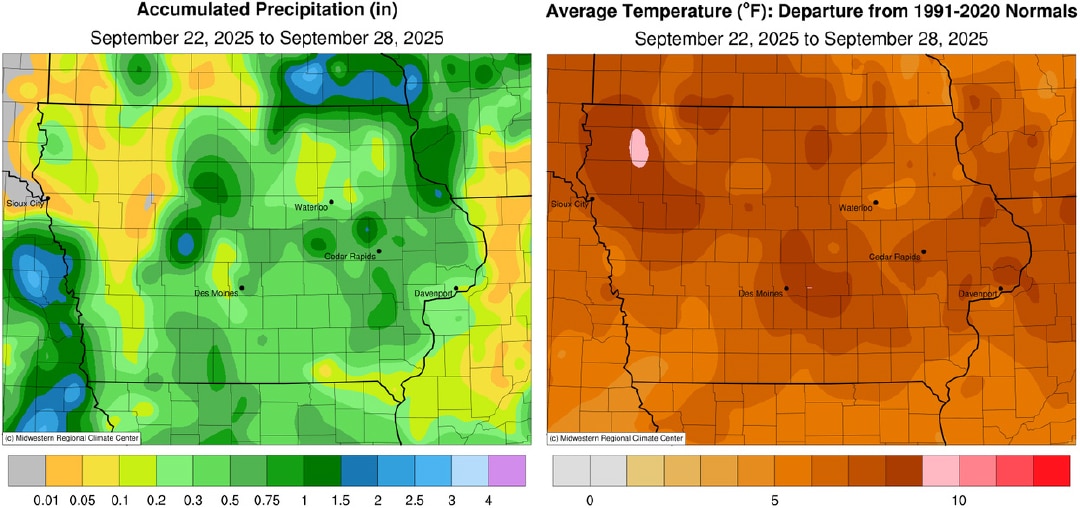
A nearly stationary cut-off low pressure system spun over the Upper Midwest throughout the reporting period, bringing above-normal rainfall to much of Iowa’s western three-quarters. Unseasonal warmth also persisted, with positive departures in the 10- to 12-degree range in eastern and southern Iowa. The statewide average temperature was 71.6 degrees, 8.6 degrees above normal.

Sunday (14ᵗʰ) afternoon was the warmest of the reporting period, with daytime highs in the mid-80s to low 90s under sunny skies; the statewide average high was 90 degrees, 14 degrees above normal. Scattered thunderstorms developed over central Iowa into Monday (15ᵗʰ) morning and continued into northeastern Iowa during the day. Temperatures rebounded into the upper 80s, with some locations in the southeast reaching the 90s. Additional storms formed in eastern Iowa toward evening before dissipating around sunset. Eastern Iowa recorded the highest totals: 1.98 inches in Sigourney (Keokuk County) and 1.99 inches in Mount Auburn (Benton County). Outside of these amounts, a broad swath of 0.25-to-0.75-inch totals extended from east-central to northeast Iowa. Winds shifted southeasterly into Tuesday (16ᵗʰ), bringing mostly clear skies and morning lows in the mid to upper 60s. Pulse thunderstorms developed intermittently throughout the day as the cut-off low pressure system provided energy and instability. With little steering flow, some storms in central and northern Iowa produced locally heavy rainfall and hail. Totals ranged from 2.13 inches in Burt (Kossuth County) to 4.25 inches in Fort Dodge (Webster County). Much of west-central Iowa received at least 0.75 inch, with another pocket of heavier rainfall in northeastern Iowa. Showers and thunderstorms persisted in western and northern Iowa into Wednesday (17ᵗʰ) morning, then shifted into central and eastern Iowa after noon. Temperatures varied widely, from the low 70s northwest to the low 90s southeast. Some storms were severe warned for hail and strong winds. The complex weakened as daytime heating ended, dissipating by nighttime. Four stations reported nearly half of their monthly rainfall in a single day, with totals from 2.01 inches in Carlisle (Warren County) to 2.37 inches in Eagle Grove (Wright County).

Thursday (18ᵗʰ) began with widespread, locally dense fog produced by warm surface temperatures, ample low-level moisture, and light winds. With the existing unsettled pattern, showers and a few thunderstorms continued across much of the state, though many stations reported lighter totals. In Jefferson (Greene County), two gauges measured 1.54 to 2.10 inches, while in Marshalltown (Marshall County), two additional gauges collected 1.30 to 1.39 inches. Many other stations reported between 0.10 and 0.40 inch, and the statewide average was 0.21 inch. Overcast skies persisted into early Friday (19ᵗʰ) as the stubborn low center over the Dakotas streamed showers into Iowa, particularly in the afternoon and evening. Light to moderate rain continued across southern Iowa through the morning of Saturday (20ᵗʰ) and lasted much of the day. Afternoon temperatures were pleasant, in the upper 60s to low 70s, though sunshine was limited. Southeastern Iowa recorded the heaviest rainfall at 7:00 a.m. on Sunday (21ˢᵗ), with amounts ranging from 1.00 inch at Mount Ayr (Ringgold County) to 2.30 inches in Milton (Davis County).

Weekly precipitation totals ranged from 0.02 inch in Fairfield (Jefferson County) to 4.54 inches in Fort Dodge. The statewide weekly average precipitation was 0.90 inch; the normal is 0.83 inch. Donnellson (Lee County) and Washington (Washington County) reported the week’s high temperature of 97 degrees on the 14ᵗʰ, averaging 18 degrees above normal. Spencer Municipal Airport (Clay County) observed the week’s low temperature of 49 degrees on the 21ˢᵗ, one degree above normal.

Iowa Crop Progress and Condition Report — Week of Sept. 15, 2025

Released by the USDA National Agricultural Statistics Service

Iowa Secretary of Agriculture Mike Naig commented on the Iowa Crop Progress and Condition Report released by the USDA National Agricultural Statistics Service. The report is released weekly April through November. Additionally, the Iowa Department of Agriculture and Land Stewardship provides a weather summary each week during this time.

“The warm and dry weather is helping to push Iowa’s corn and soybean crop toward maturity as harvest gets underway across the state. These conditions have also been helpful to farmers who are chopping silage, baling hay, seeding cover crops, and getting equipment and bins ready,” Secretary Naig said. “Looking ahead, forecasts indicate that the warm temperatures will continue this week with rain chances trending back into the picture.”

The weekly report is also available on the USDA’s website at nass.usda.gov.

Crop report

Warm, and continued dry conditions allowed Iowa farmers 6.5 days suitable for fieldwork during the week ending Sept. 14, 2025, according to the USDA, National Agricultural Statistics Service. Field activities included finishing up the third cutting of hay, harvesting corn silage and preparing for row crop harvest.

Topsoil moisture condition rated 4 percent very short, 22 percent short, 65 percent adequate and 9 percent surplus. Subsoil moisture condition rated 2 percent very short, 18 percent short, 71 percent adequate and 9 percent surplus.

Ninety percent of corn was dented or beyond, 5 days ahead of last year and 1 day ahead of the five-year average. Forty-eight percent of corn has matured, 4 days ahead of last year and 3 days ahead of average. Corn condition rated 1 percent very poor, 4 percent poor, 16 percent fair, 59 percent good and 20 percent excellent. Soybeans coloring advanced to 73 percent, 2 days ahead of last year and 1 day ahead of average. Thirty-five percent of soybeans were dropping leaves. Soybean condition rated 1 percent very poor, 4 percent poor, 20 percent fair, 57 percent good and 18 percent excellent.

The third cutting of alfalfa hay reached 96 percent complete. Pasture condition rated 63 percent good to excellent.

Weather summary

Provided by Justin Glisan, Ph.D., State Climatologist, Iowa Department of Agriculture and Land Stewardship

Temperatures were well above average throughout the reporting period, with positive departures on the order of three to six degrees. The statewide average temperature was 69.1 degrees, 4.0 degrees above normal. Unseasonable dryness also continued into the middle of September, with numerous stations reporting no rainfall from central to southeastern Iowa.

Sunday (7th) afternoon was pleasant, with variable winds, mostly sunny skies and temperatures ranging from the mid 60s to the low 70s. Winds shifted to a southerly direction into Monday (8th), with morning lows in the upper 40s and low 50s. Daytime temperatures held in the 70s with partly cloudy skies in western Iowa. Scattered showers moved into southwestern Iowa by daybreak on Tuesday (9th), expanding into northern Iowa through the day. Rainfall totals were generally light, though a few stations reported higher amounts; 0.61 inch was observed in Rock Rapids (Lyon County), while Persia (Harrison County) collected 0.80 inch. Afternoon conditions were cloudy in northern Iowa with highs in the low 70s, while farther south, temperatures were several degrees warmer. Showers continued into the early morning of Wednesday (10th) in northern Iowa, with many locations observing at least 0.50 inch. The highest totals were in north-central to northeast Iowa, ranging from 0.81 inch in Stanley (Buchanan County) to 0.96 inch in Osage (Mitchell County). Daytime conditions were sunny, with temperatures rising into the low 80s under light and variable winds.

Thursday (11th) began a stretch of increasingly warm days, with temperatures rising into the upper 70s in the north to the mid 80s in the south. Skies remained clear into Friday (12th), with southerly winds and highs in the 90s across southeastern Iowa. Scattered showers developed in western Iowa and moved east through the day, leaving very light totals at several stations; Swisher (Johnson County) registered 0.01 inch, while Le Mars collected 0.07 inch. Saturday (13th) morning was unseasonably warm, with lows in the mid to upper 60s at most locations under clear skies. Afternoon conditions were hot, with highs in the mid to upper 90s; the statewide average temperature was 93 degrees, 17 degrees above normal. Patchy fog was reported in eastern Iowa around sunrise on Sunday (14th), with light east to southeasterly winds and temperatures in the mid to upper 60s.

The weekly precipitation totals ranged from no accumulation at many Iowa stations to 1.22 inches in Elma (Howard County). The statewide weekly average precipitation was 0.10 inch, while the climatological normal is 0.85 inch. Davenport (Scott County) reported the week’s highest temperature of 99 degrees on the 13th, 22 degrees above normal. Several stations reported the week’s lowest temperature of 35 degrees on the 8th, on average 16 degrees below normal.

Iowa Crop Progress and Condition Report — Week of Sept. 8, 2025 

Released by the USDA National Agricultural Statistics Service

Iowa Secretary of Agriculture Mike Naig commented on the Iowa Crop Progress and Condition Report released by the USDA National Agricultural Statistics Service. The report is released weekly April through November. Additionally, the Iowa Department of Agriculture and Land Stewardship provides a weather summary each week during this time.

“We’ve heard some initial reports of farmers picking corn this past week in pockets of Iowa. Some early varieties of corn have started to turn quickly due to the dry August,” Secretary Naig said. “This past week’s cooler weather is expected to give way to some mid-September heat, with temperatures likely climbing back into the upper 80s and low 90s by this weekend.”

The weekly report is also available on the USDA’s website at nass.usda.gov.

Crop report

Mostly dry conditions allowed Iowa farmers 6.0 days suitable for fieldwork during the week ending September 7, 2025, according to the USDA, National Agricultural Statistics Service. Disease pressure in row crops remained a concern to producers. Field activities included cutting and baling hay and harvesting corn silage.

Topsoil moisture condition rated 2 percent very short, 13 percent short, 75 percent adequate and 10 percent surplus. Subsoil moisture condition rated 1 percent very short, 9 percent short, 79 percent adequate and 11 percent surplus.

Ninety-seven percent of Iowa’s corn reached the dough stage. Eighty percent of corn was dented or beyond, 5 days ahead of last year, but equal to the five-year average. Twenty-six percent of corn has matured. Corn condition rated 1 percent very poor, 4 percent poor, 15 percent fair, 57 percent good and 23 percent excellent. Soybeans setting pods reached 98 percent. Soybeans coloring advanced to 44 percent, 2 days ahead of last year but 1 day behind average. Eleven percent of the soybeans were dropping leaves. Soybean condition rated 1 percent very poor, 3 percent poor, 20 percent fair, 58 percent good and 18 percent excellent.

The third cutting of alfalfa hay reached 93 percent complete. Pasture condition rated 71 percent good to excellent.

Weather summary

Provided by Justin Glisan, Ph.D., State Climatologist, Iowa Department of Agriculture and Land Stewardship

Unseasonably cool temperatures blanketed Iowa during the first reporting period of September, with negative departures approaching 10 to 12 degrees from southwest to northeast; the statewide average temperature was 59.5 degrees, 8.0 degrees below normal. Dry conditions also persisted across most of Iowa, though stations in the southwest reported unseasonably wet conditions.

Rain continued over southwest Iowa through Sunday (31st) and into Monday (1st) as a nearly stationary low pressure system spun over Nebraska and Kansas. Morning temperatures held in the low 60s under cloud cover, with low 50s reported in eastern Iowa, where skies were clear. Showers finally dissipated by mid-afternoon, with overall rainfall totals confined to western Iowa. Southwestern stations collected the highest amounts, with nearly 15 stations reporting at least 2.00 inches; Pacific Junction (Mills County) registered 2.01 inches, while Mondamin (Harrison County) observed 4.02 inches, nearly a month’s worth of rain. Amounts farther east and north were confined to a few tenths of an inch or less. Tuesday (2nd) began with patchy fog across much of the state and lows in the 50s. Partly cloudy skies continued through the daytime hours as scattered showers and a few thunderstorms developed in northeastern Iowa. Additional showers formed in northwestern Iowa along a cold front after sunset, with stronger thunderstorms firing in central Iowa by daybreak on Wednesday (3rd). Winds shifted northwesterly through the day as the cold front dropped southeast, with scattered showers moving through southern Iowa. The front exited southern Iowa by the evening hours, with widespread event totals across the state. Most stations reporting measurable precipitation observed between 0.20 and 0.40 inch, with the highest amounts ranging from 0.60 inch in Waukee (Dallas County) and 0.78 inch in Lovilia (Monroe County) to 0.94 inch in Charles City (Floyd County). Skies cleared after midnight, with light westerly winds and temperatures dropping into the upper 30s and 40s.

Thursday (4th) was blustery for Iowans, with gusty southwesterly winds, mostly sunny skies, and highs in the upper 60s and low 70s. A fast-moving low-pressure center transiting Minnesota brought showers to northern Iowa later in the evening before moving out of the state by midnight. Most stations reported less than a tenth of an inch, with northwest to north-central stations observing totals ranging from 0.25 inch in Lake Mills (Winnebago County) to 0.50 inch in Le Mars (Plymouth County). Friday (5th) was a windy and unseasonably cool day, with cloudy conditions over northern Iowa and highs in the upper 50s. Skies over southern Iowa were less cloudy, allowing temperatures to reach the mid to upper 60s; the statewide average high was 65 degrees, 14 degrees below normal. Saturday (6th) was a pleasant day for the Cy-Hawk football game at Jack Trice Stadium in Ames (Story County). Game-time temperatures were in the mid-60s under partly cloudy skies and northwesterly winds. Starry skies were visible into Sunday (7th) as winds became light and variable, with lows in the upper 30s and low 40s. The statewide average low was 40 degrees, 15 degrees below normal.

Weekly precipitation totals ranged from no accumulation at several western stations to 4.05 inches in Mondamin. The statewide weekly average precipitation was 0.39 inch, while the climatological normal is 0.86 inch. Washington (Washington County) reported the week’s high temperature of 83 degrees on the 2nd, two degrees above normal. Stanley (Buchanan County) reported the week’s low temperature of 32 degrees on the 7th, which was 19 degrees below normal.

Iowa Crop Progress and Condition Report — Week of Sept. 1, 2025 

Released by the USDA National Agricultural Statistics Service

Iowa Secretary of Agriculture Mike Naig commented on the Iowa Crop Progress and Condition Report released by the USDA National Agricultural Statistics Service. The report is released weekly April through November. Additionally, the Iowa Department of Agriculture and Land Stewardship provides a weather summary each week during this time.

“Iowans enjoyed a gorgeous holiday weekend to wrap up August, with cool and mostly dry weather that was ideal for spending time outdoors,” Secretary Naig said. “As we start September, many farmers will be busy chopping silage and baling hay, while others are beginning to gear up for harvest. Now is also a great time to plan for seeding cover crops and adding other conservation practices to fields after harvest.”

The weekly report is also available on the USDA’s website at nass.usda.gov.

Crop report

With only spotty precipitation, Iowa farmers had 6.3 days suitable for fieldwork during the week ending August 31, 2025, according to the USDA, National Agricultural Statistics Service. Field activities included cutting and baling hay.

Topsoil moisture condition rated 1 percent very short, 9 percent short, 78 percent adequate and 12 percent surplus. Subsoil moisture condition rated 1 percent very short, 7 percent short, 79 percent adequate and 13 percent surplus.

Corn in the dough stage or beyond reached 92 percent this week. Sixty-three percent of the corn crop reached the dent stage or beyond, 2 days ahead of last year, but 2 days behind the five-year average. Nine percent of corn has matured. Corn condition rated 1 percent very poor, 2 percent poor, 13 percent fair, 58 percent good and 26 percent excellent. Soybeans setting pods reached 95 percent. Soybeans coloring or beyond reached 19 percent, 1 day ahead of last year, but 1 day behind average. There were scattered reports of soybeans dropping leaves. Soybean condition rated 1 percent very poor, 3 percent poor, 19 percent fair, 58 percent good and 19 percent excellent. Oat harvest was virtually complete.

The third cutting of alfalfa hay reached 87 percent complete. Pasture condition rated 72 percent good to excellent.

Weather summary

Provided by Justin Glisan, Ph.D., State Climatologist, Iowa Department of Agriculture and Land Stewardship

Iowa experienced cooler and drier weather during the last week of August and of meteorological summer. Small pockets of eastern, central and northwestern Iowa observed slightly above-average rainfall. The coolest conditions occurred in southwest Iowa, where temperatures were six to eight degrees below the climatological average. The statewide average temperature was 65.0 degrees, 6.2 degrees below normal.

Sunday (24th) afternoon remained mostly sunny with gusty northwesterly winds and daytime temperatures in the upper 60s to low 70s. Winds diminished into Monday (25th) morning, shifting to a more westerly direction as lows dropped into the 40s across much of the state. Afternoon conditions were similar to the previous day, with slightly more cloud cover. Starry skies persisted overnight into Tuesday (26th) as winds became light and variable, with morning lows in the 40s. Clouds increased across portions of the state through the afternoon and evening hours, becoming more widespread after sunset. Light rain showers developed during the early morning hours of Wednesday (27th) and continued from north-central to eastern Iowa throughout the day. Much of the state’s northeastern half received measurable rainfall, though all but three stations recorded less than 0.50 inch. Swea City (Kossuth County) collected 0.57 inch, while Lansing (Allamakee County) registered 0.93 inch. Daytime temperatures approached 80 degrees in western Iowa, while conditions were 10 to 15 degrees cooler under cloud cover farther east.

Thursday (28th) dawned with morning lows in the 50s accompanied by patchy fog and clouds. Very isolated showers developed in eastern Iowa, again producing light totals at stations reporting rainfall; Oelwein Municipal Airport (Fayette County) observed 0.20 inch, while 0.62 inch was measured in Lowden (Cedar County). Afternoon temperatures were pleasant, ranging from the upper 70s in northern Iowa to the low 80s in the south. Foggy conditions were reported in eastern Iowa early on Friday (29th), with light easterly winds and temperatures in the upper 50s. A nearly stationary surface boundary draped northwest to southeast aided shower formation through the afternoon and evening hours, with some cells producing persistent rainfall over the same locations. Four stations reported an inch or more, including 4.07 inches in Hopkinton (Delaware County). Additional showers and thunderstorms developed along a narrow line on the existing boundary on Saturday (30th) from central to northwestern Iowa. Several stations reported higher totals, ranging from 0.74 inch in Westfield (Plymouth County) to 2.06 inches in Ames (Story County). A more concentrated shield of rain entered southwest Iowa on Sunday (31st) morning, producing widespread totals of 0.10 to 0.20 inch.

Weekly precipitation totals ranged from no accumulation at western and southern stations to 4.19 inches in Hopkinton. The statewide weekly average precipitation was 0.19 inch, while the climatological normal is 0.88 inch. Iowa Falls (Hardin County) reported the week’s highest temperature of 88 degrees on the 29th, nine degrees above normal. Several stations reported the week’s lowest temperature of 40 degrees on the 25th and 26th, which was on average 17 degrees below normal.

Iowa Crop Progress and Condition Report — Week of Aug. 25, 2025 

Released by the USDA National Agricultural Statistics Service

Iowa Secretary of Agriculture Mike Naig commented on the Iowa Crop Progress and Condition Report released by the USDA National Agricultural Statistics Service. The report is released weekly April through November. Additionally, the Iowa Department of Agriculture and Land Stewardship provides a weather summary each week during this time.

“Farmers across Iowa enjoyed a welcome break from the rain last week along with cooler temperatures and less humidity,” Secretary Naig said. “As we finish out August, the forecast calls for more of the same this week. Looking ahead, initial outlooks are pointing toward a potentially warmer September as harvest approaches.”

The weekly report is also available on the USDA’s website at nass.usda.gov.

Crop report

Iowa had 5.6 days suitable for fieldwork during the week ending Aug. 24, 2025, according to the USDA, National Agricultural Statistics Service. The week started with warm temperatures but closed with much cooler weekend weather. Field activities included harvesting oats and hay. Reports noted increasing levels of disease in field crops.

Topsoil moisture condition rated 1 percent very short, 5 percent short, 74 percent adequate and 20 percent surplus. Subsoil moisture condition rated 1 percent very short, 5 percent short, 77 percent adequate and 17 percent surplus.

Corn in the dough stage reached 88 percent, 1 day behind last year’s pace and 3 days behind normal. Corn in the dent stage reached 45 percent, 1 day ahead of last year, but 1 day behind the five-year average. Corn condition rated 1 percent very poor, 2 percent poor, 13 percent fair, 56 percent good and 28 percent excellent. Ninety percent of soybeans were setting pods, 1 day ahead of last year, but 4 days behind normal. Soybeans coloring reached 8 percent. Soybean condition rated 1 percent very poor, 3 percent poor, 17 percent fair, 59 percent good and 20 percent excellent. At 97 percent, almost all Iowa’s oat for grain crop has been harvested.

The third cutting of alfalfa hay reached 78 percent complete. Pasture condition rated 80 percent good to excellent.

Weather summary

Provided by Justin Glisan, Ph.D., State Climatologist, Iowa Department of Agriculture and Land Stewardship

Early-week rainfall gave way to quieter conditions toward the weekend, with unseasonably high totals at several northeastern Iowa stations. Temperatures remained unseasonably warm for most of the reporting period, though a late-week cold front ushered in cooler and less humid air; the statewide average temperature was 73.0 degrees, 1.3 degrees above normal.

Sunday (17th) afternoon was hot and muggy across southern Iowa, where temperatures rose into the low 90s under sunny skies. Farther north, a stationary front was situated near the Iowa-Minnesota border, with highs in the mid- to upper 80s. This boundary was the forcing mechanism for slow-moving thunderstorms into the evening hours, one of which became severe and produced a weak tornado near Crystal Lake (Winnebago County). A broader complex of showers and thunderstorms formed in northwestern Iowa into Monday (18th) morning and pushed through the state before exiting northeastern Iowa after noon. Flash flood warnings were issued for northeastern counties due to heavy rain. Several stations from north-central to northeast Iowa reported significant rainfall, including 4.15 inches in Fort Atkinson (Winneshiek County), 6.51 inches in Elma (Howard County), and 8.64 inches in Decorah (Winneshiek County), which was the week’s highest amount. Nearly 35 stations recorded totals in the 2.00-to-4.00-inch range, with numerous 1.00-inch amounts in western and northern Iowa. Winds turned to a westerly direction into the afternoon as highs held in the low 80s north to the low 90s south. Clouds remained over northern Iowa through sunrise on Tuesday (19th), with widespread fog and temperatures in the mid 60s to low 70s. Daytime conditions were mostly sunny with light northerly winds and highs in the mid 80s statewide. Wednesday (20th) dawned with partly cloudy conditions, patchy fog and morning temperatures in the mid to upper 60s. Afternoon temperatures warmed by 10–20 degrees, with spotty showers reported southeast; a handful of stations observed a few tenths of an inch, including 0.35 inch at Bellevue Lock and Dam (Jackson County) and 0.43 inch in Wapello (Louisa County). Winds shifted to the east later in the night as starry skies appeared in the cloudless sky.

Thursday (21st) began a stretch of pleasant days as high pressure dominated the Upper Midwest. Daytime temperatures peaked in the upper 70s and low 80s, with a gradually shifting southwesterly wind into the evening hours. Overnight lows became more seasonal – in the upper 50s and low 60s – as clouds dotted portions of Iowa and fog developed at sunrise on Friday (22nd). Winds began shifting to the northwest through the late afternoon as a cold front dropped southeast through the state. Highs remained in the low 70s in northwest Iowa as the front passed, with upper 70s and low 80s elsewhere. Showers and a few thunderstorms formed along the surface boundary through the nighttime hours, with the front fully exiting the state by daybreak on Saturday (23rd). Rainfall was widespread, though very light, with most stations receiving less than 0.20 inch. Sioux City (Woodbury County) reported 1.05 inches from a thunderstorm, while two stations in Dallas Center (Dallas County) measured 0.75 to 0.81 inch from an overnight thundershower. The rest of the day was clear and breezy, with mostly sunny skies and highs in the 70s. The remaining clouds cleared by Sunday (24th) morning, which began chilly with lows in the upper 40s and low 50s.

The lowest reported weekly precipitation total was no accumulation at stations in south-central Iowa. The statewide weekly average precipitation was 0.87 inch, compared with a normal of 0.93 inch. Ames (Story County) reported the week’s highest temperature of 97 degrees on the 17th, 16 degrees above normal. Spencer Municipal Airport (Clay County) recorded the week’s lowest temperature of 45 degrees on the 24th, 13 degrees below normal.

Iowa Crop Progress and Condition Report — Week of Aug. 18, 2025 

Released by the USDA National Agricultural Statistics Service

Iowa Secretary of Agriculture Mike Naig commented on the Iowa Crop Progress and Condition Report released by the USDA National Agricultural Statistics Service. The report is released weekly April through November. Additionally, the Iowa Department of Agriculture and Land Stewardship provides a weather summary each week during this time.

“Warm and muggy conditions didn’t deter visitors from enjoying another successful Iowa State Fair,” Secretary Naig said. “Drier weather in western Iowa broke an eight-week streak of unseasonably wet conditions, and for the first time in over a year, Iowa’s drought map is free of drought and abnormal dryness. The outlook through the end of August suggests cooler temperatures and more seasonal rainfall potential.”

The weekly report is also available on the USDA’s website at nass.usda.gov.

Crop report

Scattered precipitation across the State allowed Iowa’s farmers 5.1 days suitable for fieldwork during the week ending Aug. 17, 2025, according to the USDA, National Agricultural Statistics Service. Field activities included harvesting oats and hay and a few reports of fungicide and insecticide applications.

Topsoil moisture condition rated 0 percent very short, 2 percent short, 72 percent adequate and 26 percent surplus. Subsoil moisture condition rated 0 percent very short, 4 percent short, 73 percent adequate and 23 percent surplus.

Nearly all of Iowa’s corn has reached the silking stage. Corn in the dough stage reached 78 percent, 1 day behind last year’s pace and 3 days behind normal. Corn in the dent stage reached 27 percent, 1 day ahead of last year, but 1 day behind the five-year average. Corn condition rated 1 percent very poor, 2 percent poor, 11 percent fair, 56 percent good and 30 percent excellent. Soybeans blooming reached 96 percent. Eighty-three percent of soybeans were setting pods, 1 day ahead of last year’s pace, but 4 days behind normal. Soybean condition rated 1 percent very poor, 2 percent poor, 15 percent fair, 60 percent good and 22 percent excellent. Ninety-one percent of the oat for grain crop has been harvested.

The third cutting of alfalfa hay reached 65 percent complete. Pasture condition rated 83 percent good to excellent. Frequent rains have kept pastures growing and extended grazing periods. Livestock were generally in good condition, with a few reports of stress caused by heat and humidity.

Weather summary

Provided by Justin Glisan, Ph.D., State Climatologist, Iowa Department of Agriculture and Land Stewardship

While parts of eastern Iowa saw above normal rainfall during the reporting period, this was the first week since mid-June in which statewide precipitation was below normal. Unseasonably warm and muggy conditions also persisted with positive departures in the two-to-four degree range; the statewide average temperature was 74.8 degrees, 2.9 degrees above normal.

Thunderstorms producing moderate to heavy rainfall across eastern Iowa finally exited the state early on Sunday (10th) afternoon. Nearly 20 stations observed at least 2.00 inches from east-central to northeast Iowa; Waterloo (Black Hawk County) collected 2.10 inches while 3.10 inches was reported at Dubuque Lock and Dam (Dubuque County). Daytime temperatures ranged from the low 70s north to low 80s south with lingering showers in western Iowa. Isolated strong storms reformed in eastern Iowa towards evening but fell apart after sunset. Scattered showers and thunderstorms developed in southeastern Iowa through the day on Monday (11th) as afternoon temperatures held in the upper 70s and low 80s. Some storms became severe in extreme southeast Iowa with two weak and short-lived tornadoes observed in Lee County. Rainfall was observed over Iowa’s southeastern one-third with widespread 0.50-1.00 inch totals; the highest amounts were found in a swath from south-central to eastern Iowa with 1.18 inches in Ottumwa (Wapello County) to 2.20 inches in Parnell (Iowa County). Stations farther north and west reported a few tenths of an inch. Patchy fog was reported at daybreak on Tuesday (12th) with lows in the upper 50s northwest to low 70s southeast. Skies remained mostly sunny with afternoon temperatures held in the low 80s as a cold front dropped southeast through the state. Winds shifted northeasterly behind the front with overnight lows dropping into the mid 50s to low 60s west to east. Daytime conditions were pleasant with light winds, lower relative humidity and temperatures in the upper 70s and low 80s.

Winds shifted to a southeasterly direction into Thursday (14th) as scattered showers pushed across parts of Iowa with numerous stations registering a tenth of an inch or less. Winds became blustery through the day as a low pressure center approached the Upper Midwest. Clouds increased into Friday (15th) morning as a small complex of thunderstorms propagated into northwestern Iowa from South Dakota. In the presence of ample moisture and instability, the complex expanded into a severe-warned bow echo and sped across northern Iowa before banking southeast into eastern Iowa by the evening hours. There were several reports along the path of the storms of large hail and wind gusts above 60 mph; 72 mph gusts were observed at La Porte City (Black Hawk County) and East Amana (Iowa County). The strongest part of the line moved out of eastern Iowa by sundown with scattered thunderstorms popping in northeast Iowa. Multiple stations along the swath observed totals above 0.75 inch with two stations in Vinton (Benton County) registering 1.72 to 2.07 inches. Amounts on the periphery were from a few to several tenths of an inch, particularly in northwest, central and eastern Iowa. Saturday (16th) was generally a quiet day, though unseasonably hot with daytime temperatures in the upper 80s and low 90s under bright sunshine. Nearly stationary thunderstorms formed on an existing boundary along the Iowa-Wisconsin border into Sunday (17th) morning. Decorah Municipal Airport (Winneshiek County) observed 1.02 inches while Decorah’s National Weather Service co-op station reported 2.90 inches.

Weekly precipitation totals ranged from no accumulation at a few western Iowa stations to 5.01 inches in Monticello (Jones County). The statewide weekly average precipitation was 0.80 inch, while the normal is 0.93 inch. Guttenberg Lock and Dam (Clayton County) reported the week’s high temperature of 98 degrees on the 17th, 16 degrees above normal. Spencer Municipal Airport (Clay County) reported the week’s low temperature of 53 degrees on the 13th, seven degrees below normal.