Stars and stripes at the lake
DCIM100MEDIADJI_0043.JPG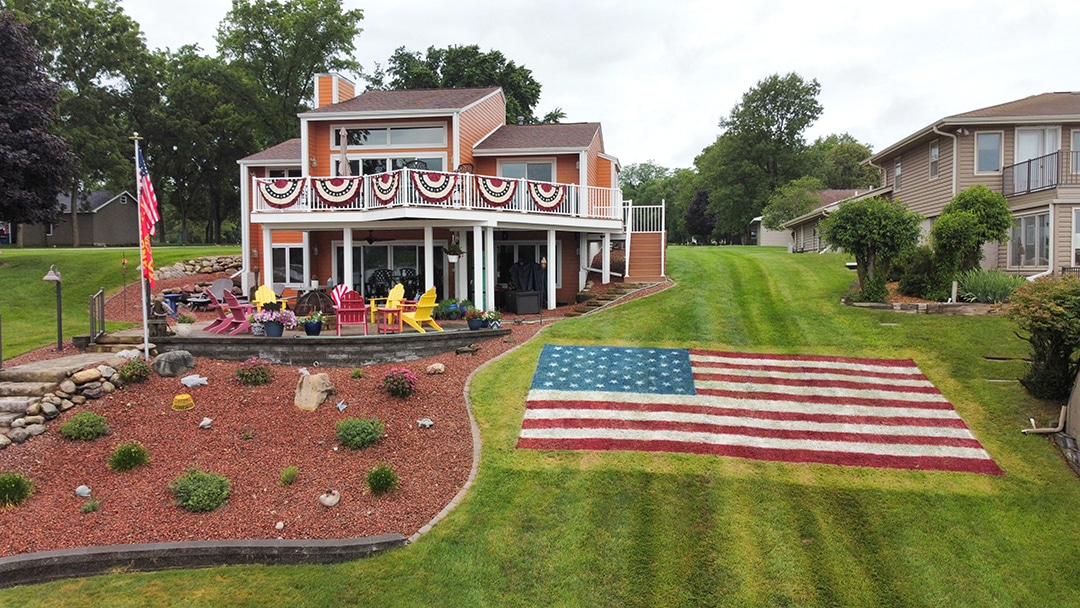
Special to the Times Vedette
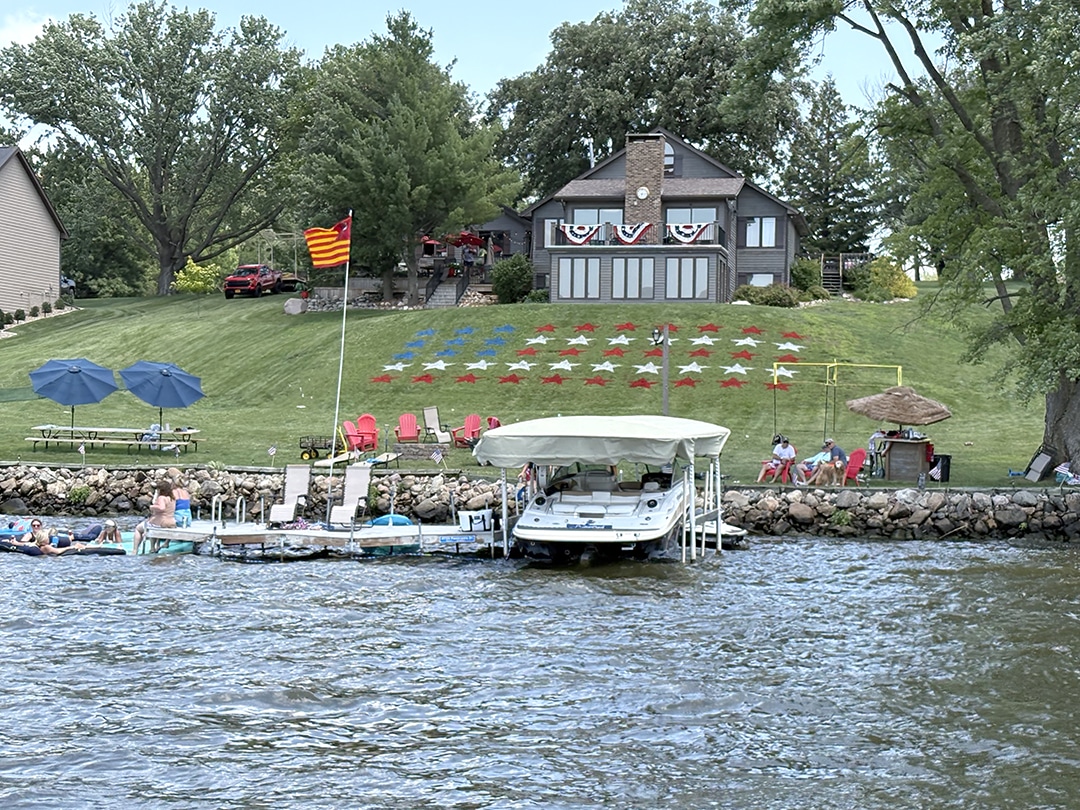
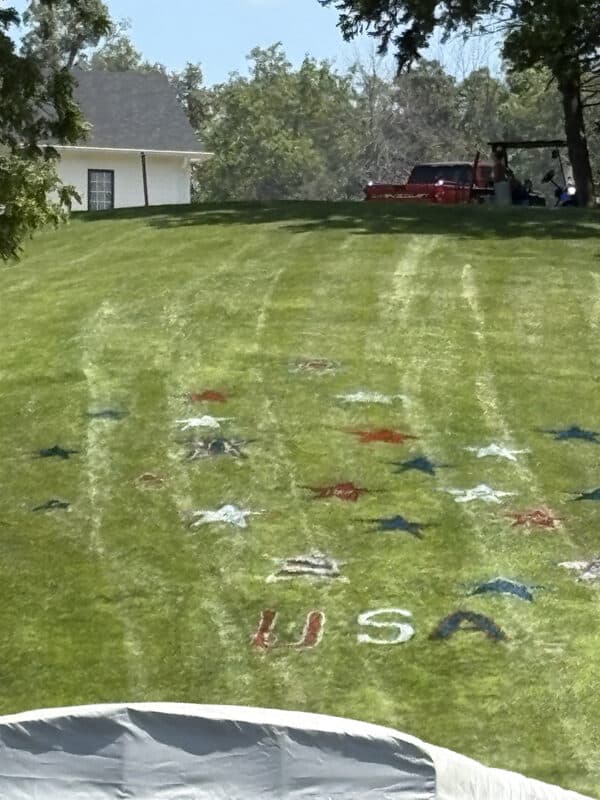
Several Lake Panorama residents showed their patriotic spirit by painting Americana images in their lawns in preparation for the Fourth of July.
DCIM100MEDIADJI_0043.JPG
Special to the Times Vedette
Several Lake Panorama residents showed their patriotic spirit by painting Americana images in their lawns in preparation for the Fourth of July.
Special to the Times Vedette
Despite a day of intermittent rain showers, the Lake Panorama Fireworks show went on as planned — and so did many of the private post-show fireworks off the shores of several property owners on Saturday evening as shown in these videos. Note the lights on the parade of boats returning home after the official show.

Special to the Times Vedette
Doug and Teresa Kent at 914 15th St. in Guthrie Center are the winners of $100 in chamber bucks from the Guthrie Center Lions Club and the Guthrie Center Chamber of Commerce for the Yard of the Month contest for June. These two organizations have teamed up to award citizens who maintain and take pride in their yard with this monthly contest.
By Rich Wicks | Panora Times, June 2025
Barns have been called “cathedrals of the prairie.” That seems a fitting phrase, since, like cathedrals, barns are often the most easily spotted and recognizable features on the horizon for travelers through rural Iowa. And for the families that live and work on Iowa farms, the family barn means much more than just a structure to which the cows come home.
Barns have long been an iconic image of Iowa. In recent decades, the number of family farms statewide has decreased, and barns have also become less prevalent. But in Guthrie County, many barns have stood the test of time. Some have been repurposed, while others have been refurbished to continue housing livestock, hay bales, and other farm necessities.
Here are the stories of some notable local barns and the families that cherish them.
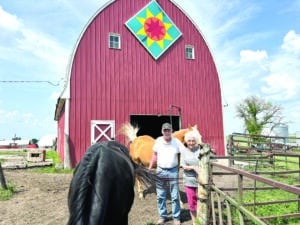
Marvin and Judi Smith are proud of their barn.
Marvin and Judi Smith’s property and barn in rural Panora have some interesting history. Judi explained.
“Actually, this property was Milo Yale’s. He gave all the land that became the town of Yale. There used to be a big, square, three-story house here,” Judi said. “When Marvin bought this place in 1972, he could see that it was going to be a money pit, so he tore it down and built this house.”
The story of the barn is a story of changes. Marvin said he recalls when the barn was built.
“I believe the barn was built in 1950, because I remember when they built it; I graduated in 1954, and they were building it a few years before that,” Marvin said. “We’ve lived here since 1972. We’ve always had horses and ridden horses. We used it as a corn crib for a while. It used to sit a little further north, but I converted it to shelled corn for several years. I filled both sides with shelled corn. We had about 14,000 bushels of corn in there.”
When the government program changed, using the building in that way no longer made financial sense, so Marvin came up with a new idea.
“We didn’t want to have to tear it down, and we weren’t going to use it for a corn crib anymore. It’s worked out really nice for a barn,” Marvin said. “Now we have a head gate in there, and we can run cattle in there and work them.”
Marvin recalled the process of moving the one-time corn crib and turning it into a barn.
“We moved it up here for a barn. I’d say that was in the late 1980s,” Marvin said.
“Well, first I ran the foundation. Then I had the guy from Perry come, and he just loaded it up and pulled it up there and set it on the foundation, and it’s been there ever since. Hopefully, it doesn’t blow away.”
Eventually, the couple decided they wanted their small barn to look more like a traditional barn. Judi took on the challenge of creating a barn quilt on the building. She started looking for a pattern she liked.
“I saw ours on a calendar. It was called the “Star of the East,” and since it was going to be on the east side of our house, and I liked the colors, that’s how I came up with that,” Judi said.
About 15 years ago, Judi painted the original barn quilt pattern herself.
“We had a guy come out with a cherry picker and put it up there, along with a cupola, and I had bought a horse weathervane, so we put that up there,” she said. “That made it look like a barn instead of a corn crib.”
The barn quilt is 8 feet by 8 feet, and it was repainted by a crew last summer.
The Smiths are happy with how their small barn functions and with its appearance, too.
“Now we just use it for horse stables, mostly, and I’ve got a tack room in there. So, when we saddle up the horses, we bring them in through there into the tack room and throw the saddle on,” Marvin said.
He added how others seem to agree that the barn is pleasing to the eye.
“When people stop out on the road to take pictures, I don’t know if it’s because of the quilt block or because of the barn,” Marvin said.
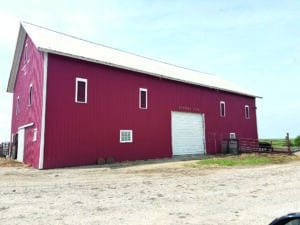
Dave and Sheila Deardorff’s home is a century farm with an historic barn.
The barn of Dave and Sheila Deardorff, rural Yale, is one of the most historic in the county. Not only did the barn have a notable beginning, but it is still in use today to house the many cattle on the farm.
In 1889, Mahlon and Sarah Deardorff moved from Illinois to a farm in rural Yale in Cass Township. The farm previously had been the Reuben Reaver farm and consisted of 267 acres. In 1892, the Deardorffs had a new barn built. As was common at the time, a large crew of men helped build the new barn. The workers must have been skilled carpenters, since the barn is still in use today. Reportedly, after the barn was completed, the 70 men were treated to a well-deserved dinner, followed by cigars and lemonade.
The farm has been in the Deardorff family ever since. Mahlon and Sarah’s son, Russell, and his wife, Mary, owned the farm, followed by their son, Orville, and his wife, Marjorie. Dave and Sheila Deardorff now own the farm.
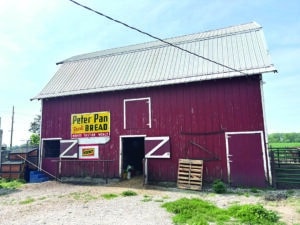
An old sign adorns the barn at Megan Smith’s home.
At 1075 Highway 4 in rural Bagley, Megan Smith and her family live on a farm with a traditional Iowa barn.
“It was built in 1904, but I don’t know much else about its history,” Smith said.
The barn is still used for housing livestock.
“I’ve lived here all my life,” Smith said. “We had used it for draft horses, but then we converted it, and now we use it for horses and my daughter’s show calves.”
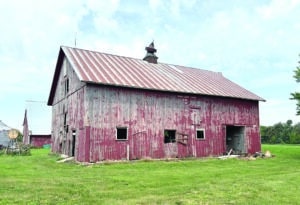
Signage on the Willey’s barn says “Woodland Farm 1934”
For Gladys Willey of rural Yale, the family farm, and especially the barn, is a tangible reminder of her family’s history. Although the two large barns on her property no longer house any farm animals, the buildings are home to a lifetime of family memories.
“My grandparents, Arthur and Femmie Wood, came to live here in 1934. They had lost their farm in Orient, Iowa. They went 28 miles the first day and stayed at Stuart. Then they came the last 20 miles the next day, with horses tied onto their wagons,” Gladys said. “They raised horses and angus cattle. The barn was already here when they came. They kept their draft horses and cattle in there.”
Since then, the farmstead has stayed in the family.
“My parents, Lloyd and Delores Chaloupka, bought it in 1965. I was in fourth grade, maybe,” Gladys said. “They lived here until 1981, and at that time, my husband, Norman, and I moved here. After my mother passed away, we sold the farmland but kept the acreage.”
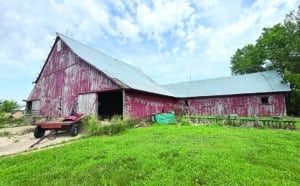
The western barn on the Willey’s property is weathered but structurally sound.
Norman and Gladys are now retired, and the barns on the property are no longer used regularly.
“About three years ago, we had a family reunion here, and everybody came out and looked at the barns,” Gladys said. “They’ve been unused for about 20 years.”
Looking back, she recalled a childhood memory at the farm.
“I remember one story after we had moved here. One of my sisters had graduated. One was a senior, and my brother was a junior. Dad sold the milk cows because he didn’t have enough kids around to do the milking anymore,” Gladys said. “The other kids told me I was spoiled because I was the baby and I didn’t have to milk cows.”
She also recalled how the barn offered kids plenty of chances for fun.
“We used to play in the haymow. That east barn had a pretty nice haymow,” Gladys said. “There were always kittens to find up there, too, because the cats would have them up there to hide them.”
Looking to the future, Gladys knows the barns are continuing to age, but she has no plans to fix them in the foreseeable future.
“I’d like to have the money to restore them, but I don’t think that’s in the cards,” she said.

Eric Morris’ business is ready to make your vehicle shine.
By Rich Wicks | Guthrie Center Times, June 2025
Soap and water are the basic elements of most cleaning, and, at first glance, Eric Morris’ business is not much more complex than that. He owns and operates The Washing Machine carwash in Guthrie Center, as well as carwashes in other local communities.
“Carwashes just come down to very simple things: soap, pressure, the soft water for the spot-free rinse. Other than that, there’s really not a lot to them,” Morris said. “This one was ‘The Washing Machine’ when we bought it and has been since it opened. So, we didn’t change the name; everybody already knows what it is. We have owned this one since 2019.”

The Washing Machine is located on Highway 44 west across from Café on the Hill.
Morris recalled that he had not intended to buy a carwash in Guthrie Center, but when the opportunity arose, it felt right.
“We just got into it by accident,” Morris said. “My friend owned it. His dad had unfortunately passed, and they were selling it, and it just came up organically in conversation.”
Morris also owns car washes in Adair, Anita and Stuart. He has learned about the seasonality of the business.
“When my friend owned this place, he said, ‘You survive the summer; you thrive in the winter,’ ” Morris said. “That’s true, but lately our winters have had very cold snaps for a couple of weeks at a time. When the high for the day is less than double digits, we just close.”
Morris explained why winter is his busiest season.
“In the winter, when the brine is on the cars, people want to get that off. That helps us,” Morris said. “Spring and fall are good, but the dry months — July and August — we don’t do much.”
However, Morris explained that the dry summer weather brings an additional concern for car owners. Morris said that, although people quickly notice when a car begins to look dirty or dusty, the undercarriage isn’t so easy to see. He added how vehicles that frequently travel on gravel roads will quickly accumulate lots of dust and debris underneath the vehicle, and the undercarriage wash is perfectly designed to deal with that unseen issue.
Although soap and water are the foundation of any carwash, Morris admits there is more to his operations. Much of his work involves keeping the equipment in working order.
“A lot of people just wash their car but don’t see anything beyond the spraying water and soap. They don’t see all the moving parts, and how many things can go wrong, and how much it costs to fix all the moving parts,” Morris said. “Technology is making big differences. If you looked at my carwashes in Adair and Anita, they are much older machines. I can work on them a lot easier, but the newer technology makes things a little smoother and a little more efficient.”
Morris lives in Panora with his wife, Jenna, and son, Keaton. He says he has no plans to expand his business in the near future. Keeping four carwashes going provides plenty to keep him busy. He shared the story about an incident that closed The Washing Machine for 42 days earlier this spring.
“The snowstorm in March, that’s what took out our coinbox. It had a vent on the back for letting out the heat, and that got full of snow, and it was outdated anyway,” Morris said. “Now it has a new electronic control system. This new one has cellular backup, so even if our internet goes down, we can still run credit cards and still do everything.”
Morris encourages customers to read and follow posted instructions at the carwash, including to fold in mirrors (if possible), remove extended trailer hitches, remove loose items from truck beds, and note the height and width limits. The Washing Machine can accommodate vehicles up to 90 inches in height (7.5 feet).
Although Morris encourages drivers to come through The Washing Machine often, he admits sometimes a vehicle needs the manual attention that only a handwash can provide.
“It’s still good to handwash a car at least once a year,” Morris said.
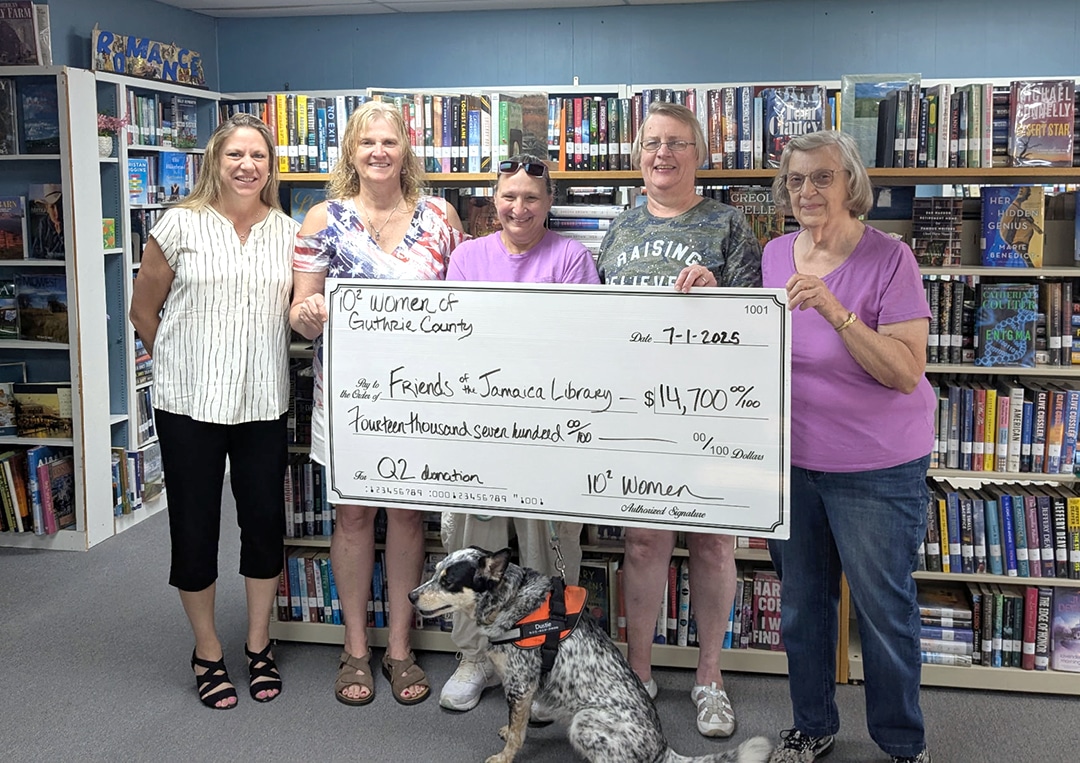
Kristen Crouthamel (Ten Squared Women), Carla Hilgenberg, Laurie Carnahan, Deb Louk and Karen Onken were on hand for the check presentation, along with Dustie the dog.
By Rich Wicks | Times Vedette
The Ten Squared Women of Guthrie County group presented its second quarterly donation of 2025, giving $14,700 to Friends of the Jamaica Library. This amount includes member donations and several employer matches.
The Jamaica Public Library, founded in 1948, holds a special place in the county — not only as a public library for the community of Jamaica but also as the longtime home of the Guthrie County Genealogical Society. For more than 40 years, the society has helped countless individuals across the county and the country trace their family histories.
The Friends of the Jamaica Public Library was officially established in the summer of 2024 and is now recognized as a 501(c)(3) organization. A recent membership drive brought more than 50 members into the Friends organization. The group is led by a five-member board, working closely with Library Director Laurie Carnahan and the library board.
“The library board, Library Director Laurie Carnahan, and the Friends of the Jamaica Library are beyond excited and thankful,” Friends board member Carla Hilgenberg said. “With this wonderful gift, we’ll be able to help the library upgrade its technology and increase programs and services.”
As part of its support, the Friends group will provide prizes and snacks for the Library’s summer reading program. The group will also sponsor a special event featuring Fonziba Drums on Thursday, July 31 at 5 p.m. at the Jamaica Community Center. All are welcome to this free, interactive program, which will give attendees the opportunity to learn and play Djembe drums.
To make a donation to the Friends of the Jamaica Public Library, or to inquire about volunteering, contact Hilgenberg at 563-212-0945.
The Jamaica Public Library is located at 316 Main St., Jamaica. For more information, call 641-429-3362.