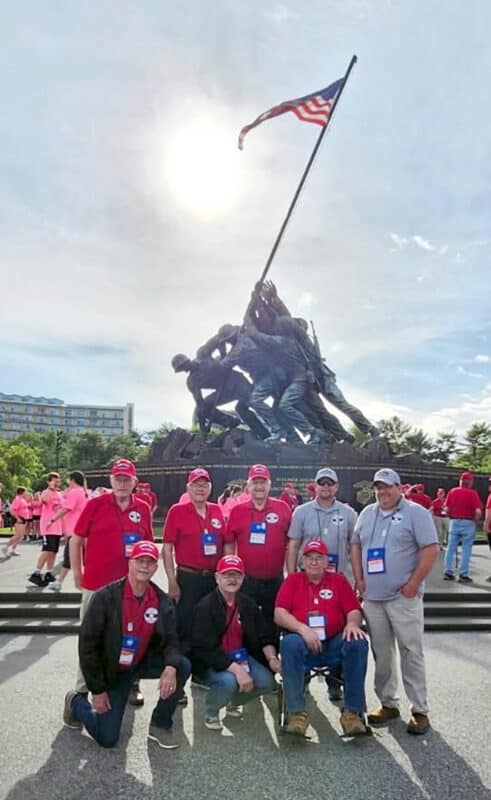
Brushy Creek Area Honor Flight takes place May 7

Special to the Times Vedette

The 26th Brushy Creek Area Honor Flight was held May 7 and was sponsored by Guthrie County American Legions/Sal Posts: Panora 372, Guthrie Center 124, Stuart 146 and Menlo 511. The flight is part of the Honor Flight Network, which transports approximately 22,500 veterans annually. More than 300,000 veterans have taken these one-day flights to Washington, D.C., since the first flight.

Honor Flight Network is a national nonprofit organization comprised of independent hubs working together to celebrate America’s veterans. While initially focused on America’s World War II veterans, Honor Flight Network expanded to include those who served during the Korean War and the Vietnam War.

Veterans boarded a plane at the Fort Dodge Regional Airport that took them to Dulles Airport in Washington, D. C., where they visited the nation’s capital to visit their memorials. 

Pictured are, back row: Rick Buttler, Daryl Dinkla, Dwight Dinkla, Jalen Spack and Bill Messinger. Front row: Craig Hiatt, Tom Francis and Arnold Kesselring.

GCH presents DAISY and Sunshine awards 

Chris Stipe, Shannon Haus, Lori Harrah, and Sandy Atkinson pose following the DAISY award presentation.

By Rich Wicks | Times Vedette

On Tuesday, May 6, Guthrie County Hospital held its annual DAISY and Sunshine awards, honoring nurses and patient care technicians (PCT). CEO Chris Stipe offered opening remarks and spoke of pioneering nurses Clara Barton and Florence Nightingale. Chief Nursing Officer Sandy Atkinson read aloud the nominations for each nominee.

LaRoyce Kress was announced as winner of the Sunshine award, given each year to an outstanding PCT. Shannon Haus won the DAISY award for nurses. Other nominees for the DAISY award included Kassie Cline, Jenna Deist, Nicole Esslinger, Jentry Hise and Dale Peterson.

Chris Stipe, Lori Harrah, LaRoyce Kress, and Sandy Atkinson following the announcement of Kress for the Sunshine award.


Volunteer to help with brush management at Whiterock Conservancy

Special to the Times Vedette 

Team up with Whiterock Conservancy as they continue restoration efforts on Saturday, May 17, from 9:30 a.m. to noon. Meet at Betts Shop, 1221 Fig Ave., Coon Rapids.

Volunteers will be clearing a remnant prairie of invasive brush to create a heathier, more diverse landscape. Do you have similar restoration projects you are working on or thinking about? Bring questions and learn about the work Whiterock has done and the many different management tools that have been used over the years.

Work may include navigating rough terrain, using loppers to cut brush, piling brush and treating cut stumps. Wear close-toed shoes, pants and long sleeves and bring personal protective equipment (PPE) if you have it. Whiterock can provide basic PPE if needed; this would include gloves and eye and ear protection.

All volunteers will be required to sign a waiver upon arrival. RSVP is required to Tyler Bruck by phone at 712-790-8221 ext. 6 or by email at tbruck@whiterockconservancy.org. There will be pizza and refreshments to end the day. Contact Tyler with any questions or for more information.

Pool season is nearly here

By Rich Wicks | Times Vedette

The Guthrie Center Aquatic Center is tentatively set to open May 23. As of now, the weather forecast looks to cooperate with that plan, but any changes will be noted on the Guthrie Center Aquatic Complex’s Facebook page.  

Admission pricing for the pool this year is: Daily pass ($5), Family season pass ($160), and Single season pass ($90).

The hours will slightly change this year with the pool open daily noon to 5 p.m. and 6-8 p.m. There may be schedule changes due to home swim meets. Swim lessons will likely be offered, but details are not yet known.

Check the Facebook page for any updates, changes, cancellations, etc.

Peak camping season kicks off this month

From the Iowa Department of Natural Resources

Iowa state parks and forest staff are busy preparing for the summer camping season, turning on water, sprucing up campgrounds and freshening up bathroom, cabin, lodge and shelter facilities. With more than 759,000 campers and more than 13.5 million visitor days last year, state parks are anticipating another busy season.

Recently renovated and 100 percent reservable sites

More state parks are offering real-time availability and ability to make online reservations for 100 percent of their campground sites. In 2025, Backbone, Geode, Lake Macbride, Palisades-Kepler and Rock Creek state parks transitioned to 100-percent reservable at iowastateparks.reserveamerica.com

Additionally, several state parks are showcasing new or renovated amenities:

  • Red Haw – campground renovation and playground scheduled to be completed by July 1, 2025
  • Viking Lake – new campground playground
  • Wildcat Den – shelter and sidewalk renovations
  • Lake Manawa – concession building remodel
  • McIntosh Woods – fish cleaning station replacement
  • Fort Atkinson – restoration of historic buildings
  • Big Creek – accessible fishing pier

Current construction and renovation projects

Several state parks also are busy with new construction projects during the 2025 season. Projects include:

  • Clear Lake – lodge/shower buildings/beach restroom renovations are being designed and will go out for bid this year. The campground is undergoing renovations and is closed to reservations, with a portion re-opening in June 2025.
  • Lake Kemoah – lake restoration, lodge window and pedestrian bridge replacement
  • Lake Ahquabi – lodge and shelter renovations
  • Lewis and Clark – visitor center repairs and renovations
  • Brushy Creek – campground renovations. A closure is in place for the entire recreation season, but walk-ins are being accepted now in the South and Beach campgrounds until a timeline on construction is available. The North campground will remain closed all year.
  • Ledges – new shower building and shelter renovation
  • Pine Lake – boat ramp repairs
  • Lake MacBride – kayak launch and accessible parking

To learn more about Iowa state parks, go to iowadnr.gov/stateparks or make a reservation at https://iowastateparks.reserveamerica.com.

Leave wildlife babies where they belong — in the wild

From the Iowa Department of Natural Resources

It’s as predictable as May flowers. From border to border, the Wildlife Baby Season has arrived in Iowa. From now until at least mid-June, DNR field offices across the state will be inundated with hundreds of phone calls and scores of deliveries regarding “orphaned wildlife.”

Most calls begin with something like, “We were walking in the park when…,” or “I looked out my window and saw…” In nearly every instance, the scenario ends with something [or several somethings] being rescued from their mother.

During a typical season, the species people call about will range all the way from baby robins and squirrels to spindly-legged white-tailed fawns. At this time of the year it is not at all uncommon for biologists to discover that complete litters of baby raccoons, foxes, or even skunks have mysteriously appeared on their doorsteps.

Why this happens is no real mystery. From fuzzy yellow ducklings to tiny baby bunnies, nothing appears more cute and cuddly than a wildlife baby. But in reality, most of the wildlife reported to DNR field offices are not really orphaned at all. And while the people who attempt to “rescue” these babies have the best of intentions, they are in fact dooming the very creatures they intend to help.

The babies of most wildlife species leave their nests or dens well in advance of being able to care for themselves. Although broods or litters may become widely scattered during this fledgling period, they still remain under the direct care and feeding of their parents.

For many songbirds, the transition to independence comes quickly and may take as little as four or five days. For other species such as Canada geese, kestrels, or great horned owls, the young and parents may stay in contact for weeks — even months.

At the beginning of the fledgling period, young birds appear clumsy, dull-witted, and vulnerable. The reason for this is because they really are clumsy, dull-witted, and vulnerable. But as the education process continues, the survivors smarten up fast, while slow learners quickly fade from the scene. Most birds have less than a 20% chance of surviving their first year. While this seems unfortunate or cruel, this is a normal occurrence in nature. In the real out-of-doors, it’s just the way things are.

Most mammals employ a slightly different strategy when it comes to caring for their adolescents. Since most mammals are largely nocturnal, the mother usually finds a safe daytime hideout for her young while she sleeps or looks for food. Consequently, it is perfectly normal for the young to be alone or unattended during the daylight hours.

Nevertheless, whenever a newborn fawn or a nest full of baby cottontails or raccoons is discovered by a human, it quite often is assumed that the animals are orphaned. The youngster’s fate is usually sealed when it is promptly “rescued from the wild.”

Many wildlife babies die soon after capture from the stress of being handled, talked to, and placed into the unfamiliar surroundings of a slick sided cardboard box. Should the animal have the misfortune of surviving this trauma, they often succumb more slowly to starvation from improper nourishment, pneumonia, or other human caused sicknesses.

Whether they are adults or young, all species of wildlife have highly specific needs for survival. “Rescuing a baby from its mother” not only shows bad judgment, it also is illegal.

Observing wildlife in its natural habitat is always a unique privilege.  Taking a good photo or two provides an even more lasting memory. But once you’ve done that, let well enough alone. Leave wildlife babies where they belong — in the wild.

A list of wildlife rehabilitators is available online at https://www.iowadnr.gov/programs-services/wildlife-rehabilitation.