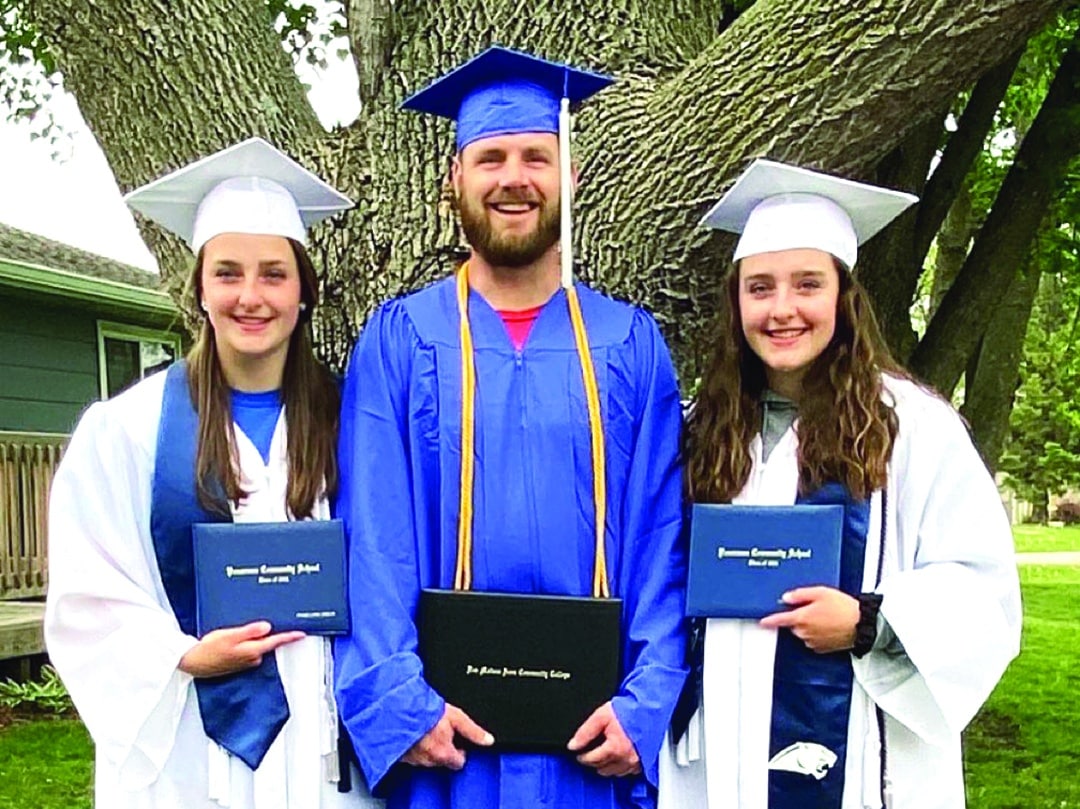
Audrey and Paige Cmelik with their dad, Chris Cmelik, at graduation.
Multiple birth siblings form special bonds
By Rich Wicks | Panora Times, April 2025
Over the years, many TV shows and movies have used twins as a theme for comedy, drama or both. Twins were featured in TV commercials as part of Doublemint Gum’s “Twins” campaign, which ran from the 1950s into the 1990s. The jingle included the lyrics, “Double your pleasure, double your fun.”
But do families that include twins view the situation as “double the fun” or as “double the trouble”? The short answer is, yes.
The rate of multiple births (twins, triplets, etc.) in the U.S. has increased significantly in recent decades. In the early 1980s, the rate was around 20 multiple births per 1,000 live births. By the year 2000, that had climbed to more than 30, and since then it has hovered in the 30 to 35 range.
Experts say the change is partly because of the increased use of assisted reproductive technologies such as in vitro fertilization, when multiple eggs are fertilized and implanted. Also, the average maternal age has increased, and, on average, older women are more likely to use assisted reproductive technologies than younger women.
Locally, examples of multiple births abound, sometimes with surprising frequency. For example, the Panorama graduating class of 2021 included four sets of twins (Audrey and Paige Cmelik; Gwen and Olivia Steffen; Drew and Evan Taylor; and Domonic and Preston Walker).
Below, a few local families share their experiences with twins (or more).
Audrey and Paige Cmelik
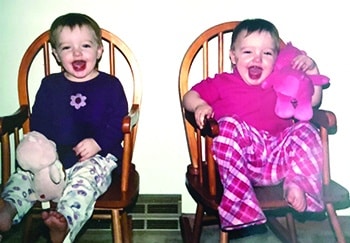
Paige and Audrey Cmelik in their early years.
Audrey and Paige Cmelik and their classmates in the Panorama class of 2021 are statistically unusual for the frequency of twins.
“I believe there were 82 graduates in our class, and we had four sets of twins. We’re all identical twins,” Audrey said.
How those four families ended up “rolling doubles” is anyone’s guess. In most cases, twins are a surprise, and that is true of the Cmeliks, who have no known instances of twins in the family tree. But, Audrey would not have it any other way.
“After we graduated, I started to fully realize the effect of having a twin sister, because we always enjoyed the same sports and activities, so we always had that connection,” Audrey said. “And even something as simple as going to grab groceries, we’d usually go together. So, she was my best friend that I always had growing up.”
Paige agreed that having a twin is something she only fully appreciated after graduation.

Paige and Audrey Cmeilk show their twin catches.
“We always had someone to do something with, and we never really knew what it was like to be alone until we became adults,” Paige said.
Although some twins develop a unique lingo, Audrey does not recall that happening between Paige and herself.
“I wouldn’t say a language, but we would mimic each other’s actions, and that seemed to continue throughout our childhood,” Audrey said.
Whether identical or not, most twins attempt to switch identities briefly on occasion. In the case of the Cmeliks, the girls’ skills of mimicry and deception apparently improved over time.
Paige recalled the first time the two tried tricking their teachers.
“When we were younger, our mom would dress us up in specific colors to make it easier for people to tell us apart. But Audrey and I had gotten the hang of it when we were in elementary school, so sometimes we tried changing it around,” Paige said. “We had two teachers that were husband and wife, and we tried to fool them sometimes, but they would figure it out and have us go back to the right room.”
But as the saying goes, practice makes perfect. Years later, the girls were able to pull off the trick.
“We had to do it once while we were in high school. I believe we were sophomores,” Audrey said. “We went into the restroom and swapped clothes before first period, and then we just went about our day as if we were each other.”
Audrey recalled that some of their best friends realized the switcheroo but kept the secret under wraps. She added that none of the teachers noticed the change.
“The teachers called us the wrong names the entire school day,” Paige said. “And it was amusing to see our friends’ looks when they caught on.”
For Audrey, the best part of having a twin is that she always had a best friend nearby, but it wasn’t always a joy. Audrey recalled that, in her childhood, there were times she tired of “always having to share everything,” including a room, a birthday, and even a cell phone for a while.
But, overall, the girls agree they are thankful for being twins.
“We always had a little sense of competition,” Audrey said. “I think that helped give us the drive that we have now.”
Knox and Lenox Matthies
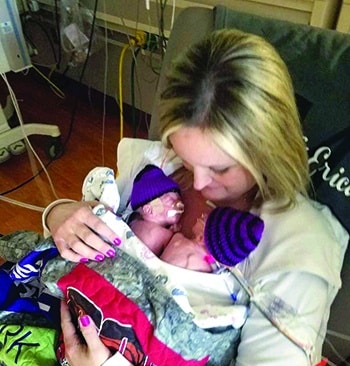
Erica Matthies holds her twin girls.
John and Erica Matthies were hoping for a baby but ended up with two. The girls are named Knox and Lenox and are now 6 years old. Erica described how the situation unfolded.
“We found out really early, because we were about to start with MidIowa Fertility. We had been trying. The doctor told us not to wait the whole year but to try for six months, and if nothing happened, to come in. So we were starting that process, and I happened to be pregnant,” Matthies said. “I was scheduled to go in with MidIowa on May 9, and on Cinco de Mayo (May 5) I went and took a test, and I was pregnant.”
Matthies said she decided to keep an ultrasound appointment that was already scheduled with MidIowa, and that allowed her and husband, John, to see the first sign of twins much earlier than most parents can.
“They were only like four to six weeks, and they could see that there were two,” she said.
Mattheis recalled that, after many months of trying for a pregnancy, the sudden news of two babies on board was a whirlwind of emotion.
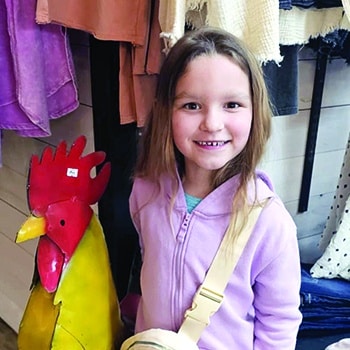
Lenox Matthies is all smiles.
“It was a mixture of laughing and crying, because a lot was happening all at once,” Matthies said. “That changes things real fast.”
Matthies said neither she nor her husband have any known family history of twins. She also explained that Knox and Lenox are considered “mono-mono” twins, which is a type of identical twins.
“One percent of twins are born this way,” Matthies said. “It’s when one egg gets fertilized and splits.”
Matthies explained that, with mono-mono twins, significant medical concern can occur if the babies are born prior to 24 weeks.
“With mono-mono, they say your first goal is to make it to 24 weeks. A regular pregnancy is 40 weeks,” Matthies said. “I went in for inpatient as late as I could — at 27 weeks — because, mentally, being stuck in a hospital bed, it’s a lot.”
The twins were born at 29 weeks and two days. When the moment finally arrived, things sped up.
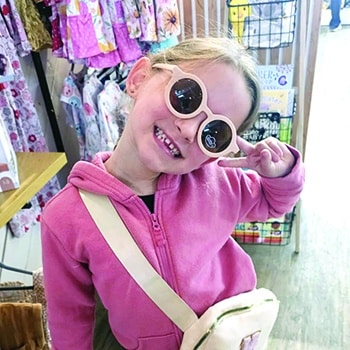
Knox Matthies shows her style.
“It went fast. Knox was 1 pound, 13 ounces, and Lenox was 2 pounds, 1 ounce,” Matthies said.
Because of the early arrival and small size of the twins, they were in an incubator until they were ready to go home.
Matthies noted that, although she knows each girl will reach various developmental milestones individually, she finds it tough not to compare them if/when one lags behind the other.
Also, despite Knox and Lenox being identical twins, Matthies has definitely noticed individual differences in personality and behavior.
“I have one that’s a little more tender-hearted,” Matthies said. “I have one that, in social settings, is going to hang back next to mom, while the other one goes up and makes friends with anybody.”
Matthies shared that she enjoys seeing the girls learn things quickly as they explore their world.
“When they catch on to things, it’s fun to watch that growth,” she said.
Twins learn early on that they can pretend to be each other, and Matthies recalled that happening on the first day of 3-year-old preschool. But she found a solution to avoid mistaken identity.
“For their birthday, we went and got their ears pierced, and one has pink earrings, and one has purple,” Matthies said.
But, overall, the girls remain similar.
“They just love being outdoors, swimming, being at the park. That’s just kind of their jam,” Matthies said.
Matthies admits that twins can be a challenge, but she takes it in stride.
“I always say, ‘My hands are full, but my heart’s even fuller,’ ” she said.
Kenny McCaughey
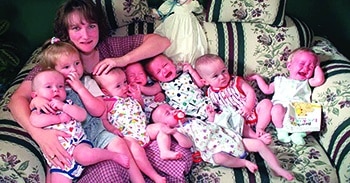
Bobbi McCaughey with Mikayla and the septuplets.
Having a twin is a joy, and, at times, a challenge. But, what if, instead of one twin, you had six? That is the situation Kenny McCaughey of rural Bagley grew up in. He is one of the “McCaughey seven” from Carlisle who became famous as the world’s first surviving septuplets.
The McCaughey septuplets were born at Blank Children’s Hospital in Des Moines, on Nov. 19, 1997, to Bobbi and Kenny McCaughey. The babies were named Kenny, Alexis, Natalie, Kelsey, Nathan, Brandon and Joel. The family already had a 1-year-old daughter, Mikayla.
Kenny was the first-born of the septuplets, emerging at 12:48 p.m. The seven siblings were born at a speedy rate of one per minute from 12:48 to 12:54 p.m. So, if you ever feel rushed or overworked, just imagine Bobbi McCaughey delivering seven babies in a seven-minute span.

Kenny (holding Kenny the fifth) and Thia McCaughey (holding Missie).
The septuplets each weighed between 2 pounds, 5 ounces and 3 pounds, 4 ounces. Kenny was not only the “oldest” of the seven but also the largest at birth. Despite this, he claims he never held his “big brother” status over the other six because they all had their big sister Mikayla to look up to.
“We have an older sister, so she was more like the boss when our parents were gone,” Kenny said.
As the septuplets grew from babies to toddlers to school kids, the family continued to be the focus of much media attention.
“I think, as kids, we liked the attention,” Kenny said. “A lot of times, the journalists would bring us gifts and stuff.”
Kenny and his siblings grew up accepting the fact that they were the center of media attention. They adjusted to the feeling of living inside a fish bowl. Kenny reported that, when his parents had an “open house” for their newly-built house in 1998, an estimated 3,000 people came to walk through the home.
“It was Iowa’s biggest open house at that time,” Kenny said. “We lived in Carlisle until we were 19 or 20, when our parents sold the house.”
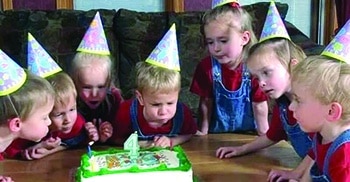
Kenny McCaughey (center) had plenty of help to blow out birthday candles.
“The one question everybody asks that’s hard to answer is, ‘What is it like to have seven brothers and sisters?’ because we grew up with it,” Kenny said. “It was all we knew.”
The media attention was nearly constant when the seven were born. As the kids grew, the media coverage, although intermittent, continued. When the kids turned 18 and graduated from high school, the hoopla calmed down.
“It slowed way down after that,” Kenny said.
Nowadays, the seven are scattered around the country, but they stay in touch in the same way most families do.
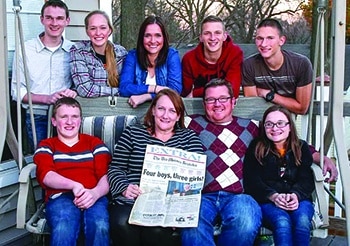
The McCaughey septuplets with their parents, Bobbi and Kenny McCaughey.
“We all see each other, usually a couple of times a year,” Kenny said. “But we have a group text that all of the family members are in. That’s how we mostly communicate. Only two of my brothers and one sister live here in Iowa still,” Kenny said. “Two sisters live in Missouri, and a brother in South Carolina, and my older sister lives in Virginia.”
Kenny and wife, Thia, now live in rural Bagley, with their children, Kenny and Missie. Kenny McCaughey is a name shared by five generations of men in the family, so they found a solution.
“Sometimes we call him Kenny the fifth,” Kenny said of his son.
Jobwise, Kenny and Thia have found a balance that works for their family.
“I do cabinetry at Waukee Cabinet Works. I’m the shop manager there now,” Kenny said.
Thia operates Thia’s Photography, which allows her to work from home and watch the kids. The family is happy to be in a small-town area, where people know each other.
Looking back at his family’s early fame, Kenny doesn’t mind that much of his childhood was under the spotlight. But, he admits, sometimes his unique childhood had a downside with so many siblings around.
“All through elementary and all the way through high school, you were going to be in a classroom with at least one of your siblings,” Kenny said. “So, like in high school, if I was in a class with one of my sisters, and I was goofing around in class, I could just expect that my sister would go and tattle on me to Mom.”



 Audubon County Tourism is reviving the June Flight Breakfast event from five years ago complete with ham and cheese omelets and pancakes on Sunday, June 8 at the Audubon County Airport on the south edge of Audubon. The breakfast will be served 6:30-10:30 a.m. with tickets available at the door. Automobile parking will again be available at the Audubon Community High School with a shuttle bus proving the trip to the airport. No vehicle parking will be available at the airport.
 With the Kentucky Derby just behind us, some people still have horse racing on their mind. And some people are still grumbling over their lost wagers, too. Have you ever bet on horse racing? Are you a regular at the track? Or do terms like “win,” “place,” “show,” “across the board” and “exacta” leave you clueless?