
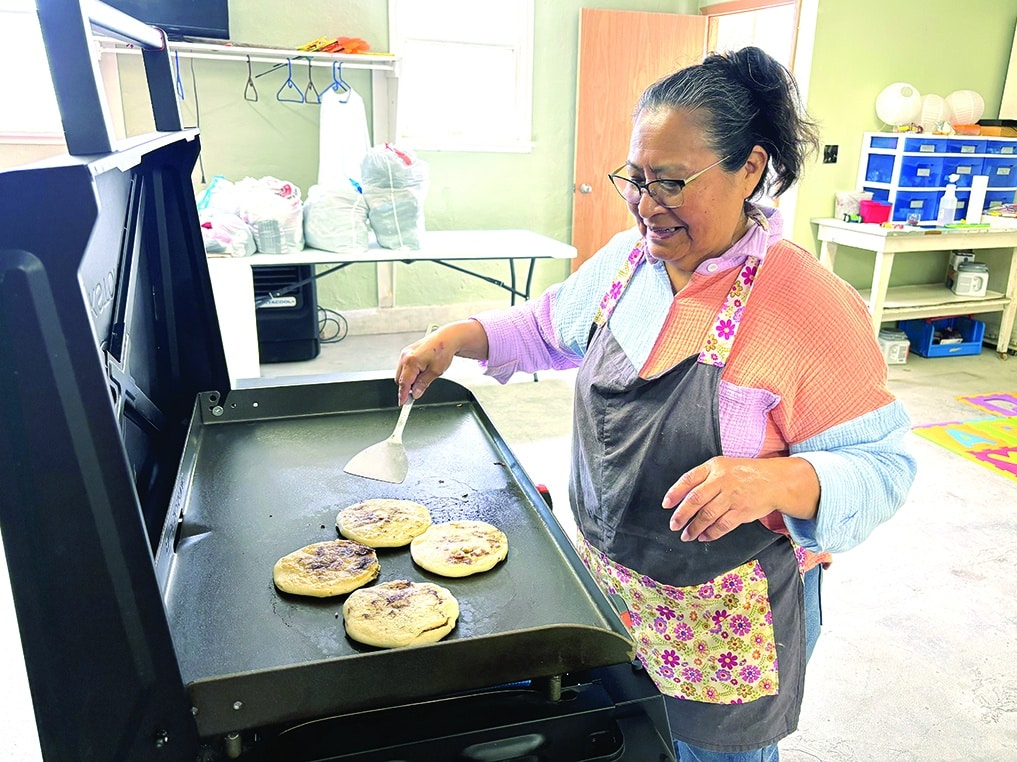
Dina Martinez cooks pupusas.
Dina Martinez turns a beloved Salvadoran tradition into a meal that nourishes neighbors while supporting her church.
By Rich Wicks | Panora Times, July 2026
Dina Martinez of Jamaica enjoys cooking, and one of her specialties is a food that many Iowans may have never heard of. She makes pupusas, which are recognized as the national dish of El Salvador. On this particular day, Dina was joined in the church kitchen by her husband, Carlos, and their daughter, who is also named Dina.
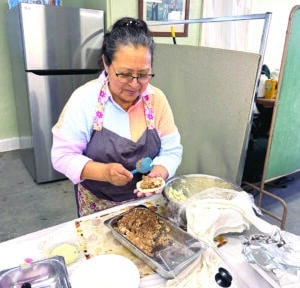
Dina Martinez spoons filling into the dough to create a pupusa.
As the Martinez family demonstrated, pupusas are made by rolling a handful of corn dough (masa). The flour is then flattened and stuffed with fillings. The pupusa is then cooked on a hot griddle until golden brown. Pupusas are traditionally eaten by hand, which allows them to be taken along for lunch anywhere.
“The pupusas are a traditional food for the people working in the fields,” Carlos said. “They take them for lunch.”
The family also makes curtido, which is a spicy side dish similar to cole slaw. Salvadorans traditionally put a spoonful of curtido on pupusas before picking them up to eat.
“It’s like a vinaigrette-flavored cole slaw,” Dina the daughter said.
Curtido can be made quite spicy, but the family aims for a milder version. The main ingredients are cabbage, carrots, peppers and vinegar.
“Most of the time, we don’t put in much heat, so everyone can enjoy it,” Carlos said.
On this day, Dina the mother cooked a batch of pupusas with a filling of pork, beans and cheese. She then made a batch with just cheese filling. Dina the daughter and her father explained there are many varieties of pupusas.
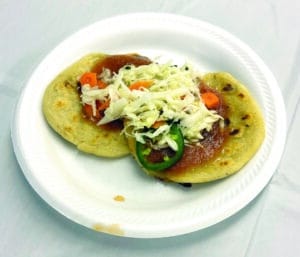
Pupusas are often eaten with curtido (spicy slaw) on top.
“They do shrimp and cheese,” she said. “They do a breakfast one with egg and ham.”
“They can do them with fish. They can do them with vegetables. They are very versatile,” Carlos said.
While his wife quickly and effortlessly formed the masa into balls, stuffed the filling inside and then formed the mixture into disks for cooking, Carlos pointed out that the process is not nearly as easy as she made it appear. Then, after a few minutes of hot grilling on each side, the pupusas were ready to eat. Carlos added that pupusas are delicious whether eaten hot off the grill or later at room temperature, or even when frozen and reheated another day.
Dina the daughter explained how the family started making pupusas for more then just their own family.
“My parents are both retired now. My dad works in the garden, and my mom wanted to do something for the community and for the church,” she said. “Little by little, she started selling these to people.”
The church the family belongs to is Jamaica Union Church, where Carlos serves as pastor.
The pupusas that Dina cooks are generally sold for $1.50 or $2 each. When Dina’s pupusas are sold, some of the money is used to help support the church.
For the Martinez family, pupusas are more than a favorite meal. They are a way to preserve their heritage, serve their community and bring people together around the table. Every hand-formed pupusa carries a taste of El Salvador, but after 20 years in Iowa, it also reflects the warmth they have found in their adopted home. As Carlos put it, the people here are friendly — and thanks to the Martinez family, many are discovering that friendship pairs especially well with a fresh, hot pupusa.