Iowa Crop Progress and Condition Report — Week of July 7, 2025
From the Iowa Department of Agriculture and Land Stewardship

Iowa Secretary of Agriculture Mike Naig commented on the Iowa Crop Progress and Condition Report released by the USDA National Agricultural Statistics Service. The report is released weekly April through November. Additionally, the Iowa Department of Agriculture and Land Stewardship provides a weather summary each week during this time.

“Widespread showers and thunderstorms across Iowa helped close out a wetter than average June. July got off to a similar start, with hit-or-miss storms over the long holiday weekend. Chances of rain remain in the forecast for portions of the state this week,” Secretary Naig said. “Outlooks for the next few weeks indicate that warm weather is likely to stick around as we enter the peak of county fair season and an important period for corn and soybean development.”

The weekly report is also available on the USDA’s website at nass.usda.gov.

Crop report

Farmers had 4.8 days suitable for fieldwork to during the week ending July 6, 2025, according to the USDA, National Agricultural Statistics Service.

Topsoil moisture condition rated 1 percent very short, 10 percent short, 73 percent adequate and 16 percent surplus. Subsoil moisture condition rated 3 percent very short, 14 percent short, 73 percent adequate and 10 percent surplus.

Corn silking reached 15 percent, matching last year, but 2 days ahead of the five-year average. A few reports of corn reaching the dough stage were received. Corn condition rated 0 percent very poor, 2 percent poor, 12 percent fair, 62 percent good and 24 percent excellent.  Soybeans blooming reached 36 percent, 3 days ahead of last year and 1 day ahead of average. Nine percent of soybeans were setting pods. Soybean condition rated 1 percent very poor, 2 percent poor, 18 percent fair, 60 percent good and 19 percent excellent. Iowa’s oat crop reached 94 percent headed and 55 percent turning color. Oats harvested for grain reached 9 percent complete. Oat condition rated 0 percent very poor, 1 percent poor, 11 percent fair, 71 percent good and 17 percent excellent.

The State’s second cutting of alfalfa hay reached 53 percent complete and a few producers have started on the third cutting. Hay condition rated 84 percent good to excellent. Pasture condition rated 71 percent good to excellent. Livestock conditions were generally good despite the heat and high humidity.

Weather summary

Provided by Justin Glisan, Ph.D., State Climatologist, Iowa Department of Agriculture and Land Stewardship

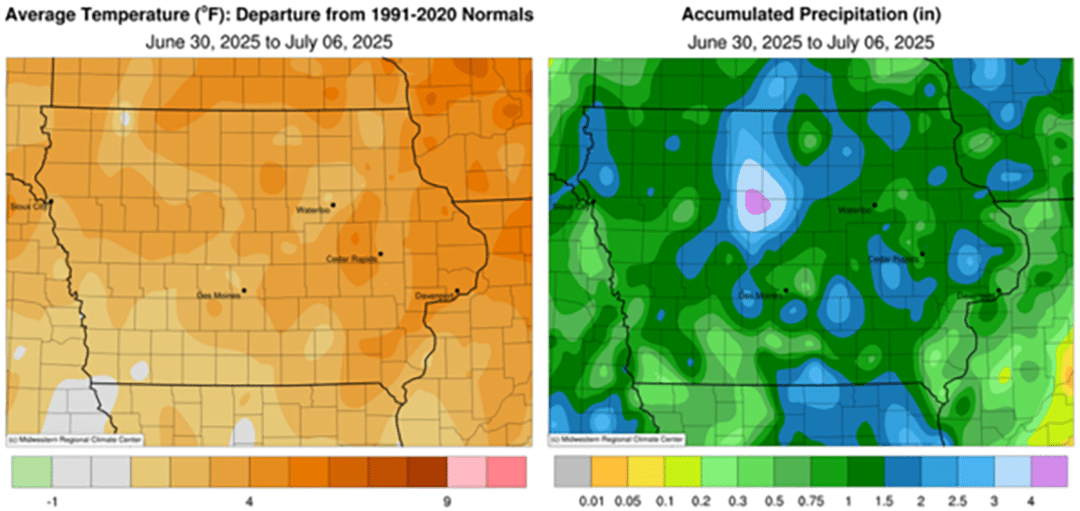
Unseasonably warm and wet conditions continued into the first week of July with many stations observing positive departures in the 0.50- to 1.00-inch range portions of southeast and southwest Iowa were slightly below normal. The warmest conditions were found in eastern Iowa with the statewide average temperature at 76.4 degrees, 3.2 degrees above normal.

Morning thunderstorms across western and southern Iowa dissipated by Sunday (29th) afternoon, which was mostly sunny with light winds and temperatures in the low to mid 80s. Thunderstorms refired along a cold front in northeastern Iowa and held together into the early hours of Monday (30th) before falling apart. Skies continued to clear with morning lows in the upper 60s and low 70s and patchy fog in western Iowa. Rain amounts were highest in southern and northeast Iowa where many stations collected more than an inch; Elkader (Clayton County) reported 1.14 inches while Promise City (Wayne County) observed 2.61 inches. With a dome of high pressure centered over the Upper Midwest, daytime temperatures on Tuesday (1st) held in the low to mid 80s with lower humidity and light northwesterly winds. Nighttime skies remained clear with a small pocket of showers pushing into southwestern Iowa by daybreak. As of 7:00 am on Wednesday (2nd) only a handful of stations reported a trace or more with 0.28 inch in Leon (Decatur County). Morning lows varied from the mid 60s to low 70s though conditions warmed into the mid 80s, helped along by sunshine and southerly flow. Isolated thunderstorms popped in northeastern Iowa as the sun set, with two cells becoming severe warned for hail and gusty winds. A few more cells moved into northwestern Iowa several hours later but dissipated in the early morning. Rain totals covering the previous 24 hours were more prevalent northeast and southwest with 0.38 inch in Lime Springs (Howard County) and between 0.45 to 0.60 inches in Council Bluffs (Pottawattamie County).

Thursday (3rd) was unseasonably warm with partly cloudy skies and southerly winds boosting temperatures in the upper 80s and low 90s. Instability in eastern Iowa helped thunderstorms bubble into the late evening hours, some of which produced localized tree and outbuilding damage in Grundy and Jones counties. Stations from east-central to northeast Iowa reported a few tenths of an inch though several stations measured totals nearing an inch; Garwin (Tama County) had 0.65 inch with a 0.86-inch total in Independence (Buchanan County). Friday (4th) dawned pleasantly with temperatures in the low 70s under cloudless skies. Conditions were ideal for Independence Day fireworks after a muggy afternoon of highs in the upper 80s. Cloud cover gradually increased over western Iowa into Saturday (5th) as a cold front pushed east through Iowa. Several waves pushed across central to eastern Iowa as the day progressed, leading to several pockets of higher-end rain totals, particularly south-central to north-central Iowa. Event totals were at or above one inch for more than 200 stations and more than double for 40 stations. The highest totals were found in east-central to north-central Iowa; Fort Dodge (Webster County) registered 4.76 inches with 5.19 inches in Pella (Marion County) and statewide average at 1.15 inches. Winds swung to the north behind the front as clouds cleared west to east. Morning temperatures on Sunday (6th) varied from mid 60s northwest to low 70s southeast.

Weekly precipitation totals ranged from 0.22 inch in Salem (Henry County) to 5.19 inches in Pella. The statewide weekly average precipitation was 1.36 inches; the normal is 1.08 inches. Ames (Story County) reported the week’s high temperature of 95 degrees on the 3rd, 11 degrees above normal. Several stations reported the week’s low temperature of 57 degrees on the 1st, on average six degrees below normal.
Barns of Guthrie County

Stories of notable local barns and the families that cherish them


By Rich Wicks | Panora Times, June 2025

Barns have been called “cathedrals of the prairie.” That seems a fitting phrase, since, like cathedrals, barns are often the most easily spotted and recognizable features on the horizon for travelers through rural Iowa. And for the families that live and work on Iowa farms, the family barn means much more than just a structure to which the cows come home. 

Barns have long been an iconic image of Iowa. In recent decades, the number of family farms statewide has decreased, and barns have also become less prevalent. But in Guthrie County, many barns have stood the test of time. Some have been repurposed, while others have been refurbished to continue housing livestock, hay bales, and other farm necessities.  

Here are the stories of some notable local barns and the families that cherish them.


Marvin and Judi Smith

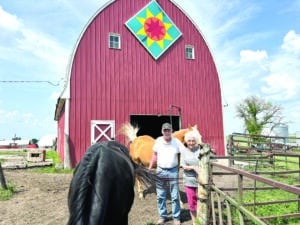
Marvin and Judi Smith are proud of their barn.

Marvin and Judi Smith’s property and barn in rural Panora have some interesting history. Judi explained.

“Actually, this property was Milo Yale’s. He gave all the land that became the town of Yale. There used to be a big, square, three-story house here,” Judi said. “When Marvin bought this place in 1972, he could see that it was going to be a money pit, so he tore it down and built this house.”

The story of the barn is a story of changes. Marvin said he recalls when the barn was built.

“I believe the barn was built in 1950, because I remember when they built it; I graduated in 1954, and they were building it a few years before that,” Marvin said. “We’ve lived here since 1972. We’ve always had horses and ridden horses. We used it as a corn crib for a while. It used to sit a little further north, but I converted it to shelled corn for several years. I filled both sides with shelled corn. We had about 14,000 bushels of corn in there.”

When the government program changed, using the building in that way no longer made financial sense, so Marvin came up with a new idea. 

“We didn’t want to have to tear it down, and we weren’t going to use it for a corn crib anymore. It’s worked out really nice for a barn,” Marvin said. “Now we have a head gate in there, and we can run cattle in there and work them.”

Marvin recalled the process of moving the one-time corn crib and turning it into a barn.

“We moved it up here for a barn. I’d say that was in the late 1980s,” Marvin said. 

“Well, first I ran the foundation. Then I had the guy from Perry come, and he just loaded it up and pulled it up there and set it on the foundation, and it’s been there ever since. Hopefully, it doesn’t blow away.”

Eventually, the couple decided they wanted their small barn to look more like a traditional barn. Judi took on the challenge of creating a barn quilt on the building. She started looking for a pattern she liked.

“I saw ours on a calendar. It was called the “Star of the East,” and since it was going to be on the east side of our house, and I liked the colors, that’s how I came up with that,” Judi said.  

About 15 years ago, Judi painted the original barn quilt pattern herself. 

“We had a guy come out with a cherry picker and put it up there, along with a cupola, and I had bought a horse weathervane, so we put that up there,” she said. “That made it look like a barn instead of a corn crib.”

The barn quilt is 8 feet by 8 feet, and it was repainted by a crew last summer.

The Smiths are happy with how their small barn functions and with its appearance, too.

“Now we just use it for horse stables, mostly, and I’ve got a tack room in there. So, when we saddle up the horses, we bring them in through there into the tack room and throw the saddle on,” Marvin said.

He added how others seem to agree that the barn is pleasing to the eye.

“When people stop out on the road to take pictures, I don’t know if it’s because of the quilt block or because of the barn,” Marvin said.


Dave and Sheila Deardorff

Dave and Sheila Deardorff’s home is a century farm with an historic barn.

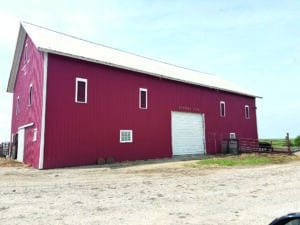
The barn of Dave and Sheila Deardorff, rural Yale, is one of the most historic in the county. Not only did the barn have a notable beginning, but it is still in use today to house the many cattle on the farm. 

In 1889, Mahlon and Sarah Deardorff moved from Illinois to a farm in rural Yale in Cass Township. The farm previously had been the Reuben Reaver farm and consisted of 267 acres. In 1892, the Deardorffs had a new barn built. As was common at the time, a large crew of men helped build the new barn. The workers must have been skilled carpenters, since the barn is still in use today. Reportedly, after the barn was completed, the 70 men were treated to a well-deserved dinner, followed by cigars and lemonade. 

The farm has been in the Deardorff family ever since. Mahlon and Sarah’s son, Russell, and his wife, Mary, owned the farm, followed by their son, Orville, and his wife, Marjorie. Dave and Sheila Deardorff now own the farm.


Megan Smith

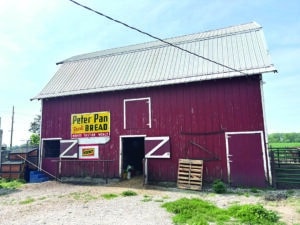
An old sign adorns the barn at Megan Smith’s home.

At 1075 Highway 4 in rural Bagley, Megan Smith and her family live on a farm with a traditional Iowa barn. 

“It was built in 1904, but I don’t know much else about its history,” Smith said. 

The barn is still used for housing livestock.

“I’ve lived here all my life,” Smith said. “We had used it for draft horses, but then we converted it, and now we use it for horses and my daughter’s show calves.”  


Norman and Gladys Willey

Signage on the Willey’s barn says “Woodland Farm 1934”

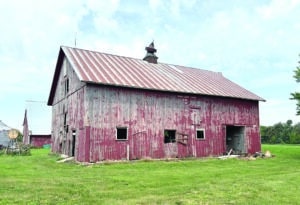
For Gladys Willey of rural Yale, the family farm, and especially the barn, is a tangible reminder of her family’s history. Although the two large barns on her property no longer house any farm animals, the buildings are home to a lifetime of family memories.

“My grandparents, Arthur and Femmie Wood, came to live here in 1934. They had lost their farm in Orient, Iowa. They went 28 miles the first day and stayed at Stuart. Then they came the last 20 miles the next day, with horses tied onto their wagons,” Gladys said. “They raised horses and angus cattle. The barn was already here when they came. They kept their draft horses and cattle in there.”

Since then, the farmstead has stayed in the family. 

“My parents, Lloyd and Delores Chaloupka, bought it in 1965. I was in fourth grade, maybe,” Gladys said. “They lived here until 1981, and at that time, my husband, Norman, and I moved here. After my mother passed away, we sold the farmland but kept the acreage.”

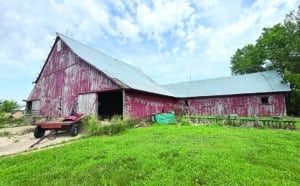
The western barn on the Willey’s property is weathered but structurally sound.

Norman and Gladys are now retired, and the barns on the property are no longer used regularly. 

“About three years ago, we had a family reunion here, and everybody came out and looked at the barns,” Gladys said. “They’ve been unused for about 20 years.”

Looking back, she recalled a childhood memory at the farm.

“I remember one story after we had moved here. One of my sisters had graduated. One was a senior, and my brother was a junior. Dad sold the milk cows because he didn’t have enough kids around to do the milking anymore,” Gladys said. “The other kids told me I was spoiled because I was the baby and I didn’t have to milk cows.”

She also recalled how the barn offered kids plenty of chances for fun.

“We used to play in the haymow. That east barn had a pretty nice haymow,” Gladys said. “There were always kittens to find up there, too, because the cats would have them up there to hide them.”

Looking to the future, Gladys knows the barns are continuing to age, but she has no plans to fix them in the foreseeable future. 

“I’d like to have the money to restore them, but I don’t think that’s in the cards,” she said.

Guthrie County’s top athletes and Kadyn Proctor’s high rating

By Cyote Williams | Times Vedette

Professional athletes from Guthrie County

Who are the greatest athletes from Guthrie County to make it to the professional level of their respective sports? I found three in my quick research. Here are the names and what they were able to accomplish:

Elvin Hutchinson. Hutchinson was born in Guthrie Center in 1912. He attended school in Red Oak and played football at Whittier College in California. He was the quarterback there and was nicknamed the “Red Oak Express.” I love a good nickname. Hutchinson went on to play in the NFL for the Detroit Lions as a halfback in 1939. He also spent a few years playing in the Coast Professional Football League. After his time as a professional athlete, Hutchinson joined the United States Navy in 1942.

Merv Krakau. Krakau was born in Jefferson but attended Guthrie Center High School where he excelled in football. He played at Iowa State University as a defensive end and racked up many awards in the process. He was named third-team All-American, first-team All-Big Eight, and was inducted into the Iowa State Athletics Hall of Fame in 2007. Krakau played six seasons in the NFL from 1973 to 1978 for the Buffalo Bills and New England Patriots and in the USFL for the Tampa Bay Bandits.

Kip Janvrin. As a newcomer to the area, I first heard Janvrin’s name while covering Panorama track and field, as one of the meets is named after him. I now see why. Janvrin was born in Guthrie Center and is a native of Panora. He graduated from Simpson College in 1988 after winning three NCAA Division III titles in the decathlon and won individual titles in the pole vault and 400-meter hurdles. His success at the international level is extensive. Janvrin won the decathlon at the 1989 Olympic Festival, placed fourth at 1998 and 1999 USA Outdoor Track and Field Championships, and won the championship in 2001. Locally, Janvrin won the decathlon a record 15 times at the Drake Relays and has been inducted into the Drake Relays Hall of Fame. And this is just a short list of Janvrin’s accomplishments.

Of course, most of you know these names and their many accomplishments, but what folks did I miss? Let me know of other prominent athletes from Guthrie County, and I will profile them here as well. They do not have to be professional athletes. Former program standouts are welcome, too. Just shoot me a message at cyote@dmcityview.com.

Iowa native Kadyn Proctor rated best offensive lineman

Player overall ratings have begun to trickle out with the anticipated release of EA Sports NCAA College Football 26 coming soon. Iowa native Kadyn Proctor’s overall rating was revealed as a 94, the highest of any offensive lineman. The former five-star recruit out of Southeast Polk High School has caused headaches for Hawkeye fans over the years. Proctor originally committed to play at Iowa but then flipped to Alabama. Then, in January of 2024, he transferred back to Iowa. But then, Proctor again flipped and transferred back to Alabama before ever hitting the field at Kinnick Stadium. It is a whirlwind story for one of the country’s top linemen and certainly a future NFL player.

ACGC baseball loses doubleheader against Van Meter, 13-1, 12-2

By Cyote Williams | Times Vedette

The ACGC baseball team (9-13) lost both of its home games against Van Meter (21-8) on Tuesday, July 1. Tommy Skram scored the Chargers’ lone run in game one. Noah Kading and Jackson Pfrang had one RBI each in game two.

The Chargers compete in the first round of substate against AHSTW (4-18) on Saturday, July 5 at the Woodbine athletic complex.

Charger softball drops both games against No. 1 Van Meter, 21-1, 10-0

By Cyote Williams | Times Vedette

The ACGC softball team (2-19) lost both games of its home doubleheader against No. 1 Van Meter (26-2) on Tuesday, July 1. The Chargers’ next game is against another solid WCAC opponent, West Central Valley (14-12). That game is at WCV today, Thursday, July 3.