From the Iowa Department of Natural Resources
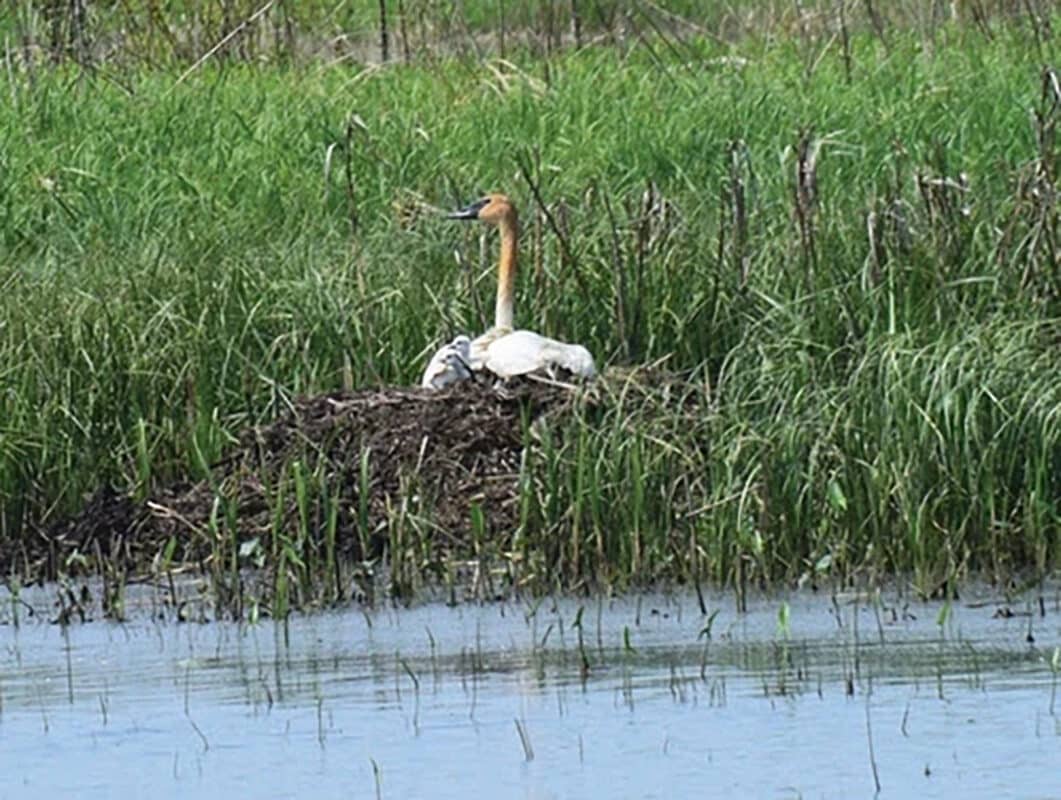
Iowa’s trumpeter swans attempted a modern-day record 158 nests in 2025, which is an increase of 17% over 2022. The nesting data is from the most recent statewide observation survey completed in December.
“It’s a neat story about the restoration. We spent a lot of time and effort to get the population established and it’s really taking off right now,” Orrin Jones, state waterfowl biologist with the Iowa Department of Natural Resources (DNR), said.
Recovery has taken time but is a true modern-day conservation success story, he said.
The restoration effort was supported by the Iowa DNR’s Fish and Wildlife Trust Fund, a constitutionally protected fund where hunting, fishing and trapping license fees are deposited and used, in part, to protect, restore, or manage fish and wildlife.
The largest waterfowl in North America, trumpeter swans have come a long way since the 1930s when conservation efforts began in order to protect small populations in Montana and Alaska.
Native to Iowa, trumpeter swans were once as widely distributed as Canada geese but had been extirpated by the early 1880s. Early and aggressive reintroduction efforts in the Midwest by Minnesota and Wisconsin, followed a few years later by Michigan, and then Iowa, sought to return these iconic waterfowl to their traditional place on the prairie wetlands.
Iowa began with a restoration plan in 1993 followed by the first release of four swans in 1994. The plan included monitoring the swans to evaluate reintroduction success. The DNR released a total of 1,218 swans, ending in 2022.
Iowa’s first trumpeter swan nest in the modern era was in 1998, in Dubuque County, followed two years later by one in Winnebago County. Nesting attempts increased slowly following the growing number of released swans. After averaging in the mid-50s for nearly a decade, nest attempts jumped to more than 120 in 2020, followed by nearly 140 in 2022.
“Reintroduction has been successful and we continue to monitor the population as time goes on,” Taylor Ballard, wildlife research technician with the Iowa DNR’s Clear Lake office, said. “We ask our staff to record any observations of swans — active nests, swans with a brood — let us know if they see a successful nest and the number of cygnets that nest has, which gives us our number of cygnets of per successful nest.”
Ballard said the active nests average 4.4 cygnets, or young swans, which is helping grow the local population. Of the 158 active nests, Ballard said 98 were known to be successful in hatching.
Population surveys begin in mid- to late-April with peak surveys from May to September. Iowa DNR staff, along with staff from local county conservation boards, the U. S. Fish and Wildlife Service and private citizens, check areas with preferred habitat or where nests have previously occurred.
The data is passed along to the Mississippi Flyway Council, which coordinates management with the U.S. Fish and Wildlife Service.
“The birds are doing best on the large semi-permanent wetlands in the prairie pothole region and their trend is continuing to expand in abundance, like we thought it would,” Jones said. “It takes time for swans to reach maturity but once they begin nesting they are productive and we have vacant habitat available for them.”
The Iowa DNR has captured and collared cygnets as part of a survival study. Swans live as a family unit with parents providing protection and teaching the young skills needed to survive. More than 70% of cygnets that fledge in September will survive to March.
“Trumpeter swans are emblematic of healthy wetland systems, clean water, and are a way to tie a species to the habitat,” Jones said. “It’s a neat story about the swan restoration, and we’re seeing a similar response with the sandhill cranes — they’re expanding, too — and likely will increase until population reaches the carrying capacity of the habitat.”
Iowa swans, along with swans from Minnesota and Wisconsin, are part of the interior population of trumpeter swans. Some of these birds follow traditional winter migration to Missouri and Arkansas, while others will remain in Iowa, to be joined by swans from up north. The 2025 midwinter waterfowl survey recorded more than 4,700 swans in Iowa.
While the population has been increasing, threats do remain.
Collisions with powerlines is a major problem, as is ingesting lead. In the last few years, avian influenza has claimed some swans, as well.

 We had some icy roads and severely cold weather in central Iowa recently. Fortunately, it was during Christmas break, so schools did not have to cancel classes.