
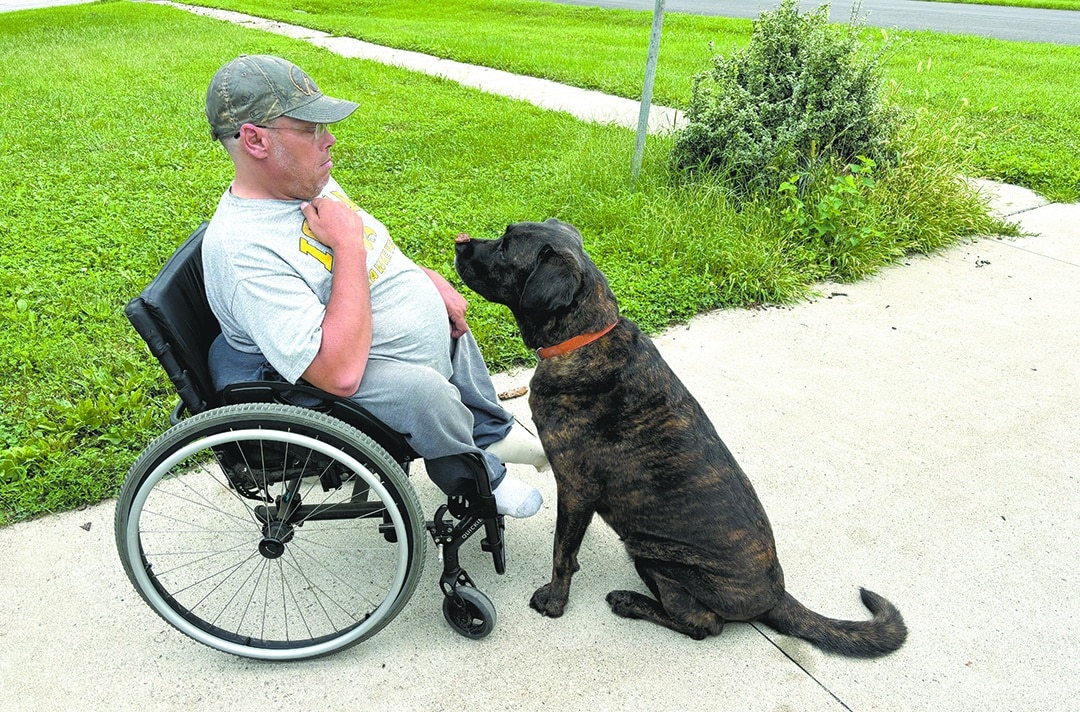
With a treat balanced on her nose, Bella waits for a command from her owner.
Panora’s Ryan Atkinson brings 25 years of experience to Wheels Canine Academy, where he says successful training starts with understanding the dog and its owner.
By Rich Wicks | Panora Times, August 2026
Earlier this summer, Ryan Atkinson of Panora opened a dog-training business at his home. He recently shared his story and demonstrated his partnership with his dog, Bella.
“I’ve been working with dogs, training them, for probably close to 25 years now, but I just opened Wheels Canine Academy about two months ago,” he said. He explained the origin of the business name.
“Everybody calls me Wheels. I don’t even remember who started that,” Atkinson said. “It’s been 30 years or more.”
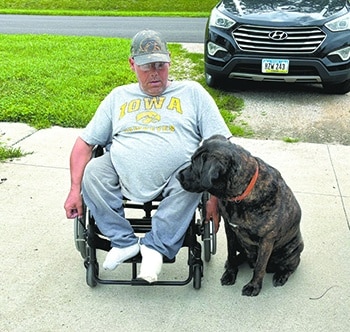
Bella heels on command.
Atkinson shared some general rules of thumb about how he works with dogs, but he said every situation is unique, depending on the dog’s breed and history, as well as the home situation in which the dog lives. Generally, when Atkinson starts working with a new dog, he will train that dog for approximately three weeks to three months.
“Most of the time, the biggest challenge is trying to get the owners to understand and flip their way of thinking about dog training, because a lot of times they think that purely positive training is going to work, but it doesn’t. It needs to be a balance,” Atkinson said.
In most cases, dogs are brought to Atkinson for each training session. Occasionally, he also boards a dog while training it.
“I’ll only take three at a time for training. Any more than that, and it’s too much,” he said. “I have kennels. But if I’m boarding and training a dog, then I only do one at a time, so I can spend the time with that one dog that really needs the work.”
Atkinson’s business model focuses on the energy level of the dogs he trains. He encourages owners to practice routines that help a dog stay calm rather than creating nervous energy.
“When you come home for the day, you can let the dog out of the kennel if it’s in one, but don’t look at it, don’t talk to it, don’t touch it. Then put your keys on the hook and do the things you have to take care of, then after a minute or so, then greet your dog. It will be in a lower range of anxiety,” he said.
Atkinson also shared that dog training is not a one-size-fits-all proposition.
“Dogs are like people; they all learn at different rates. It depends on the dog and what habits you’re trying to break, and the breed of the dog,” he said. “The herding breeds are very reactive. They are meant to chase the livestock, so if there’s any little movement, they pick up on it right now.”
Through his many years of working with dogs, Atkinson has learned that a dog’s breed and age factor greatly in what he can accomplish, as does the owner’s approach. Not every situation matches what Atkinson can offer.
“Sometimes, it gets to the point that I start thinking I’m wasting my time and my client’s money, and I don’t want to do either one,” he said.
But there are relatively few dogs with which Atkinson doesn’t match. He shared a recent success story.
“One of my clients has a 9-month-old pit bull mix. I called the owner up two days after our very first meeting, and he said the difference was like night and day. So, I watched him the next time he brought his dog here for a session, and he was doing everything right, and the dog was responding to it.”
Atkinson also pointed out a type of dog training that he does not offer.
“I will not do protection work,” he said, referring to the type of training that some police dogs may receive.
Atkinson also shared a piece of equipment that he uses with many of the dogs he trains.
“One of the best things is a prong collar or Martingale collar, which tightens more as a dog pulls,” Atkinson said. “It’s one of the best training tools you can get. And as long as you make that collar a very happy thing and only use it when you’re taking the dog on walks or training time, then they are going to look at that as a positive thing.”
Atkinson says dogs need to understand that the owner is the alpha, at the very top, and that if the owner has kids, the kids are above the dog.
“Otherwise, I’m just starting at square one every week,” he said.
When asked what he works on most frequently with dogs, Atkinson said it’s overly excited dogs that create a nuisance when visitors arrive.
Ryan Atkinson is growing his client list in the Panora area.
As Atkinson describes his philosophy of dog training, one concept comes through clearly: When a dog is experiencing excitement and high energy, it is less able to focus on whatever the owner asks of it.
With that in mind, there are a few breeds Atkinson avoids because they are overly protective or have excess energy. Atkinson shared a general rule about setting the stage for success with a dog.
“I tell my clients, before you take your dog for a walk, take them out in the yard and throw the ball 20 times. Get them kind of panting,” he said. “Now, they’re paying more attention to you on the walk because they’re already a little tired.”
The first thing Atkinson does with his customers is an assessment.
“I need to meet the dog and the owner. I need to see what the communication between them is like and what the dog knows. That’s where it all starts,” Atkinson said. “Then I ask a lot of questions about what triggers that dog.”
Atkinson says he typically charges $50 per session, with a session lasting two hours.
“I want the dog three days a week, minimum, sometimes more,” he said. “And one of those days, the owner needs to be present, so I can continue teaching the owner what I’m doing with the dog. Because if you’re not doing it right, what I do won’t sink in.”