
Collecting tractors is Steensen’s hobby
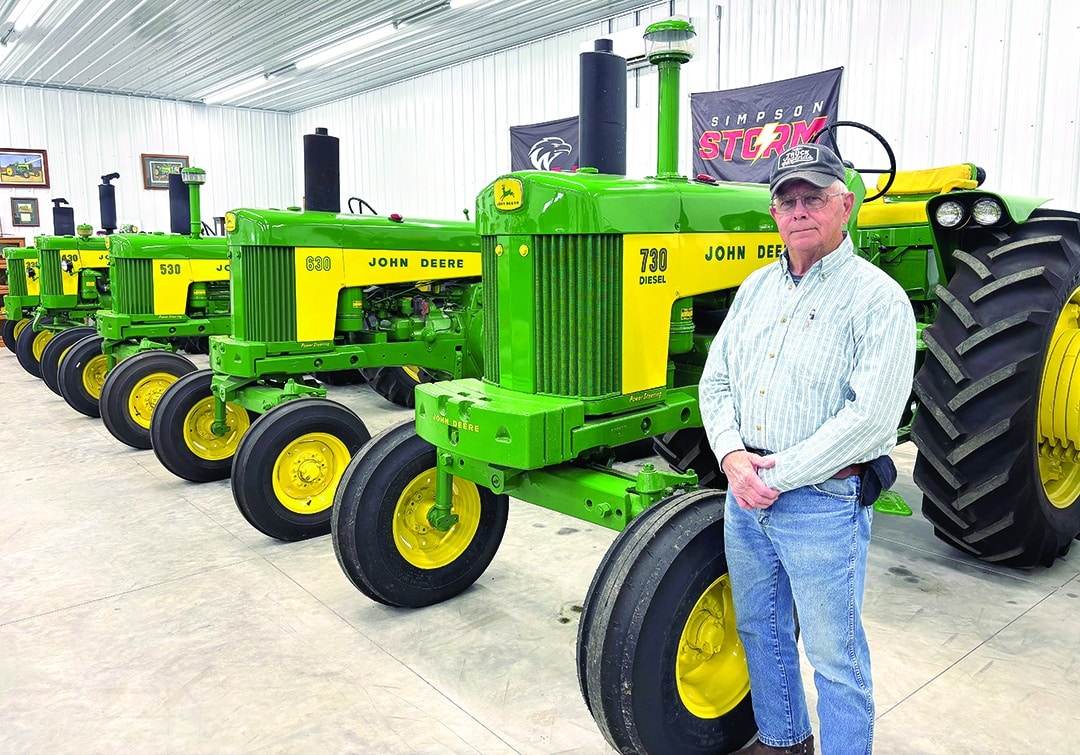
Cletus Steensen and his favorite tractor.

Purchase of a John Deere 730 Diesel in 1970 led to a lifelong pursuit.

By Rich Wicks | Guthrie Center Times, April 2025

Most anyone who likes classic tractors would be thrilled to walk into the shed of Cletus and Cindy Steensen of rural Adair.

“I’ve been a tractor nut from the day I was born. I grew up on the Fords and the John Deeres. My uncle lived next door, and he was a tractor nut, too, and he liked the mechanic work,” Steensen said. “My dad was more of a woodworker.”
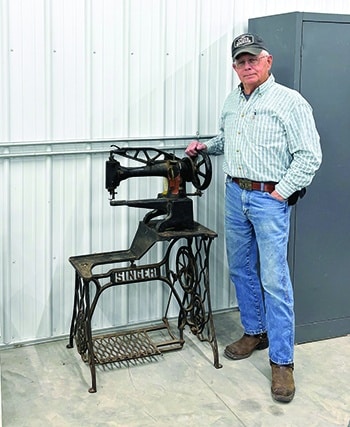
From tractors to vintage sewing machines, Cletus Steensen likes making things run.

Steensen recalled his father assigning him the job of maintaining the family’s tractors, which included tuning them up, changing oil and making numerous repairs. Steensen quickly learned much of what it takes to keep a tractor running smoothly. That experience later paid off both professionally and as a hobby.

“In 1998, hog prices had really dropped, so I got out of the hog business, and, just by word of mouth, people started asking if I’d help them with some tractors. I had a little mechanic shop and welding stuff,” Steensen said. “I ended up doing a lot of tractor repairs and restorations as a business, and then I retired from that in 2018.”

While working on other people’s tractors, Steensen also worked on a few of his own. He now has a small collection of his favorites.

“The collection I have here, the six of them, are the 30 series. It’s the last series of two-cylinder tractors that John Deere made,” Steensen said. “The one I bought first was the 730 Diesel. I bought that in 1970, and I didn’t know it was a 1960; I just wanted a tractor.”

That purchase in 1970 led to a lifelong pursuit and hobby.

“I started wanting to collect the 1960 series. That was the thrill of the hunt,” Steensen said. “One came from 50 miles west of Fort Smith, Arkansas, in Oklahoma. Another one came from South Dakota. One I bought at a Carroll machinery auction.”

Besides that series of six classic John Deere tractors, Steensen also has a few Ford tractors in his shed.  But even that isn’t his entire collection. 

“I’ve got a few more tractors down at my son’s place,” he said. “It’s been fun, and I still do it. I’ve got one in the shop I’m waiting on parts for.”

Some of the tractors Steensen has restored sat unused for as many as 20 years. This can make his task more challenging, but he doesn’t back down. In particular, carburetors, injection pumps and fuel tanks do not age well when neglected for many years. But, for Steensen, the end justifies the means.

“I tear them clear down and rebuild them. And when you first hit the switch to start them up, it’s kind of a neat thing to hear them running,” he said.

Steensen displays great attention to detail in his hobby.

“I like to keep everything as original as I can,” he said. “But I’ve had some parts that I couldn’t find, so I had to have a friend machine one for me.”

As if finding, fixing and restoring classic tractors to near mint condition was not enough to keep him busy, Steensen has also found himself doing similar work on vintage sewing machines. In his shed, along with the tractors, he has several Singer sewing machines manufactured more than a century ago. 

“Usually, in the winter, I work on them,” Steensen said. “That first one I did, we took it to the county fair, and my granddaughter sewed with it.”

Steensen recalled a favorite memory with his John Deere tractors.

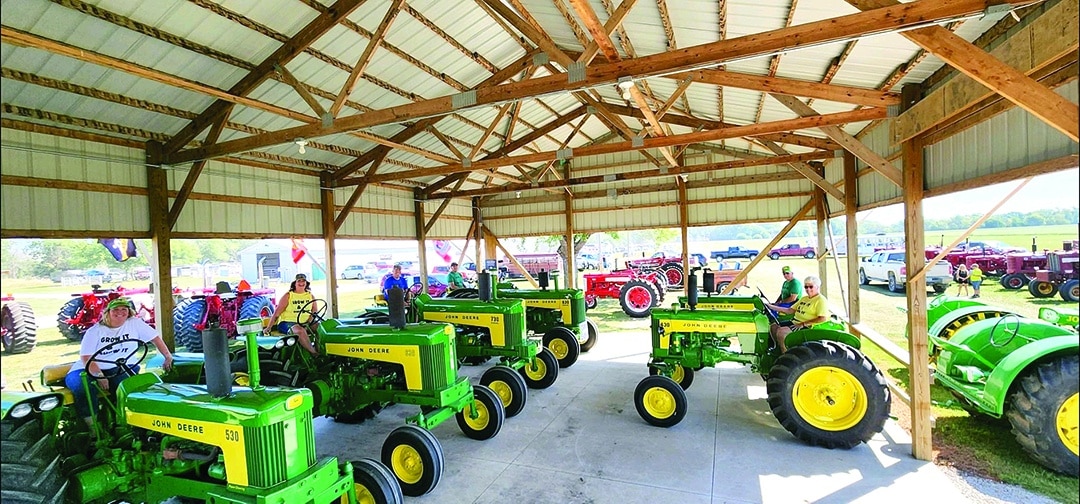
“It’s been a few years ago that we had all six of them in the Guthrie County Fair parade,” he said. “My youngest boy drove the 830. My next youngest drove the 730. My youngest daughter drove the 630, and my oldest daughter drove the 530. My wife, Cindy, drove the 430, and then I came up behind with a hayrack with the grandkids on it.”

Steensen plans to continue his hobby. 

“I’ll keep working on these things until I can’t do it anymore,” he said. “I’ve had a good time doing it.” 

The Steensen family drove tractors in the Guthrie County Fair parade.
Know someone in Guthrie County whose vehicle, collection or hobby would make an interesting story? Email ideas to rich@gctimesnews.com.

Livestock producers concerned about livestock diseases, uncertain about level of threat and capacity to manage

From Iowa State University Extension and Outreach

Livestock diseases have received substantial attention and global media coverage in recent years. Highly pathogenic avian influenza, or HPAI, has dominated the news as it has led to loss of millions of poultry, increased egg prices and viral spillovers to other livestock such as dairy cattle, and has recently been found to infect humans. However, there are many other diseases that impact Iowa’s livestock sector, the top U.S. producer of red meat and eggs, including porcine reproductive and respiratory syndrome, or PRRS, and bovine respiratory syncytial virus, or bovine RSV, that cause billions of dollars in annual losses to farmers and increased consumer prices.

“Farmers are on the front lines of managing livestock disease threats, and their capacity to identify and treat diseases before they become major outbreaks is critical,” Hanna Bates, a research administrator at Iowa State University’s Nanovaccine Institute and lead author of the study, said. “This research from the Iowa Farm and Rural Life Poll is helping us to better understand farmers’ degree of concern about different diseases and their capacity to manage them.”

New to the ISU Extension store, the Livestock Producer Perspectives on Livestock Disease report draws on data from the 2024 Iowa Farm and Rural Life Poll survey, which surveyed 432 livestock producers in February and March of 2024. The survey included two sets of questions aimed at understanding livestock producers’ perspectives and attitudes relating to livestock disease management. The first part of the survey provided a list of eight major diseases and asked farmers to rate their levels of concern about each. A second set of questions examined attitudes regarding multiple dimensions of disease management.

The research found high levels of concern about many of the diseases, with bovine respiratory disease, hoof-and-mouth disease, and bovine RSV among the top concerns, with 77%, 74% and 73% of respondents expressing worry, respectively, and more than half of producers indicated concern about the eight major diseases listed.

Because livestock diseases have differential impacts depending on species, the report also examines livestock producers’ concerns by type of livestock raised to measure concern among producers whose animals were most likely to be impacted. For example, nearly all swine producers were concerned about PRRS and swine influenza, and 81% of poultry producers were at least somewhat concerned with avian influenza.

While results again showed significant levels of concern, many farmers were not concerned. For example, 22% of cow-calf producers and 16% of fed cattle producers selected either “not concerned” or “don’t know” for bovine RSV, a major cattle disease prevalent in Iowa. Similarly, one-third of cow-calf producers and 29% of fed cattle producers selected either “not concerned” or “don’t know” for Johne’s disease.

The survey also posed questions about monitoring and management challenges. About 58% agreed that current monitoring and management strategies are effective at limiting disease outbreaks, and 53% agreed that they have sufficient access to monitoring and mitigation resources. That said, 33% and 39% selected the uncertain category for those two items, respectively, and 9% disagreed with both. This suggests that close to half of livestock producers lack confidence and capacity to effectively manage disease.

“On the whole, the results show that many producers feel that the systems in place are working and they have the resources they need to manage disease and limit the spread of outbreaks,” said J. Arbuckle, extension sociologist and report co-author. “However, the lack of concern about some major diseases and level of uncertainty about management capacity point to a need for ongoing education and support to help farmers effectively manage livestock disease.”

About the Iowa Farm and Rural Life Poll

The Iowa Farm and Rural Life Poll is an annual survey conducted by Iowa State University Extension Sociology. Initiated in 1982, the poll is the longest-running survey of its kind and works to inform local, state and national decision-making and improve extension and outreach programs. All reports are available on the Iowa Farm and Rural Life Poll web page.

Easter egg hunts this weekend

Three bicycles to be given away at Panora event.

By Rich Wicks | Times Vedette

Rose Acre Farms will sponsor an Easter egg hunt at the Guthrie Center Elementary School grounds, 900 Fourth St. The event will be held at 10 a.m. on Saturday, April 19.

The Casey Fire Department is hosting an Easter egg hunt (with the Easter Bunny) on Saturday, April 19 at 1 p.m. at Rutt Park (Casey City Park, 300 E. Second St.).  

The Panora Chamber of Commerce’s Easter activities will be held on Saturday, April 19 at Veterans Auditorium and the Panora Square rather than at the Guthrie County Historical Village. Crafts and games will be held in Vet’s Auditorium from 9-10 a.m. At 10 a.m., the fun moves outside onto the Square, with kids participating in the annual Easter Egg Hunt. Panora Fiber will be giving away three kids bicycles. Kids can register for a chance to win one of them from 9-10 a.m. inside Vet’s Auditorium during the crafts and games session. The new bike owners will be announced immediately following the Easter Egg Hunt at the town square. Must be present to win.

Randol receives President’s Award at ICA meeting and expo

Special to the Times Vedette

Andy Randol, CEO and general manager of Panora Fiber, recently received the President’s Award at the Iowa Communications Alliance Annual Meeting and Expo. The award is given to an individual who has made significant contributions to the success of the ICA and Iowa’s telecommunications industry.

Jamie Daubendiek, general manager of Jefferson Telecom and the ICA board president, presented the award to Randol with these words: “Andy successfully organized the participation of 18 people in a legislative fly-in to Washington, D.C., handling all the logistics, including the coordination of meetings with legislators. Despite frequently changing plans up until the time of the meetings, he remained adaptable and composed, ensuring everything ran smoothly. His dedication to taking care of every detail, while keeping the group informed and aligned, highlights his ability to lead effectively while remaining focused on the team’s goals and needs. Thank you, Andy.”

Faith Bible Church free community meal is April 16

Special to the Times Vedette

The Faith Bible Church free community meal will be held on Wednesday, April 16 from 5:30-6:30 p.m. All are welcome. The menu includes sliced ham, mac and cheese and smothered green beans.

Faith Bible Church is located at 2096 Highway 4 in Panora. 

Guthrie County Supervisors hold budget hearing

By Rich Wicks | Times Vedette

At the April 15 meeting of the Guthrie County Board of Supervisors, the supervisors first went into closed session to discuss strategy with counsel in matters that are presently in litigation or where litigation is imminent.

A Fiscal Year 2026 budget hearing was held at 9:30 a.m. County Auditor Dani Fink shared information on property valuation and data from prior years.

“Fifty percent of the county’s taxable value is made up of residential property; 34% from ag land, and then we kind of drilled it down…for ag buildings, commercial, industrial, railroads and utilities,” Fink said. “For this fiscal year budget, for 2026, the levies are set to remain the same.”

The supervisors adopted Resolution 25-22 (Adoption and Certification of Taxes) and Resolution 25-23 (Approving Fiscal Year 2025-2026 Annual Salary for Elected Officials). Both were approved by a 3-1 vote, with Supervisor Mike Dickson opposed. Supervisor JD Kuster was absent.

During the Public Comments section of the meeting, discussion was held about concerns of landowners regarding the planned Summit CO2 pipeline.

The supervisors meet regularly on Tuesdays at 9 a.m. The public is welcome to attend in person or via remote technology. To join remotely, call 323-792-6123, then use meeting code 547029216#.