
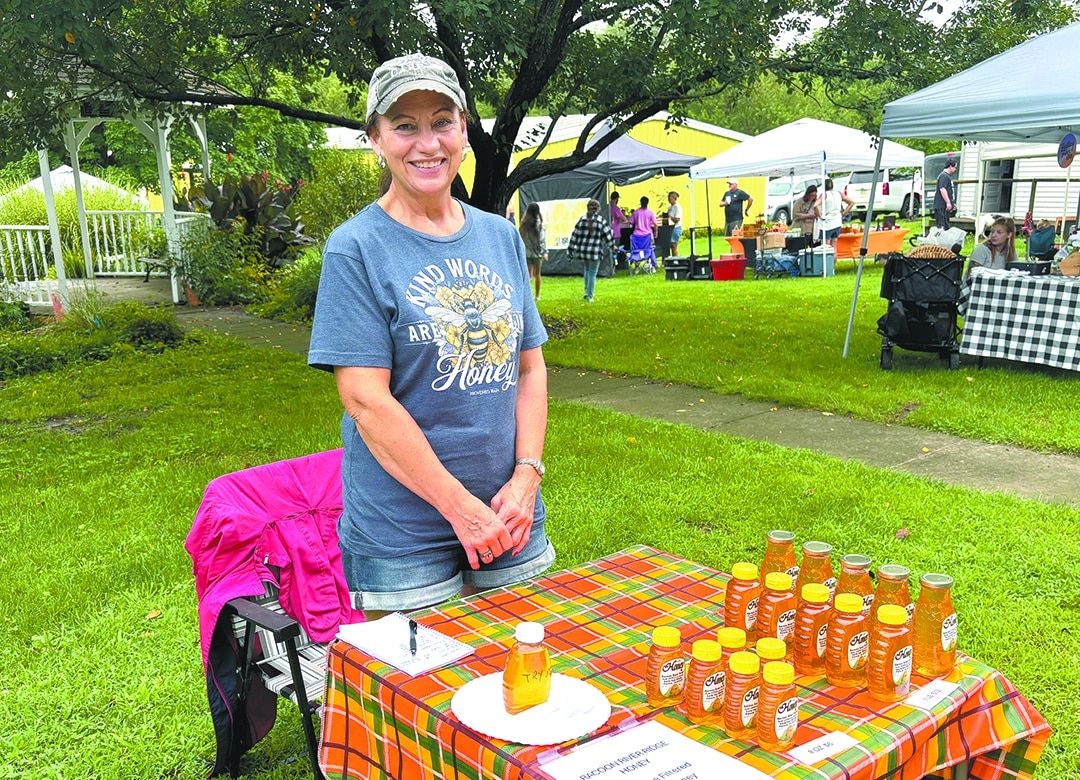
Karla Van Winkle sells her honey at the Panora farmers market.
Panora beekeeper turns a retirement hobby into a labor of love — and hundreds of pounds of honey.
By Rich Wicks | Panora Times, August 2026
After retiring in 2021 from her career at Wells Fargo, Karla Van Winkle of rural Panora decided to try her hand at beekeeping. And after mentioning her interest in the hobby, Van Winkle was surprised to receive a gift from a friend that included a basic “starter kit” for a beekeeper.
Since she had no prior experience, Van Winkle knew she needed more than a starter kit, so she wisely sought the advice of experienced beekeepers. Van Winkle met with Craig and Cathy Hinderaker, beekeepers with decades of experience, at their home in rural Guthrie Center.
“So, for the first full year after I retired, I worked with them,” she said. “They mentored me, and it’s turned into a wonderful friendship. The next year, they gave me a couple of hives to get started, so this is my fifth year.”
During that time, Van Winkle has found that, as she had been forewarned, beekeeping is an expensive hobby and a lot of work. But she does not regret her involvement.
“The joke is that if you want to end up with a million dollars as a beekeeper, start with two million,” she said.
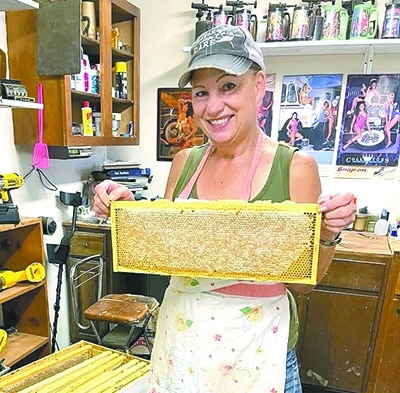
Karla Van Winkle prepares to extract honey.
“You start with one box. Then when the queen lays enough eggs and the bees have brought in enough honey and nectar that the first box is basically full, then you add a second box on top of that, and the same thing goes on there,” Van Winkle said. “Then you start adding what’s called ‘honey supers.’ You put down a metal frame with holes big enough for the worker bees to get through but the queen is too big to get through. When that super gets full, then you add another super on top. Anything the bees put in a honey super is yours to harvest.”
The term “busy as a bee” is very apt, as Van Winkle explained. The bees make honey to fulfill the dietary needs of the hive, and if pollen and conditions are right, they will actually make more than they need. Meanwhile, the queen bee is laying 1,500 to 2,000 eggs daily. So, a beekeeper needs to check the hive frequently to make sure the bees have enough room to keep growing the hive.
“If the bees run out of room, then they will swarm and the queen will leave and most of the bees will follow her, and then you’ve lost your hive,” Van Winkle said.
Van Winkle has learned many unwritten rules about dealing with bees, such as the fact that it is easier to work with a hive later in the morning when most of the worker bees are out foraging for pollen.
“Each hive will have its own personality. Some are more aggressive, but others will be more docile. They take on the personality of the queen,” she said. “I personally like to name my hives and sometimes the queens. One hive now has six honey supers on it. I affectionately call that hive the ‘East Siders’ because they’re so hard-working.”
Van Winkle also explained that a longstanding tradition among beekeepers is talking to the bees.
“Bees have always been considered part of the family. So if something happens, then you are supposed to tell the bees,” she said. “The folklore was that if you did not tell the bees the news, the entire hive could get sick and die, or they may leave, or just stop producing honey. So, I have to admit, I talk to my bees about some of that stuff.”
Within a hive, bees communicate by scent, using chemicals called pheromones. Van Winkle shared a helpful hint she learned regarding this.
“Their attack pheromone apparently smells like a banana, so you never want to eat a banana right before you go out to your hives,” she said.
Raw honey such as Van Winkle’s is known to have a variety of antibacterial properties and other potential health benefits. Some users claim that allergies can be diminished by eating local raw honey.
Van Winkle explained that despite all the precautions, a beekeeper will get stung repeatedly. But she has learned to take it all in stride.
“There’s a lot of hard work, but there’s also a lot of fun and laughter that goes into it,” she said.
Those interested in trying Raccoon River Ridge honey can buy it at the Panora Farmers Market or email Van Winkle at kvw@netins.net.
Although Van Winkle harvests hundreds of pounds of honey each year, she noted that there is very little profit in an operation of that size.
“Right now I have four hives. Each super that you have on a hive can yield about 30 pounds of honey. Last year I had a total harvest of about 330 pounds, and this year I’m expecting about 240 pounds,” she said. “It’s really just a fun hobby for me.”